


GET IN TOUCH
- Please wait...


Bangladesh’s economy has undergone a tumultuous period since the July Revolution of 2024, culminating in its democratic election in February 2026. Yet the economy showed quiet resilience through a turbulent political transition; real GDP growth held at 4.0 percent in Fiscal Year 2025 (FY25), recovering in the second half after a sluggish start.[1] Remittance inflows rose 18.05 percent year-on-year compared to the corresponding period of FY2025, driving a 33.58 percent surge in foreign reserves, underscoring how Bangladeshi workers abroad continued to anchor the economy even amid domestic uncertainty.[2]
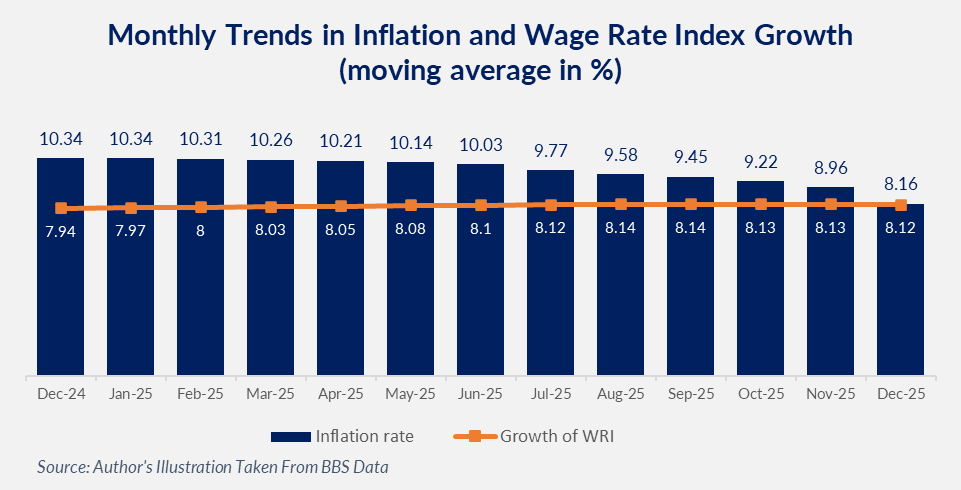
Yet behind these numbers lives a harsher reality. The economy may be growing, but employment growth in Bangladesh is not keeping pace. The very people powering Bangladesh’s economy, its workforce, are finding their living standards quietly eroding. With inflation hovering between 8.5 to 9 percent while their wage rate index growth stays between 8.12 to 8.13 percent, real incomes are barely keeping pace. This portrays a harsh reality of the growing risk of jobless growth in Bangladesh, where economic expansion fails to provide meaningful employment opportunities.
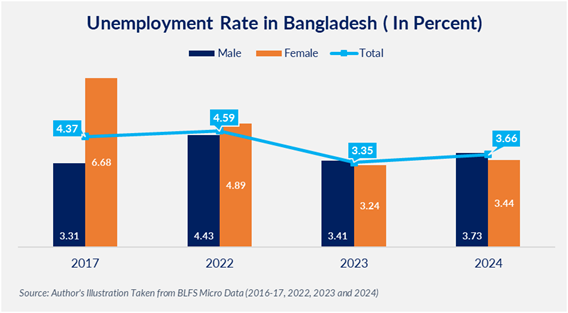
To understand the stagnant wage rate index growth (WRI), one must look back at the period between 2016-17 and 2022. During this period, Bangladesh experienced relatively strong economic growth while unemployment in Bangladesh was simultaneously increasing. This paradox exposed the fragile relationship between economic expansion and employment growth in Bangladesh.
In the following years, economic growth slowed, yet the unemployment rate declined. By 2023, when the growth rate fell to 5.8 percent, the total number of unemployed people declined to 2.46 million. At first glance, this might appear as an improvement in the labor market.
Note: Age group is 15+ years old
However, the explanation lies not in genuine job creation, but in survival. Between 2017 and 2022, the sharp rise in self-employment, particularly own-account workers, masked the true fragility of the labor market. The number of employed people did grow, from 60.83 million to 70.46 million, but this increase was largely driven by 8.5 million people creating their own work out of necessity, not opportunity.[1] Paid employment was shrinking, and workers were quietly pushed into informal self-reliance, a coping response to the growing shock of what economists call “Premature Deindustrialization.”
When a nation’s economic growth shifts in ways that no longer support employment growth, its people bear the quiet burden of that disconnect. This is precisely where Bangladesh now finds itself.
The sectoral distribution of output and employment reveals a prominent imbalance in the country’s structural transformation.
Table 1: Economic Growth vs. Employment Growth Mismatch3
| Sector | GVA Share (2016-17) | GVA Share (2024) | Employment Share (2016-17) | Employment Share (2024) |
| Agriculture | 13.36% | 10.95% | 40.59% | 44.67% |
| Manufacturing | 21.36% | 24.92% | 14.41% | 11.76% |
| Services | 53.40% | 51.32% | 38.98% | 36.33% |
Note: GVA(Gross Value Added) is the share of GDP
The table depicts a striking story. Bangladesh’s economy, without building a robust industrial base, jumped into service-based activities, creating a deep mismatch between where value is produced and where people actually work. Manufacturing GVA grew impressively, surpassing 11 percent in 2024, yet the sector was simultaneously shedding jobs. Manufacturing employment in Bangladesh fell from 8.77 million in 2017 to 7.93 million in 2022, a loss of over 833,000 livelihoods, before partially recovering to 8.12 million in 2024. This trend represents the actual scenario of “job-loss growth”.iii
What makes this even more concerning is where the workforce has ended up. Despite the service sector holding the highest GVA share in 2024, it employs only 36.33 percent of the workforce. Meanwhile, agriculture, a sector contributing a shrinking share of national output, continues to absorb 44.67 percent of all workers. More people are crowding into lower-productivity work, not because they choose to, but because the economy has left them little alternative.
In economic terms, this is a reverse structural transformation, labor moving backwards, toward lower-productivity activities, rather than forward into industrial jobs. Manufacturing and agriculture are expanding output through automation and capital-intensive technologies, reducing their need for human hands. Growth is happening, but it is increasingly happening without people.
If this trajectory continues, jobless growth in Bangladesh could have far-reaching economic implications. First, weak employment creation could intensify youth unemployment and underemployment, particularly as new workers enter the labor force each year. Second, persistent informal employment in Bangladesh could undermine income stability and social protection for millions of workers. Third, the growing disconnect between economic growth and employment generation may weaken domestic consumption, limiting long-term economic expansion.
Ultimately, without sufficient job creation in manufacturing and high-productivity sectors, Bangladesh’s economy risks becoming trapped in a development pathway characterized by premature deindustrialization, where the economy grows but fails to generate broad-based prosperity.
Bangladesh will not escape jobless growth by chasing growth alone. It has to rebuild a labor-absorbing pathway. The lessons from peer nations such as Japan and Korea should be considered, as they did not avoid industrial upgrading or automation. It is that they sequenced them after building a broad industrial base, strong supplier ecosystems, export capabilities, worker upgrading systems, and state capacity to coordinate finance, technology, and trade.
Figure 1: Korea–Japan Sequencing Model for Bangladesh[2]
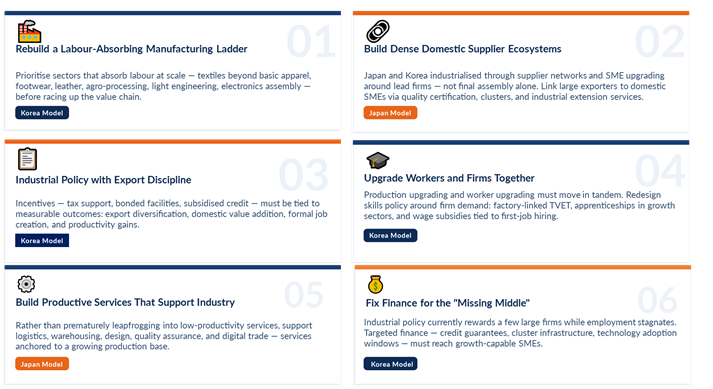
Note: The “missing middle” in the Korean development context refers to the gap between large conglomerates and very small firms, where mid-sized enterprises that could scale, innovate, and create employment remain underdeveloped or constrained. This structure in the past has resulted in slow wage growth in Korea.
Bangladesh’s growth story is not failing because the economy is expanding too slowly, but because the structure of that growth is drifting away from employment creation. Reversing this trajectory requires more than incremental reforms; it requires rebuilding the foundations of a labor-absorbing growth model.
Bangladesh’s growth is drifting away from employment creation, and reversing this trajectory requires more than incremental reforms. It requires policy sequencing; building the labor-absorbing foundations that growth alone cannot generate.
The most immediate priority lies in defending and deepening manufacturing employment. This means extending fiscal support to labor-intensive industries beyond RMG, including leather, light engineering, and agro-processing, while conditioning industrial incentives on employment outcomes rather than output alone. Growth in manufacturing Gross Value Added (GVA) that continues shedding jobs is not a success metric; it is a warning signal that policy must respond to directly.
Secondly, it is imperative to close the missing middle. Bangladesh’s industrial structure remains divided between large exporters and micro-enterprises, with limited mid-sized firms capable of scaling, innovating, and absorbing labor productively. Unlocking financing windows, simplifying regulatory pathways, and building supplier linkages between large anchor firms and smaller domestic producers can begin to fill this gap, creating the dense industrial ecosystem that sustains broad employment growth.
At the same time, worker upgrading should keep pace with technological change, not follow it. As automation advances in manufacturing and services, Bangladesh risks losing employment before its workforce is ready to transition into higher-productivity roles. Pre-emptive investment in technical and vocational education, tied to the actual skill demands of emerging industries, is not a long-term luxury; it is an immediate labor market stabilizer.
Finally, services must be reoriented to support production, not substitute for it. The premature expansion of low-productivity services has absorbed workers who should be entering formal manufacturing. Developing productive services, logistics, finance, design, and technology that strengthen industrial competitiveness can help services and manufacturing grow together, rather than in tension.
All in all, the question is not whether Bangladesh’s economy can continue to grow. The question is whether that growth will create opportunities for millions entering the labor force each year. Rebuilding a labor-absorbing industrial pathway may determine whether the country’s future prosperity becomes broadly shared or increasingly unequal.
This article was authored by Sadia Karim, a Business Consultant at LightCastle Partners. For further clarifications, contact us here: [email protected]
Our experts can help you solve your unique challenges
Stay up-to-date with our Thought Leadership and Insights