



GET IN TOUCH
- Please wait...


The OpenAI–Pentagon deal illustrates how AI ethics discussions have moved beyond philosophical debate into the domain of geopolitics, with significant implications for the Global South.
On February 27, 2026, OpenAI announced a deal with the U.S. Department of Defense to deploy its AI models on classified military networks. Hours earlier, President Trump had ordered all federal agencies to stop using rival Anthropic’s technology after the company refused to drop restrictions preventing its tools from being used for mass domestic surveillance or fully autonomous weapons.
Notably, OpenAI stated it had secured identical red lines Anthropic had demanded: no surveillance, no autonomous weapons, humans in the loop. The Pentagon accepted those terms from one company and rejected them from another, and the contract itself has not been made public. Within days, OpenAI’s head of robotics resigned, and CEO Sam Altman admitted the deal had been rushed.
These developments illustrate how AI governance discussions increasingly intersect with state priorities and regulatory authority, raising questions about the role of national borders in shaping the ethics of AI.
TIMELINE: THE OPENAI–PENTAGON STANDOFF
February 27, 2026
Pentagon gives Anthropic a 5:01 PM deadline to drop its restrictions on autonomous weapons and surveillance. Anthropic declines, and President Trump orders all federal agencies to cease using Anthropic, Defense Secretary Hegseth designates it a “supply chain risk”. Hours later, OpenAI announces its own Pentagon deal, claiming the same ethical red lines Anthropic had insisted on.
March 1-3, 2026
ChatGPT uninstalls spike 295% while Claude downloads surge. Altman admits the deal was “rushed” and “looked opportunistic and sloppy.”
March 8, 2026
OpenAI’s head of robotics resigns, citing that certain guardrails “deserved more deliberation.”
For much of its history, AI ethics discourse has centred on technical questions: how to reduce model bias, improve explainability, and align outputs with human values. The OpenAI–Pentagon episode introduced a different dimension. The central question may not be how to build ethical AI. It is whose ethics — and under whose authority.
The same contractual language on surveillance and autonomous weapons was acceptable from one company and unacceptable from another. This suggests that AI ethics is increasingly shaped by political positioning rather than principle alone.
As the Center for Democracy & Technology noted, the legal authorities cited in OpenAI’s contract have historically been used to justify mass surveillance programmes, not prevent them. The world is rapidly fragmenting into competing AI governance regimes, with each reflecting a different theory of what AI is for.
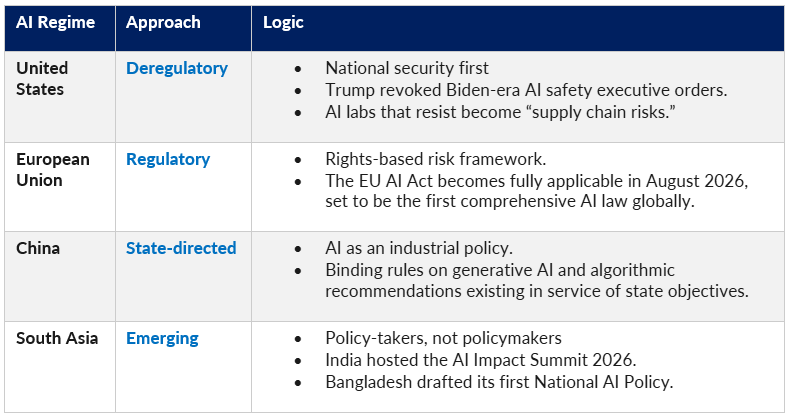
The “Brussels Effect”, which is the assumption that the EU’s regulatory model would set the global standard, as GDPR did for data privacy, is far from guaranteed. The United States is actively pursuing a deregulatory path and China is building a parallel governance architecture. As major powers develop competing AI governance frameworks, countries in the Global South face a choice between regulatory models they had limited involvement in designing.
Implications for Bangladesh
In February 2026, the ICT Division released a draft National AI Policy 2026–2030, the country’s first serious attempt at AI governance. It adopts a risk-based classification framework modelled on the EU AI Act, includes explicit prohibitions on mass surveillance and social scoring, mandates algorithmic impact assessments for high-risk systems, and signals intent to ratify the Council of Europe’s Framework Convention on AI, potentially making Bangladesh the first South Asian signatory.
Bangladesh’s AI Governance at a Glance
| AI READINESS RANK 75th Oxford Insights Global Index | DIGITAL LITERACY 8% National Average, 2025 | DRAFT AI POLICY v2.0 2026–2030 |
The policy’s ambitions are significant, but implementation remains a challenge. The 2019 National Strategy for AI produced detailed roadmaps, most of which remained unimplemented. A November 2025 UNESCO AI Readiness Assessment flagged severe gaps: fragmented data systems, GPU scarcity, outdated curricula, and AI ethics instruction described as “nearly absent.” The draft policy references a risk-based framework, but legal practitioners have argued it lacks binding enforcement mechanisms.
At the same time, the AI systems already operating in Bangladesh — in fintech, garment quality control, agricultural advisory, and credit scoring — are predominantly built on foreign models governed by foreign terms of service. When defence procurement decisions in Washington reshape the ethical boundaries of these models, the populations that interact with them have limited representation in the governance process.
The broader assumption underpinning AI ethics, that fairness, transparency, and accountability carry consistent meaning across jurisdictions is increasingly being tested. The events of February 2026 suggest that the definition of “ethical AI” may depend on which government is procuring, which company is contracting, and which regulatory regime has jurisdiction.
For countries like Bangladesh, these developments carry direct implications. A wait-and-watch approach to AI governance risks ceding regulatory influence to jurisdictions with greater leverage. The draft National AI Policy represents a constructive first step, but translating policy intent into enforceable regulation will require sustained institutional capacity building. The distance between a policy document and a functioning regulatory framework will ultimately determine whether countries participate in shaping global AI governance or remain subject to frameworks designed elsewhere.
This article was authored by Parisa Omar, Business Consultant at LightCastle Partners. For further clarifications, contact here: [email protected].
Our experts can help you solve your unique challenges
Stay up-to-date with our Thought Leadership and Insights