


GET IN TOUCH
- Please wait...

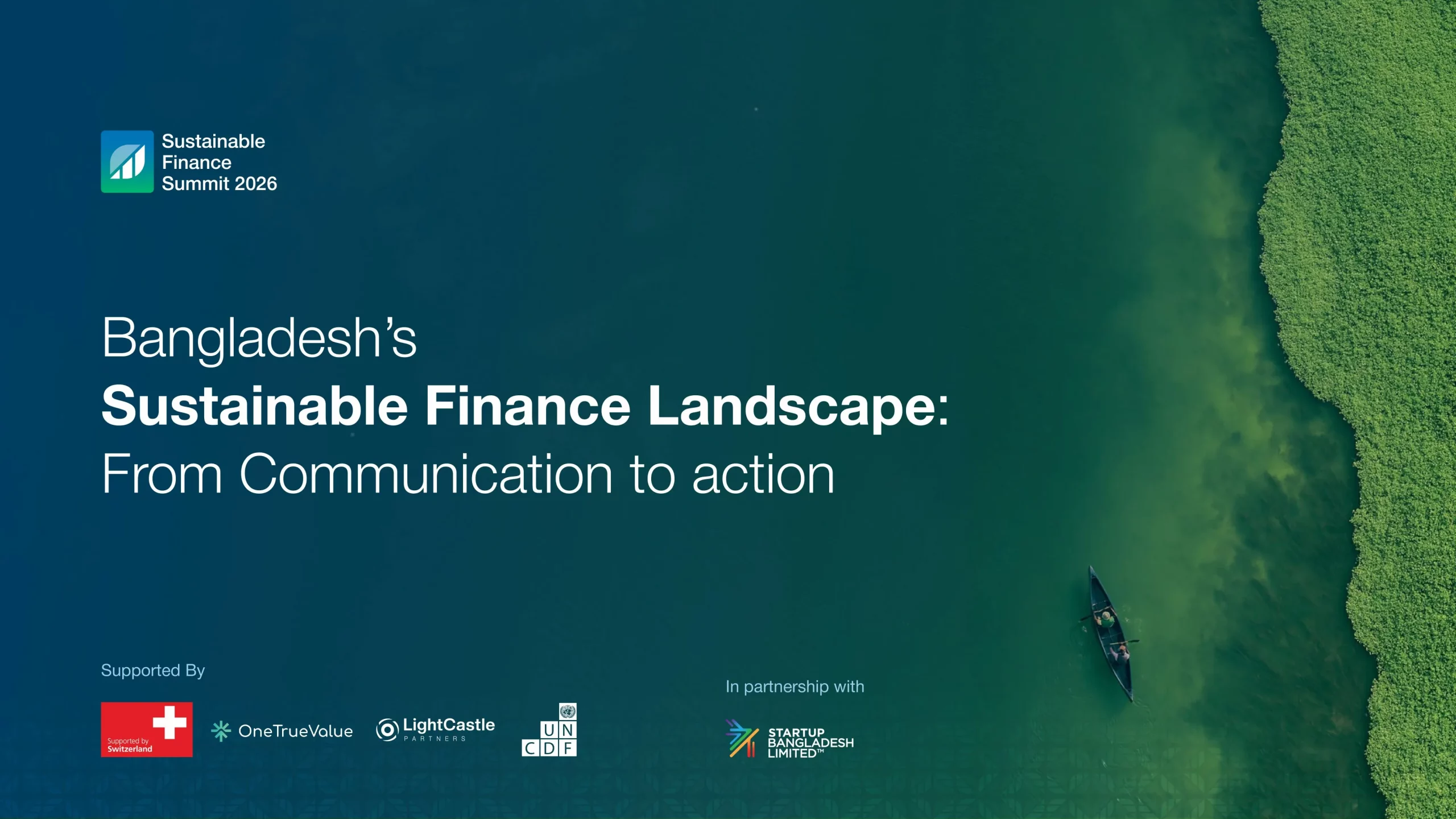
Bangladesh currently stands at a pivotal crossroads. Although the country has developed one of the most comprehensive sustainable finance policy frameworks among emerging economies in South Asia, the gap between policy design and market activation remains significant. Prepared in conjunction with the Sustainable Finance Summit 2026, this report provides a concise briefing on the sustainable finance commitments established at major global summits, Bangladesh’s comparative position relative to its peers, and the concrete steps required to close the existing activation gap.
Globally, momentum continues to accelerate. The sustainable finance market is expected to reach USD 2.5 Tn by the year 2030, driven by a fundamental shift in capital allocation. Green bonds and green loans are projected to reach USD 700 Bn and USD 255 Bn, respectively, in 2026. This trajectory is supported by clean energy investments, which now total USD 2.2 Tn, representing twice the capital currently flowing into oil, gas, and coal combined. Furthermore, the Baku to Belém (B2B) Roadmap, finalized at COP30, commits to directing USD 1.3 Tn annually in international climate finance towards emerging markets and developing countries by 2035.
For Bangladesh, the urgency is acute. Although the country requires approximately USD 29.3 Bn annually to meet its adaptation and mitigation goals, it currently mobilizes only USD 2.76 Bn, resulting in a financing gap of USD 26.5 Bn. Bangladesh contributes less than 0.56% of global greenhouse gas emissions, yet it ranks 9th in global climate vulnerability. Meanwhile, it has issued over 50 Mn carbon credits, a significant asset that remains largely unmonetized due to inadequate Monitoring, Reporting, and Verification (MRV) infrastructure, the absence of a domestic carbon registry, and a lack of de-risking instruments for buyers.
For Bangladesh, the need for accelerated capital mobilization is both moral and economic. The country possesses a policy framework that is comparatively stronger than that of many peers at a similar income level; however, the disparity arises not from the policies themselves, but rather from the prevailing market infrastructure. Key components such as measurement, reporting, and verification (MRV) systems, credit guarantees, environmental, social, and governance (ESG) disclosure templates, aggregator platforms, and financial instruments are essential for connecting Bangladesh’s climate assets to the projected USD 2.5 Tn global opportunity that is anticipated to materialize by the end of this decade.
To address these challenges, the Sustainable Finance Summit 2026 launched report is structured around five critical areas: the global sustainable finance landscape and B2B commitments; Bangladesh’s position relative to ASEAN peers; the SDG financing challenge and the tools of blended finance; the Bangladesh policy scorecard; and three priority actions.
|
If you are interested to learn more
|
Our experts can help you solve your unique challenges
Stay up-to-date with our Thought Leadership and Insights