


GET IN TOUCH
- Please wait...


Global startup venture investment reached a record USD 510 Bn in H’1 2026, more than the total funding in 2025 and approximately double the USD 260 Bn raised in H’1 2025. This growth was driven largely by AI, with AI startups accounting for 74% of total funding. Asia followed the same trajectory, with total venture investment reaching USD 70 Bn in H’1 2026, up from USD 27 Bn a year earlier, largely attributable to AI deals concentrated in China, India, and Singapore.
Macroeconomic Context And The Long-Term Growth Potential
Bangladesh’s macroeconomic fundamentals continue to signal strong long-term potential. In 2026, GDP per capita reached approximately USD 2,800, while the economy is projected to grow by around 5% in real terms, outpacing peers like Singapore, China, and Pakistan.
However, this growth potential has yet to be reflected in startup investment. In 2025, startup investment accounted for just 0.03% of GDP, among the lowest levels across regional peers, while investment per capita stood at only USD 0.03 in H’1 2026. This indicates a gap between Bangladesh’s economic growth and the scale of capital flowing into its startup ecosystem. Recent funding trends further highlight this disconnect, with capital raised declining 95% year-on-year, from USD 120 Mn in H’1 2025 to USD 6 Mn in H’1 2026, even as Singapore, China, and India experienced strong growth in startup funding over the same period.
Funding Activity Showed Sequential Growth Despite A Slower First Half
With USD 6 Mn raised in H’1 2026, funding activity remained at its lowest first-half level in five years. Despite this, total funding increased 51% from H’2 2025, which indicates an early sign of stabilization.
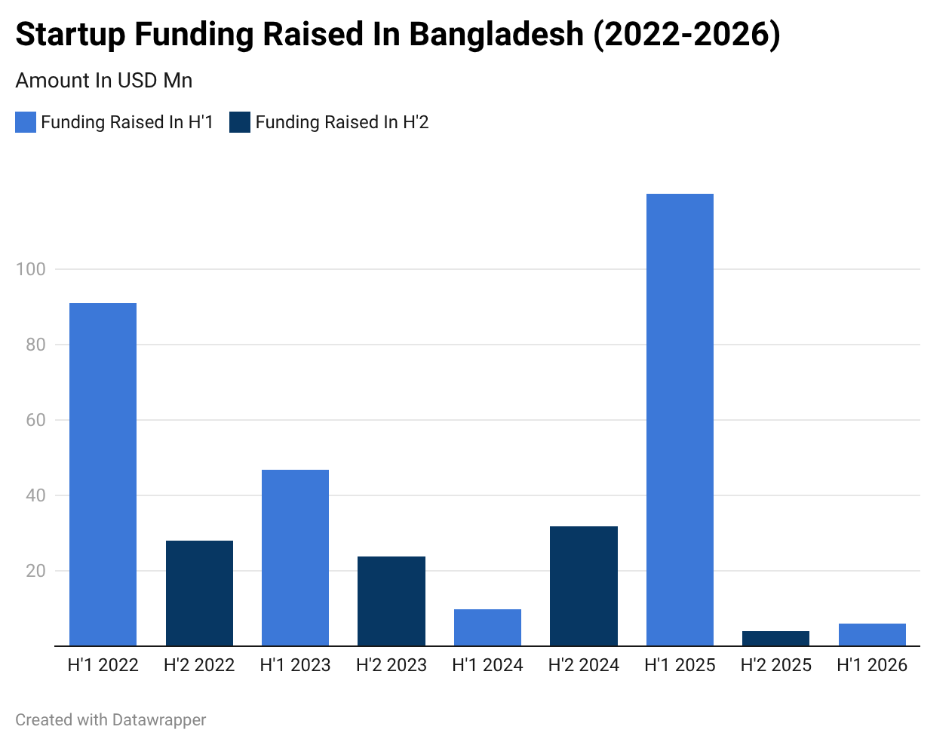
Average ticket size stood around USD 1 Mn, and the three largest transactions accounted for approximately 80% of total funding during the period. Venture capital remained the dominant investor type, contributing about USD 4 Mn (66% of funding), although its share in the total funding declined from 98% to 66% year-on-year. Global investors were the sole source of capital during the period, with no domestic participation recorded. By round, early-stage investment received the majority of the funding at USD 5 Mn, against just USD 600K in late-stage capital.
Funding Share Shifts Toward Software & Technology
The sector composition shifted compared to H’1 2025. While Financial Services accounted for 92% of total funding in H’1 2025, its share fell to 29% in H’1 2026. On the other hand, funding in Logistics & Mobility and Healthcare re-emerged after H’1 2024.
Software & Technology attracted the largest share of startup funding in H’1 2026, raising USD 2.1 Mn and accounting for 35% of total investment. The funding was comprised of two deals by Revora in seed round and grant funding. Financial Services followed, raising USD 1.7 Mn (29% of total funding), driven solely by iFarmer’s seed round and grant funding. Healthcare ranked third with USD 1.6 Mn, representing 26% of total funding, while the remaining USD 600K (10%) was invested in Logistics & Mobility.
Early-Stage Rounds Dominate The Funding Mix
The round-wise breakdown shows early-stage financing, spanning grant, seed, and pre-Series A deals, driving nearly the entirety of H’1 2026 activity, while late-stage capital was absent. In the first half of 2026, early-stage deals contributed to 90% of the total funding, amounting to approximately USD 5.5 Mn. Conversely, late-stage deals were concentrated in one Series-A deal that raised USD 625K.
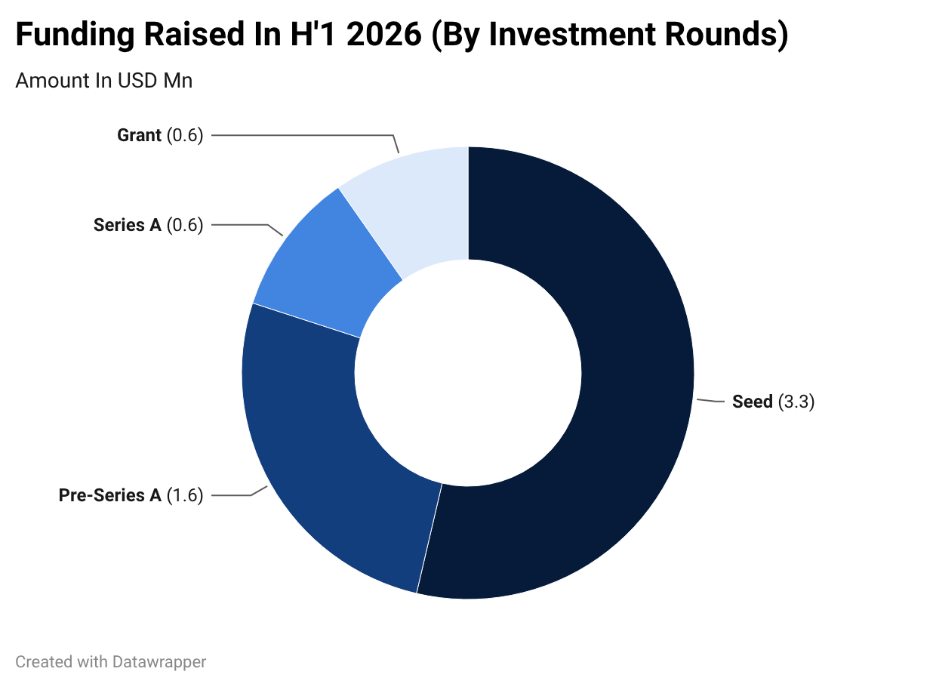
This is a reversal from H’1 2025, when a few large late-stage deals accounted for 96% of the total deal, including a USD 110 Mn M&A deal by SILQ.
Recent Institutional And Policy Developments Aim To Strengthen Startup Financing
Two developments during H’1 2026 may help strengthen domestic participation in startup financing over time. The first one is BSIC, Bangladesh Startup Investment Company, the country’s first institutionally governed venture capital vehicle. Launched with an initial commitment of USD 35 Mn and a matched co-investment model, this fund aims to support late seed to Series B startups alongside international lead investors. As a standing investment vehicle funded through a portion of commercial banks’ net profits, BSIC is intended to encourage greater participation from domestic capital while complementing existing global investment.
Second is the FY2026–27 National Budget that introduced several measures to support startup financing. This includes zero percent turnover tax and 15% VAT exemptions for eligible startups until 2035, a consolidated BDT 500 Cr Startup Fund through the ICT Division, and capital market reforms that aim to deepen domestic investment. Together, these initiatives reflect a broader policy focus on improving the startup financing environment, with their impact expected to become clearer as implementation progresses.
What’s Next
Translating recent policy measures into sustained investment activity will depend on opportunity recognition, effective implementation, and continued collaboration between the public and private sectors.
H’1 2026 was a relatively measured period for Bangladesh’s startup ecosystem in terms of funding activity. At the same time, it marked progress in institutional development through the launch of BSIC and supportive budget and regulatory measures. Together, these developments signal continued ecosystem maturation and could support broader investor participation and more sustained funding in the periods ahead.
 |
If you are interested to learn more
|
Our experts can help you solve your unique challenges
Stay up-to-date with our Thought Leadership and Insights