


GET IN TOUCH
- Please wait...

Foreign venture capital has pulled back. Local capital has not stepped in. That gap is now the biggest constraint on Bangladesh’s alternative finance market.
In H1 2026, Bangladeshi startups raised $6 million across 6 deals. That is down 95% from $120 million in H1 2025. Global investors supplied 100% of it. Domestic investors supplied 0%.
Yet money is not scarce. At end-June 2026, banks held BDT 4.08 trillion (about $33 billion) in excess liquidity, while private credit grew just 4.47%, a 33-year low. The problem is not liquidity. It is the lack of structures that let conservative local capital take private market risk.
The taka moved from 85.80 per dollar in 2021 to a record low of 123.95 on 30 August 2026. The taka lost about 31% of its dollar value. Put differently, a dollar now costs 44% more. That is a drag of roughly 7% a year on any USD fund.
Weak taka, higher hurdle. Say a foreign fund wants a 20% return in dollars. If the taka weakens 7% in a year, its investments must grow about 28% in taka to get there. Local investors do not face this extra cost.
A worked example, assuming a 7% fall in the taka over one year:
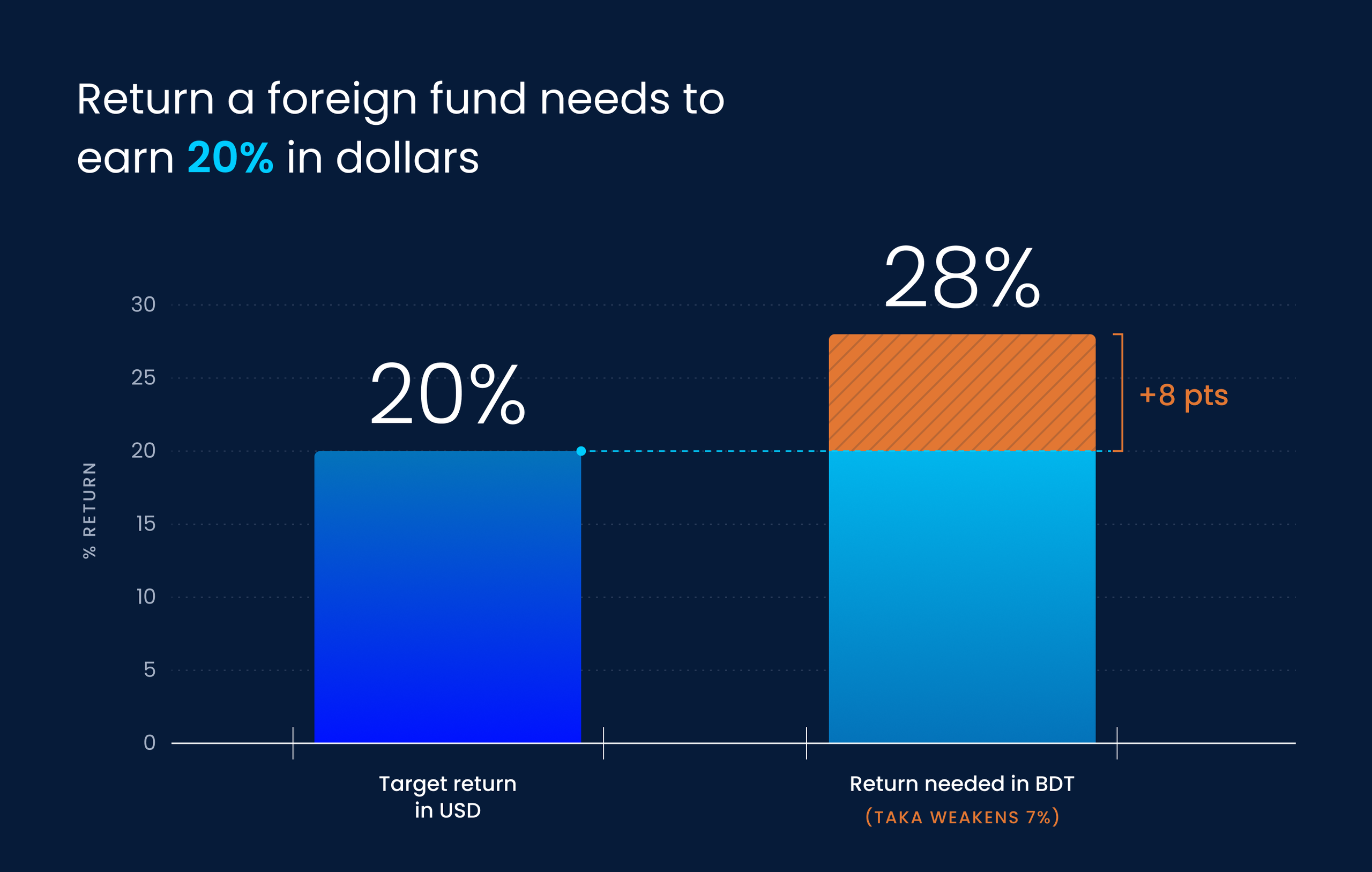
The 20% target and 7% fall are illustrative assumptions. Slow repatriation approvals and valuation resets on deals priced at peak multiples raise the bar further.
There is a window now. The taka held at 123.00 by 17 September and was flat (+0.06%) from June 2025 to June 2026, while the Indian rupee fell about 9.5%. A steadier currency is the right moment for local capital to take the lead.
The IFC puts the MSME financing gap at $2.8 billion. Bangladesh also needs about $421 billion in extra funding for the SDGs over FY2026-30, roughly $84 billion a year. Foreign VCs chase scalable consumer tech. Banks lend against collateral. Manufacturing SMEs, non-tech growth firms and climate-transition projects sit in between. Too large for microfinance, too illiquid for bank loans, outside venture mandates.
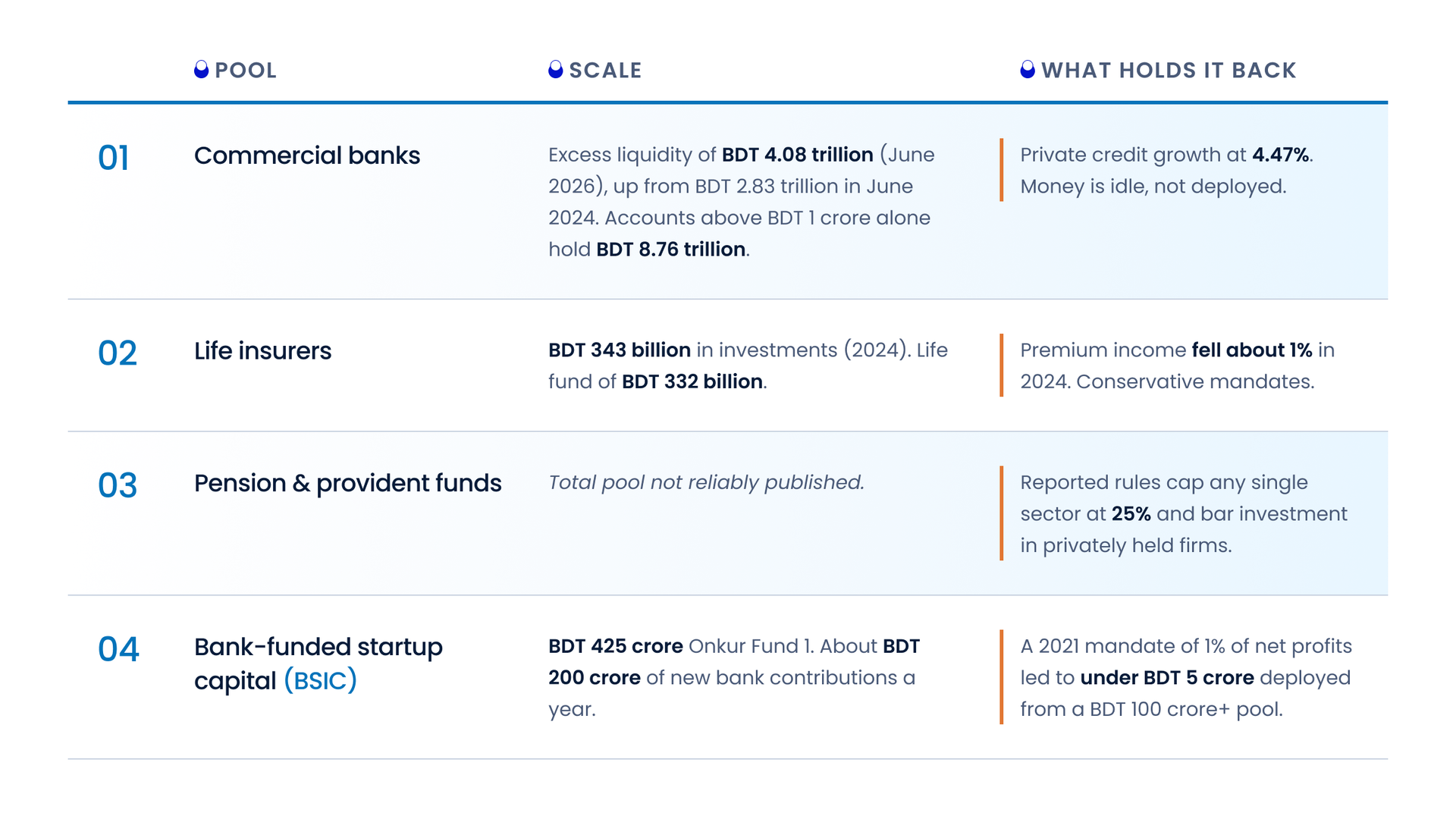
A scale check. The new Bangladesh Fund of Funds (BDT 400 crore, about $33 million) equals only 1% of excess bank liquidity. Add BSIC and the two state-linked pools reach BDT 825 crore (about $67 million), or 2%. The design is right. The scale is not yet.
Now consider the private side. If life insurers alone allocated 2-5% of their investments to licensed AIFs, that would be BDT 686-1,715 crore ($56-139 million). That is 1.7 to 4.3 times the entire Fund of Funds.
1. The risk-free hurdle is high. The 364-day T-bill cleared at 10.67% in May 2026. The 10-year bond yielded 10.49% in January. A 7-10 year illiquid fund must beat this, plus an illiquidity premium.
2. Fiduciary risk is lopsided. Trustees face blame for losses and gain little from outperformance. Government paper is the safe choice.
3. Capability gaps. Few institutions have in-house teams to underwrite private equity or price illiquid assets.
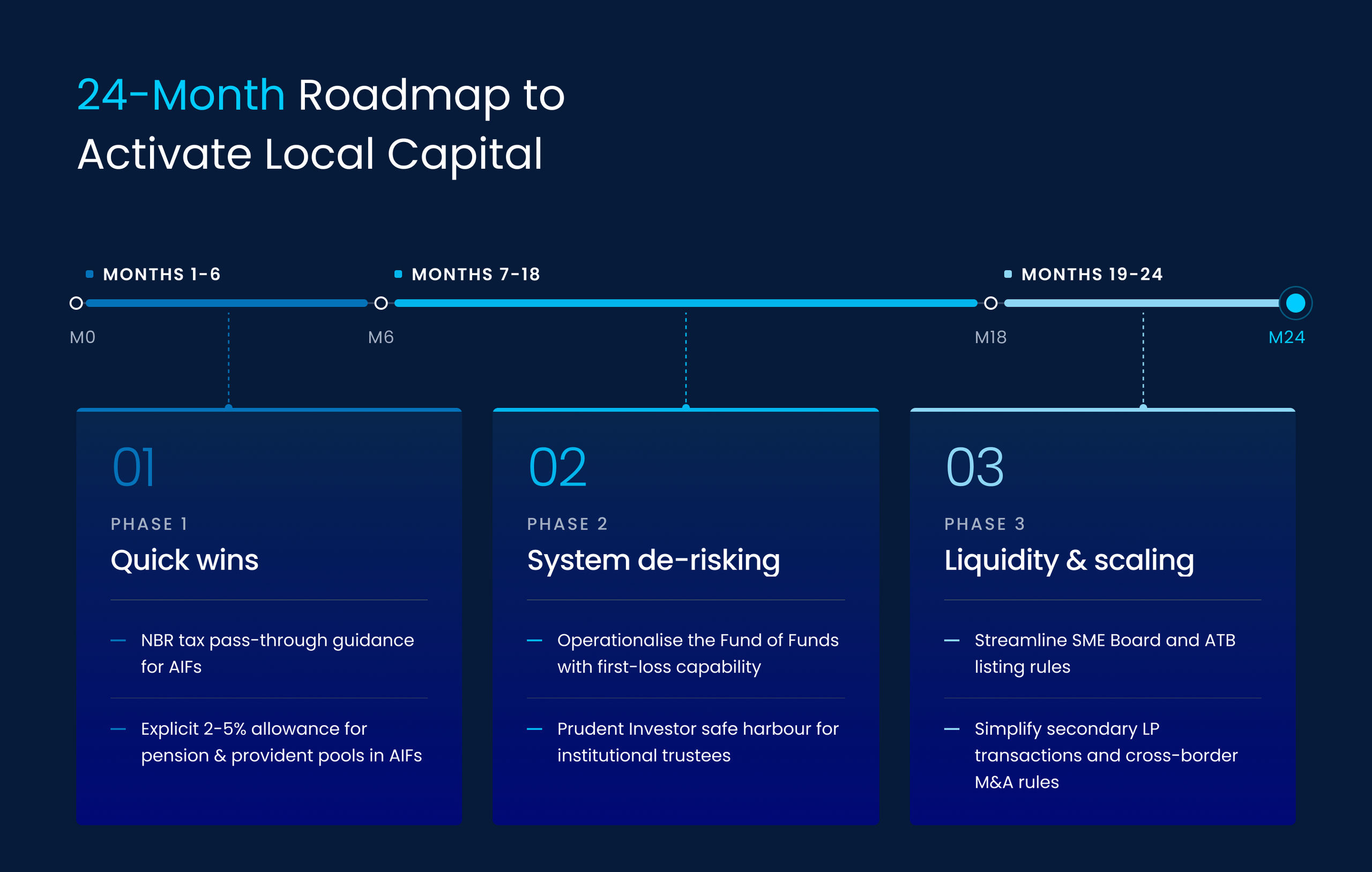
What fund managers must do. Do not copy the Silicon Valley playbook. Build yield-generating products, run independent investment committees with clear valuation practices, and frame deals around supply chain and market-access benefits for corporates.
External capital will always have a role. But a country’s financial backbone cannot rely on money that leaves when global conditions change. Bangladesh has BDT 4.08 trillion sitting idle and a Fund of Funds that covers 1% of it. Aligning rules, structures and trust between asset owners and fund managers is how idle capital becomes long-term capital.
This article was written by Ashik Muntakim, Senior Business Consultant at LightCastle Partners. For further clarifications, contact here: [email protected].
1. Startup funding H1 2026 ($6M, -95% YoY, 100% global investors, $1.1B cumulative, regional per-capita comparison): Dhaka Tribune, “Report: Bangladesh startup funding craters 95% to $6m in H1’2026” – https://www.dhakatribune.com/business/416169/report-bangladesh-startup-funding-craters-95%25-to ; LightCastle Partners, Bangladesh Startup Investments 2026 – https://lightcastlepartners.com/insights/2026/07/bangladesh-startup-investments-2026/
2. Startup funding 2025 ($124M, SILQ $110M, local investors under $1M): The Financial Express, “Startups fetch $124m in 2025” – https://thefinancialexpress.com.bd/trade/startups-fetch-124m-in-2025
3. Bangladesh Fund of Funds (BDT 400 crore, started 16 Aug 2026; local investors ~7% of $1.2B): Startup Bangladesh Limited – https://www.startupbangladesh.vc/?p=24473 ; Dhaka Tribune – https://www.dhakatribune.com/amp/bangladesh/417601/faqir%C2%A0mahbub%C2%A0anam
4. Excess liquidity (BDT 4.08 trillion, private credit growth 4.47%, repo 9.50%): Dhaka Tribune, “Excess liquidity hits Tk408,000cr despite low private credit growth” – https://www.dhakatribune.com/business/417633/excess-liquidity-hits-408000cr-despite-low-private
5. Deposits above BDT 1 crore (BDT 8.76 trillion): Dhaka Tribune – https://www.dhakatribune.com/business/banks/419882/5-000-new-millionaire-accounts-in-3-months
6. Taka exchange rate (85.80 to 123.95; 123.00 on 17 Sep 2026; regional comparison): Dhaka Tribune, “Taka strengthens against dollar after 5.5 years” – https://www.dhakatribune.com/business/banks/420369/taka-strengthens-against-dollar-after-5.5-years
7. Government yields (364-day T-bill 10.67%; 10-year bond 10.49%): The Financial Express – https://thefinancialexpress.com.bd/home/t-bill-yields-show-mixed-movement-1 ; https://thefinancialexpress.com.bd/trade/10-year-bond-yield-slides-on-dollar-buys
8. MSME financing gap ($2.8B, IFC, 2023): The Financial Express – https://thefinancialexpress.com.bd/home/msmes-in-bangladesh-face-28b-financing-gap-ifc
9. SDG financing need ($421B, FY2026-30): Dhaka Tribune – https://www.dhakatribune.com/amp/bangladesh/416043/additional-421b-needed-by-fy2030-to-advance-sdgs
10. Life insurance assets and premium (2023-24): Prothom Alo, “Life insurance losing trust” – https://en.prothomalo.com/amp/story/business/local/gdjqszj4l9
11. BSIC and Onkur Fund 1 (BDT 425 crore, 39 banks, 1% profit mandate): Future Startup – https://futurestartup.com/2026/05/13/bangladeshs-banks-backed-vc-firm-bsic-launches-with-tk-425-crore-inaugural-fund-onkur-heres-everything-you-need-to-know/ ; The Daily Star – https://www.thedailystar.net/business/economy/news/tk-600cr-venture-firm-backed-39-banks-eyes-bangladeshs-next-uber-or-instagram-4141381
12. Pension fund investment rules: The Daily Star, “Tools where pension funds can be invested” – https://www.thedailystar.net/business/news/tools-where-pension-funds-can-be-invested-3657116
13. BSEC draft amendment to Alternative Investment Rules 2015 (June 2026) – https://sec.gov.bd/storage/draft-rules/draft_rule_20260621154051_A24slqnuLp6LpaOXoagqQknr.pdf
14. Author calculations: USD/BDT moves, ~7% annual FX drag, 28% BDT-equivalent return, 2-5% allocation sizing, % of excess liquidity, $84M local capital, $84B annual SDG need, first-loss illustration.
Our experts can help you solve your unique challenges
Stay up-to-date with our Thought Leadership and Insights