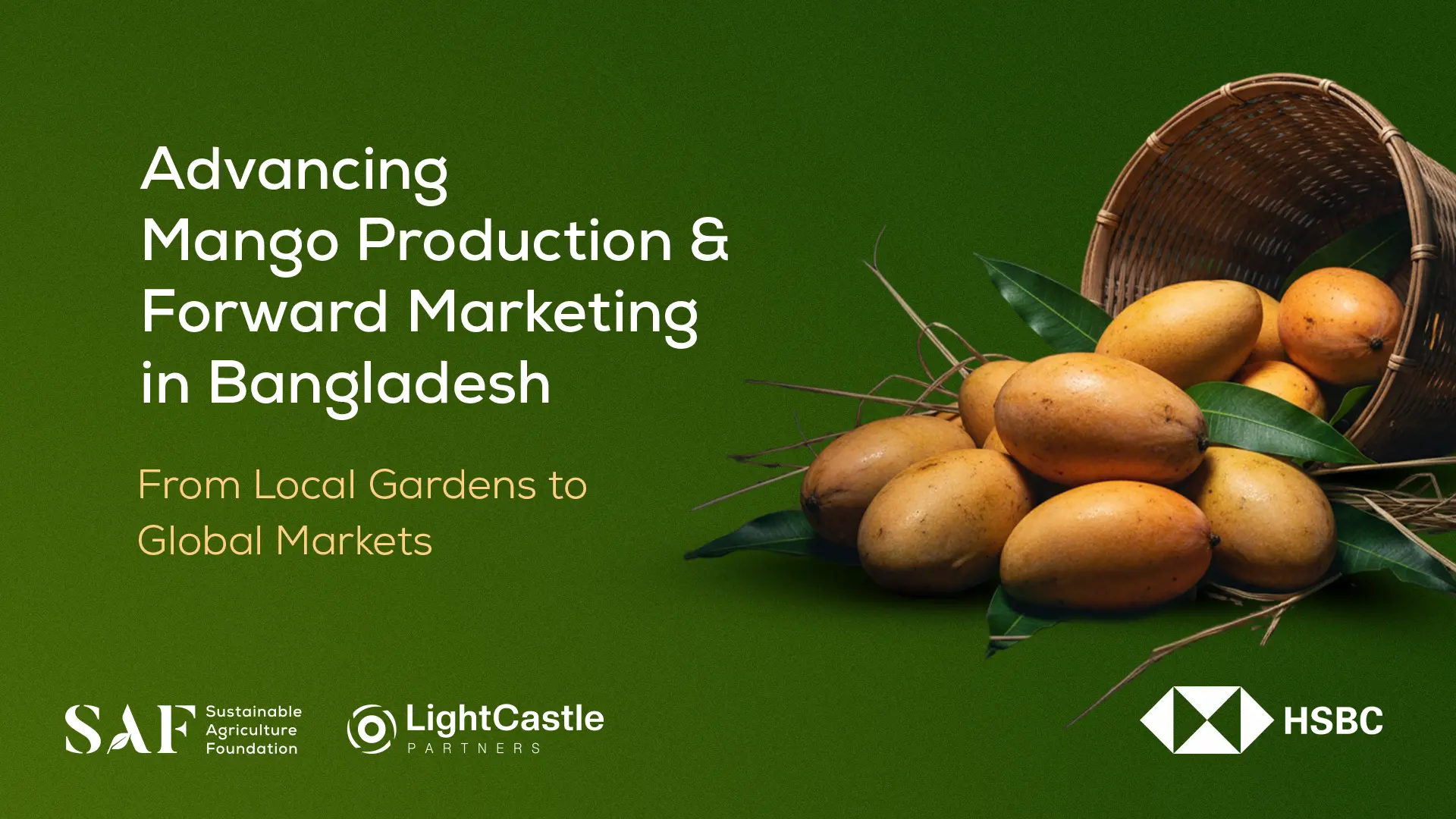
Advancing Mango Production & Forward Marketing in Bangladesh
LightCastle Analytics Wing
December 10, 2025
From Local Gardens to Global Markets
Bangladesh is the 8th largest mango producer globally, cultivating over 2 million tons annually across regions such as Chapainawabganj, Rajshahi, Dinajpur, and Naogaon. Despite this production strength, the country exports less than 0.05% of its harvest only 1,321 tons in FY24 revealing significant untapped potential.
Prepared by LightCastle Partners under the Climate Resilient Agricultural Advancement in Barind (CRAAB) project—supported by HSBC and implemented by SAF Bangladesh, this report examines the structural bottlenecks, market opportunities, and strategic pathways for boosting Bangladesh’s mango exports.
Global & Regional Outlook
Mango imports globally exceed USD 4 billion, driven by demand in the US, Europe, China, and Middle East. Competitor countries such as Thailand, India, Mexico, and Brazil have advanced infrastructure—HWT/VHT treatment plants, irradiation facilities, and decentralized cold-chain systems—allowing them to dominate premium markets. Bangladesh, however, has only 5 HWT units and no VHT facilities, limiting competitiveness in high-value markets like Japan and China.
Bangladesh’s Forward Market: Gaps & Opportunities
Key Bottlenecks
Certification barriers: Only one Bangladeshi entity currently holds GlobalG.A.P certification; costs are prohibitive for small producers.
Weak post-harvest infrastructure: Limited treatment units, insufficient cold-chain capacity, and inadequate central packing house (CPH) coverage.
Airport constraints: Lack of dedicated cold storage, non-functional EDS scanners, high airfare, and limited cargo space.
Traceability gaps: Record-keeping is inconsistent despite the introduction of DAE’s PQ-Agri Traces app.
Branding & market intelligence shortages: Limited global awareness of Bangladeshi mango varieties.
Value Chain Insights
The mango value chain from farmers to exporters faces inefficiencies in:
Pre-harvesting: Climate suitability, spacing, pruning, bagging, fertilizer and pest management.
Harvesting: High post-harvest loss (24% nationally); need for long-poled picking tools and better handling methods.
Storage & Transport: Temperature-controlled transport extends shelf life from 5–10 days to 15+ days, but access is limited.
Export Logistics: Multiple back-and-forth journeys increase cost and reduce freshness.
Market Expansion Trends
Bangladesh’s destination portfolio expanded from 2 countries in FY14 to 22 countries in FY24. Top destinations:
UK (41% of exports)
Sweden, Canada, UAE, Switzerland Bangladesh entered China, the world’s second-largest mango importer, marking a major strategic milestone. Export earnings rose to USD 284,135 in FY25 (till May) — 1.5× higher than FY24.
Best Practices & Innovations Identified
1. Ultra-High-Density Plantation (UHDP)
Doubles yield on the same land
Easier canopy management
Reduces water use through drip irrigation
CRAAB provided 300 training batches to 7,501 farmers, including 1,166 women.
2. Farmers’ Hubs for Post-Harvest Management
Improved sorting, grading, and packaging
Strengthened readiness for meeting export standards
3. Contract Farming for Traceability
Helps farmers adopt GAP practices
Prevents supply chain leakages and quality risks
4. Technology Integration
Irradiation facility planned in Gazipur
Adoption of digital traceability systems (PQ-Agri Traces)
5. Regional Learning Models
Thailand’s TMGA cooperative model shows how farmer associations can reduce certification cost and expedite export readiness.
Strategic Roadmap Forward
The report provides a future-facing plan focused on:
Expanding certified orchards through cluster-based GlobalG.A.P adoption
Building decentralized HWT/VHT and cold-chain systems
Upgrading airport infrastructure for perishables
Formalizing contract farming via digital platforms
Enhancing branding, niche positioning, and market intelligence
Strengthening PPP coordination to improve efficiency and scale
Why This Matters
With LDC graduation ahead, Bangladesh must diversify exports beyond garments. Mangoes high-demand, premium, and culturally iconic—represent a strategic agricultural export opportunity. Strengthening the forward market will improve farmer incomes, reduce post-harvest losses, and unlock global competitiveness.
At LightCastle, we take a systemic and data-driven approach to create opportunities for growth and impact. We are an international management consulting firm which creates systemic and data-driven opportunities for growth and impact in emerging markets. By collaborating with development partners and leveraging the power of the private sector, we strive to boost economies, inspire businesses, and change lives at scale.