



GET IN TOUCH
- Please wait...


Childcare As Social Protection has immense potential of generating economic and social benefits. Affordable and quality childcare offers a means to improve the standard of living for the working-age population and to reduce the labor force participation barrier for parents, especially mothers.

The female labor force participation rate in Bangladesh currently stands at 38.40 percentii. While the rate is around half that of males (79.96 percent), a significant portion of the female labor force drops out due to childbirth and to tend to childcare responsibilities. 73 percent of the unemployed female labor force exit the workforce after childbirthiii.
The burden for care and household responsibilities falls comparatively more on women. And often acts as a strong barrier to fully or partially entering or re-entering the workforce. This interrupts their earning capability, and risking economic vulnerability and financial dependence.
In 2026, the national poverty rate is expected to remain over 20 percentiv. Coupled with the slowed growth of the economy, the labor market scenario also seems bleak. With limiting job creation prospects and decreasing real wages, this will push more households to maintain dual-income sources. And with the absence of a strong and efficient social protection system, a disproportionate weight will be placed on these households, forcing them further towards poverty.
At present, there are some protection mechanisms in place from the Government of Bangladesh to directly or indirectly support working women and vulnerable households across different categories of social protectionv.
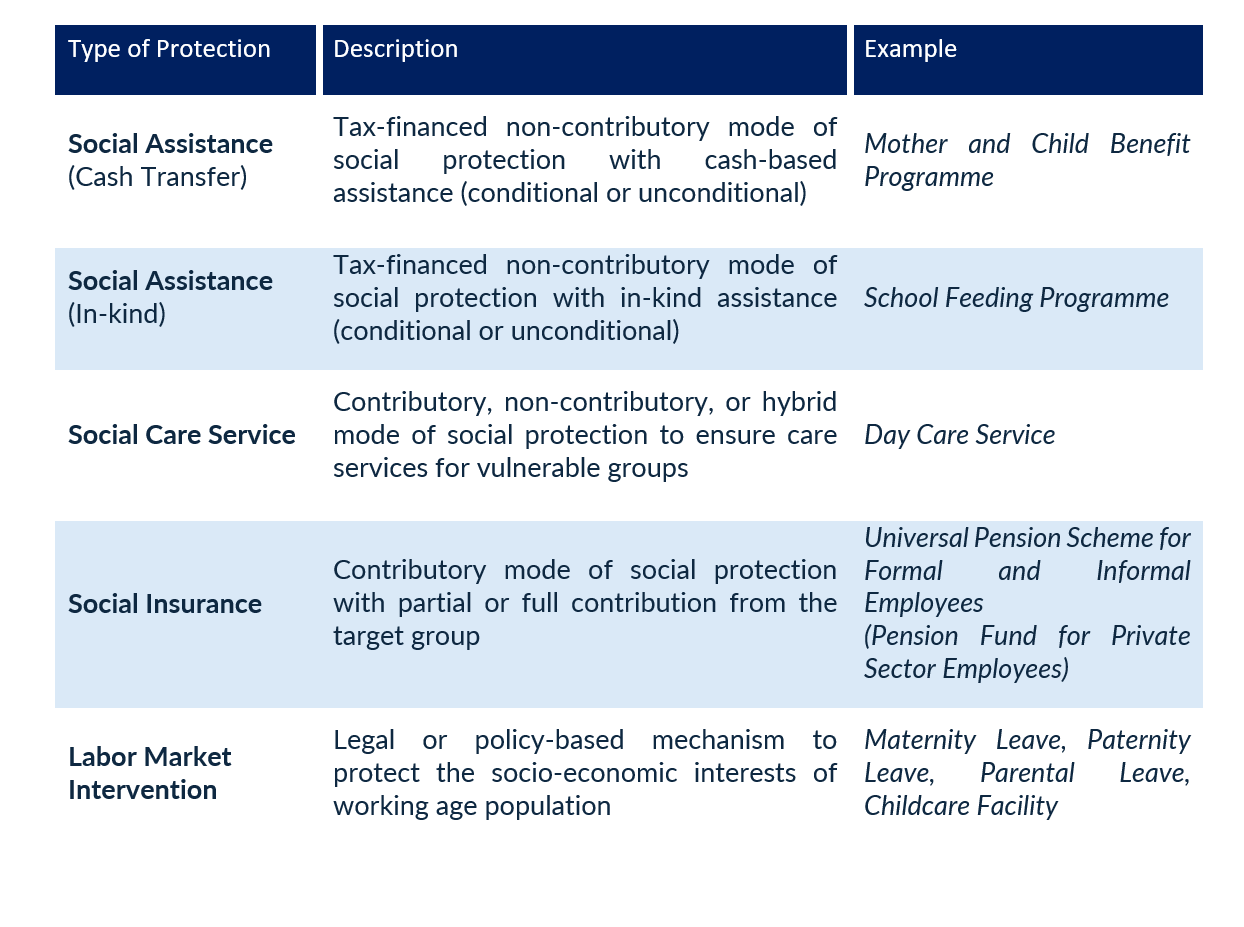
While social assistance, insurance, and benefits contribute to reducing vulnerabilities of the working population mainly through economic support, affordable childcare services pose a sustainable approach of enabling a pathway to be protected socio-economically.
Childcare is a type of care work that involves activities and relations to meet the physical, psychological, developmental, and emotional needs of children. For working parents or guardians, childcare offers an option of safe and quality upbringing, while supporting their earning prospects.

Additionally, addressing the rising need for childcare will offer the economy an opportunity to utilize the potential of its labor force by expanding the prospect of childcare as a paid formal occupation. Through sustainable and progressive investment in early childhood education and childcare, the sector is estimated to generate more than 2 million direct childcare jobs in Bangladesh by 2035vi.
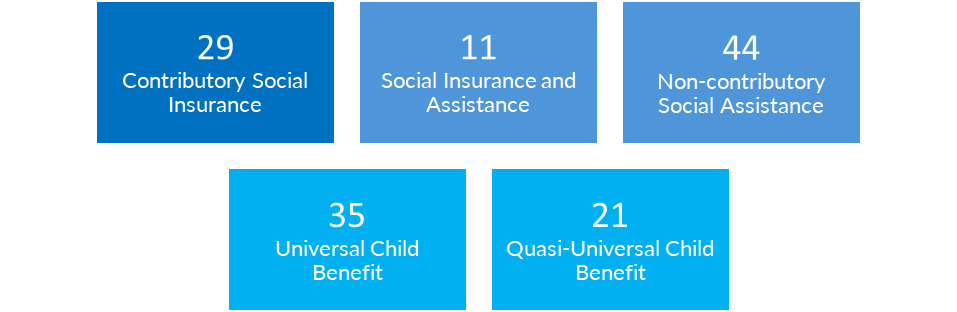
Putting childcare under the social protection lens reveals progressive practices in many developed economies. Universal Child Benefit (UCB) or Quasi-UCB with conditional features based on income class or age-group. To address the needs of the working class, such progressive practices have topped the priority action agenda for many economies.
This renewed global attention to childcare as social protection can be illustrated by the newly elected mayor of New York; Zohran Mamdani’s one of the monumental reform agendas in administering the world’s second-most expensive city.
With public-funded childcare, the Mamdani administration is promising to help working families save yearly expenses equivalent to USD 20,000. While this ambitious and expensive initiative has just started taking shape in New York, it has already been a practice in 35 countries. Such as Denmark, Finland, Germany, Ireland, Italy, Libya, Oman, Qatar, and Swedenvii.
For developing economies like Bangladesh, it is more common to have state-funded and tax-financed social assistance. This enables affordable childcare to vulnerable working families. Non-contributory conditional social benefits for children are common in countries such as Cambodia, Mexico, Pakistan, and the Philippines.
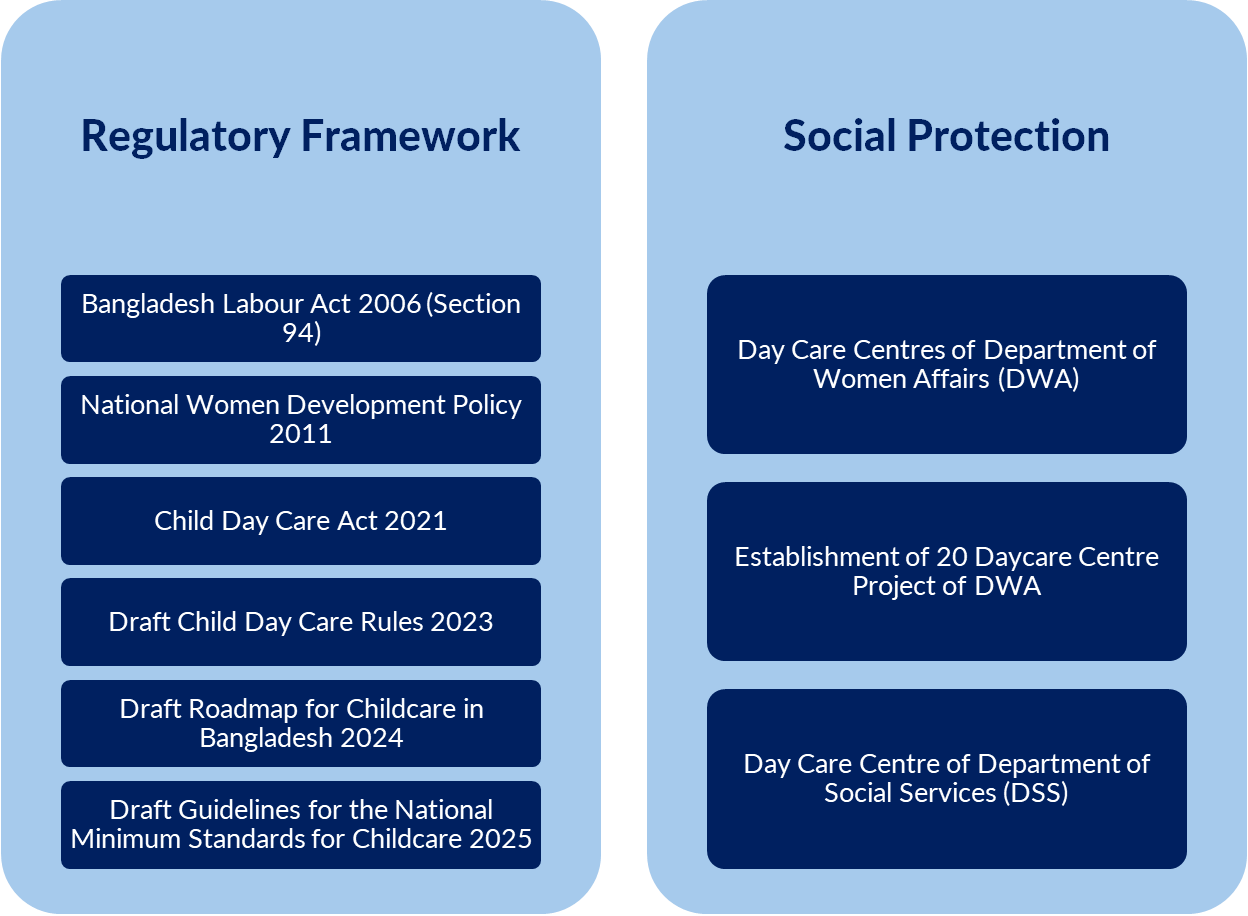
On its path towards transitioning into a developing country by the end of 2026, the political economy in Bangladesh is noticing a shift in prioritizing childcare as a key part of the worker well-being and maternity protection agenda. As a result, the government has undertaken a few initiatives to strengthen the childcare ecosystem in the country.
While many progressive practices are in place and the childcare sector is gradually growing, the consideration of affordable childcare as a social protection mechanism requires some strategic actions.
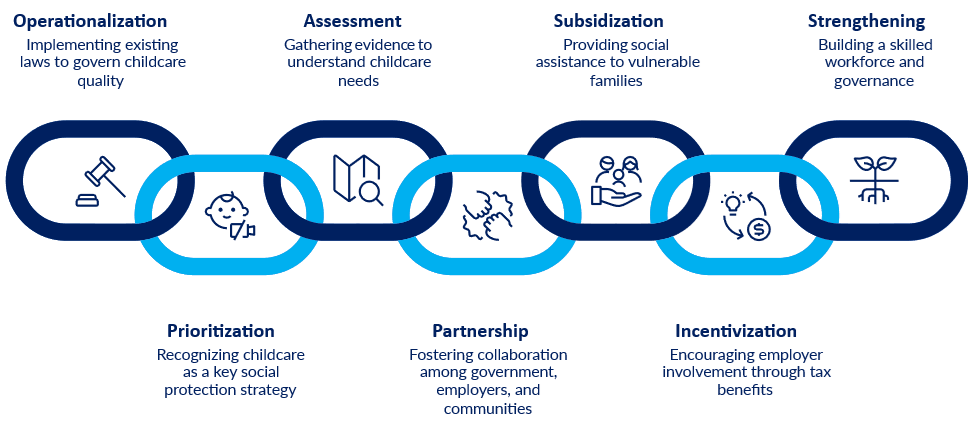
Childcare is a foundational social protection mechanism that enables employment, protects income, and empowers workers. For developing economies like Bangladesh, childcare offers an avenue to support and empower working families to continue participating in the labor force.
At this crucial point of its development journey, Bangladesh needs to prioritize the childcare agenda. Design infrastructures and initiatives to ensure access to affordable and quality childcare. Complementing the socio-economic advancement of the country. And enhancing the productivity of its workforce and contributing to the early development of the future generations.
The article was authored by Ainan Tajrian, Senior Business Consultant at LightCastle. For further clarification, please contact here: [email protected]
Our experts can help you solve your unique challenges
Stay up-to-date with our Thought Leadership and Insights