

GET IN TOUCH
- Please wait...

Over the past two decades, the Bangladesh-Netherlands investment partnership has turned a new page. What was once confined in development cooperation has progressively shifted toward a commercial partnership defined by trade, foreign direct investment, and above all, mutual trust. That trust has become especially important at a time when global supply chains are being reorganized in response to geopolitical shifts.
At the same time, the partnership is increasingly defined by a clear complementarity between the two economies. Bangladesh brings scale, competitiveness, and a steadily expanding industrial base. The Netherlands, in turn, contributes deep expertise in compliance and sustainable business practices, collectively setting the stage for more resilient collaboration.
To further explore the opportunities offered by this growing partnership, Larive International and LightCastle Partners co-hosted the Bangladesh–Netherlands Trade and Investment Dialogue on April 30, 2026, bringing together private sector leaders, investors, diplomats, government agencies, and industry associations. Following the event, a white paper was launched outlining priority sectors and emerging opportunities for deepening Bangladesh–Netherlands trade and investment cooperation.
Bangladesh’s investment case is built on more than a decade of steady GDP growth, averaging around 6.4 percent. What really stands out right now is the shift happening underneath these headline numbers. The country is moving from a low-cost production base towards a more diversified, technology-driven economy, backed by (i) a demographic dividend with 45% population under the age of 25 (ii) a rapidly expanding middle class (iii) and a policy environment that increasingly welcomes foreign capital. These are not signs of a country that is just getting started; they reflect an economy that has already been building momentum for years.
In the words of Mr. Nicolaas Jan (Koos) Dijkstra, Deputy Ambassador and Head of Trade at the Embassy of the Kingdom of the Netherlands in Bangladesh, “Bangladesh is the 8th largest country in the world in terms of population, with around 180 million inhabitants. This means that even a relatively small market share can translate into substantial commercial value for companies and investors.”
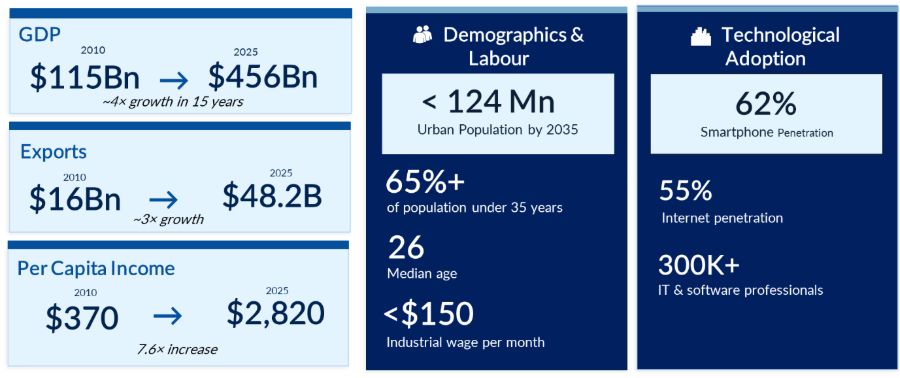
In essence, Bangladesh’s growing consumer market, expanding industrial base, and demand for technology, infrastructure and sustainable production systems have been closely aligning with Dutch investment interests. As rightly noted by Mr. Nahiyan Rahman Rochi, Head of Business Development at Bangladesh Investment Development Authority (BIDA), “The Netherlands was the single largest investor in Bangladesh in 2025. In fact, a major investment in port infrastructure has stood among the largest foreign investment commitments Bangladesh has received in recent years, reflecting growing investor confidence in the country’s long-term potential.”
What makes the Netherlands such a befitting partner is that its strengths speak directly to what Bangladesh requires. For instance, it is the world’s second-largest agricultural exporter and has strong expertise in greenhouse systems and agri-logistics. This presents a relevant area of expertise that Bangladesh can draw upon to mitigate the country’s roughly 40% post-harvest losses.
The Netherlands is also a global leader in delta engineering, which is especially relevant as climate pressures continue to rise in Bangladesh. Thus, the Dutch brings the strengths of a mature economy, including capital, advanced technology, and deep institutional expertise. Bangladesh, on the other hand, contributes a large and growing workforce of about 2.2 million people annually, a developing industrial and technology base, and expanding access to regional markets, further contributing to this growing complementary relationship.
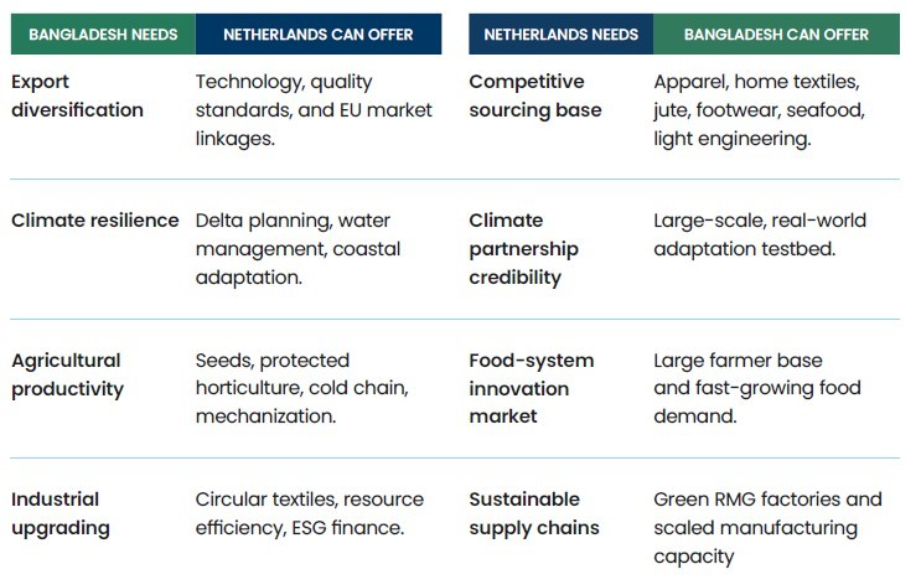
During the event, a joint presentation by Larive International and LightCastle Partners highlighted some key sectors with strong potential for collaboration between the two countries. The conversation extended well beyond the presentation itself, with experts and industry leaders in attendance adding their lived experience and practical knowledge on the evolving global trade landscape.
In this regard, The Netherlands brings strong capabilities in agri-tech, posing advanced innovations in cold-chain logistics, greenhouse systems, precision farming, and food processing. The alignment is already beginning to translate into action, with the Dutch Fund for Climate and Development acting as an active financing channel. It has already deployed grants through ACI and Ispahani as early examples of blended finance in practice.
On the circular economy front, the discussion focused heavily on Bangladesh’s garment sector as one of the most immediate opportunities for collaboration, particularly because the industry generates nearly 0.4 Mn tonnes of pre-consumer textile waste each year.
This is making circularity far more than just an environmental concern. Mr. Mubassir Rahman, Principal Business Consultant & Portfolio Manager from LightCastle Partners added that “Dutch and Bangladeshi collaborators are already working together in small pockets on plastic and textile waste recovery, pointing to the Netherlands’ own target of going 50% circular by 2030.”
This points directly to a clear area of opportunity, where the Netherlands can step in as a partner. Home to two of the world’s top three dredging companies, Dutch expertise spans the full spectrum of what Bangladesh needs, including channel deepening, delta management, and terminal operations.
Beyond the mentioned sectors, discussions also highlighted healthcare technology, light engineering, and IT/IT-enabled services as additional areas holding meaningful collaboration potential.
The webinar was notable for the candor with which the participants discussed the challenges they encountered. Several structural and operational bottlenecks emerged repeatedly across the speakers, as outlined below.
Mr. Shakawat, drawing on DBCCI’s direct facilitation experience with Dutch investors, put the gap in concrete terms: “If a Dutch company intends to operate in Jashore, some of the required documentation may still need to be processed in Dhaka.” The consequence is that foreign investors are compelled to engage a local partner not out of strategic choice, but out of administrative necessity.
On a similar note, Mr. Shakawat Hossain Mamun pointed to port testing and customs-related delays as a recurring source of frustration for foreign investors. While the Matarbari deep-sea port promises to reduce shipping costs and eliminate the need for trans-shipment, the path to a truly efficient port ecosystem will require reform that goes beyond infrastructure alone.
Despite these challenges, the session concluded on an optimistic and solution-oriented note. The webinar served as an important platform to bring existing constraints directly to the attention of relevant stakeholders, enabling open dialogue on practical pathways forward. Participants acknowledged that progress is already being made across several areas and expressed confidence in continued improvements ahead.
In this context, Mr. Nicolaas Jan (Koos) Dijkstra emphasized that advancing the next phase of Bangladesh–Netherlands partnership will require not only sustained investor interest but also continued efforts to reduce non-tariff barriers and strengthen public–private collaboration among businesses, government institutions, and development finance partners.
Mr. Nahiyan Rahman Rochi from BIDA concluded with a grounded reflection, noting that companies such as Dutch Bangla Pack have been part of Bangladesh’s investment landscape for decades. Challenges exist, he acknowledged, but investors who enter the market rarely leave. As Mr. Schouten also aptly put it, “Once you see it, you believe it.”
Our experts can help you solve your unique challenges
Stay up-to-date with our Thought Leadership and Insights