


GET IN TOUCH
- Please wait...

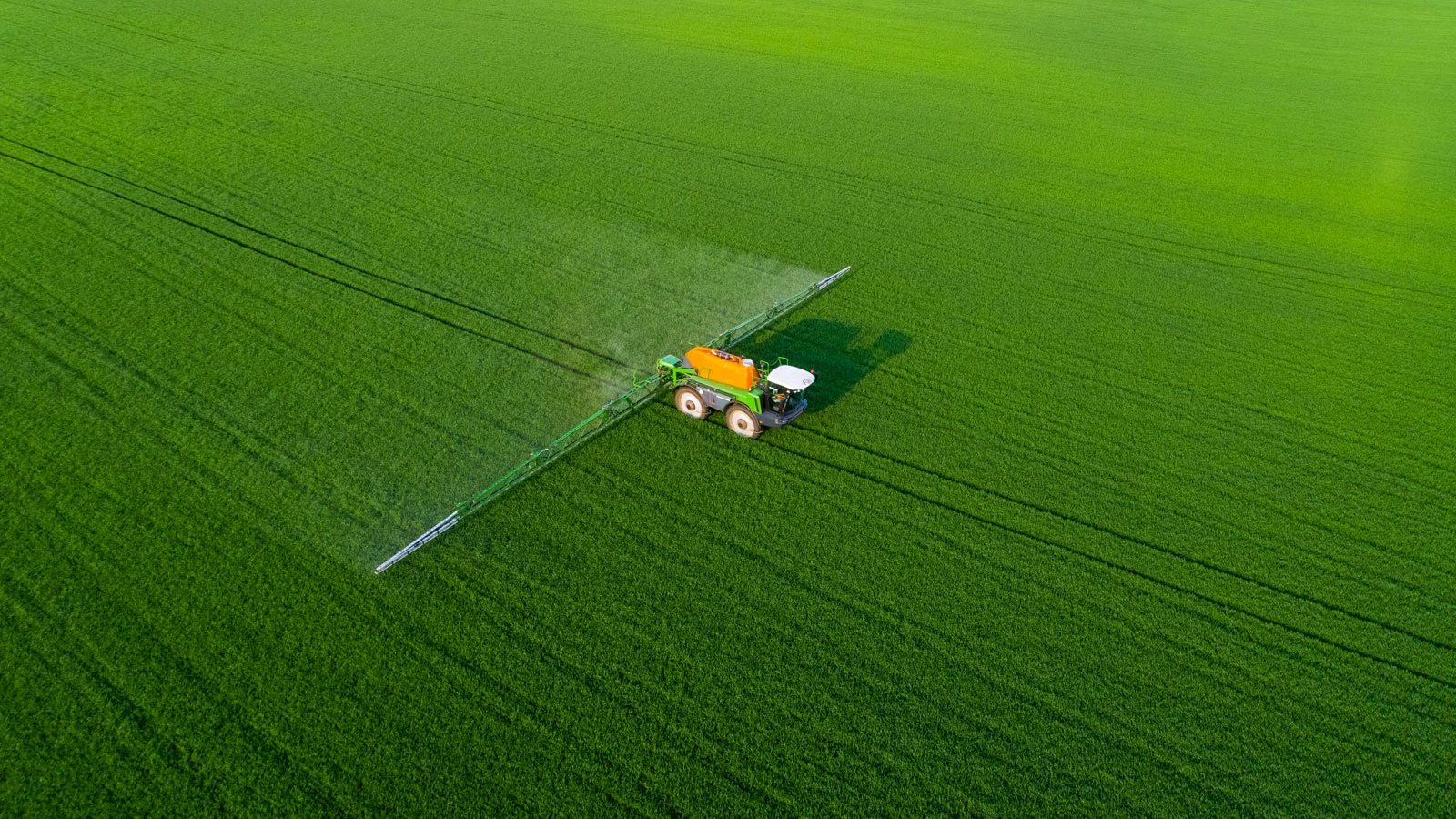
Bangladesh is predominantly an agriculture-based economy, employing roughly 40–45 percent of the workforce and contributing a significant share of rural incomes and food security. Globally, growing concerns about climate change and food security have emphasized policy attention on agriculture. Meanwhile, digital and automation technologies are reshaping the sector to improve resilience and nutrition. For Bangladesh, a stronger agricultural base is critical to reduce food import dependency and gradually build export capacity in high-value crops and processed products.
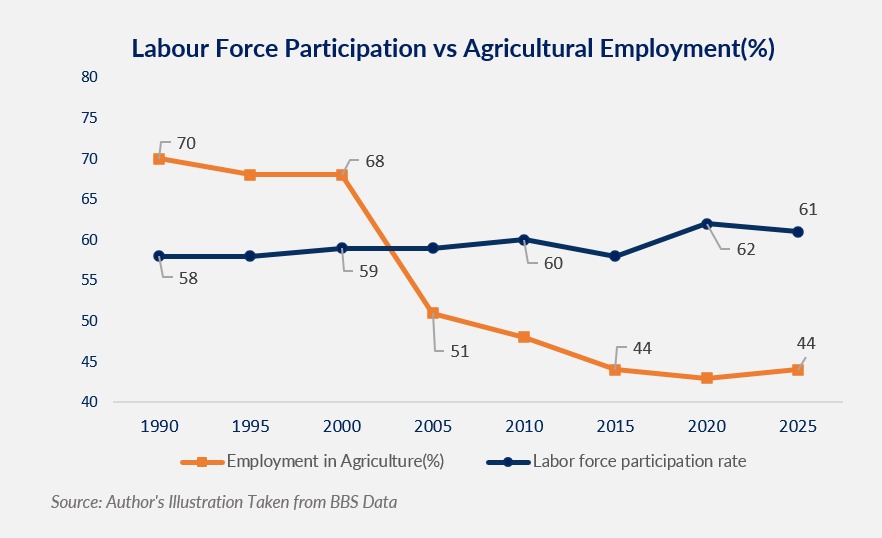
Despite its growing importance, youth engagement in agriculture appears to be moving in the opposite direction. While overall labor force participation has steadily increased, the share of employment in agriculture has continued to decline, falling from 68% in 2000 to 44% in 2025.[1] It indicates a gradual shift of the workforce toward non-agricultural sectors, with fewer employment opportunities likely attracting youth into agriculture.
Consequently, many young people are increasingly pursuing opportunities in services, gig work, and migration rather than agriculture. This article explores the changing pattern of youth engagement in Bangladesh’s agricultural sector and discusses practical strategies to encourage greater participation in modern farming and agribusiness.
Agriculture is no longer limited to traditional farming. Advances in technology, agribusiness, and value-added production have created new opportunities for innovation and entrepreneurship. Despite this transformation, many young Bangladeshis still perceive agriculture as physically demanding, low-paying, and offering limited career prospects and relatively low social status. As a result, they see it as less aligned with their aspirations for higher incomes, stability, and social mobility.
Meanwhile, social perception and mainstream career guidance encourage educated youth toward government and private-sector jobs. They position agriculture as a fallback option rather than a first-choice profession.[2] With average agricultural earnings estimated to be 30–40 percent lower than those in industry and services, the sector struggles to compete for young talent.[1]
The working conditions in agriculture further reinforce this perception. Unlike workers in manufacturing, agricultural workers are not covered by a nationally declared minimum wage. As of 2022, around 96.8 percent of agricultural jobs are informal, based on casual, seasonal, or family arrangements rather than formal contracts.[1]
Section 1(4)(n) of the Bangladesh Labour Act, 2006 explicitly excludes agricultural farms employing fewer than five workers from its scope. As a result, many workers lack standard protections on working hours, leave, or occupational safety.[3] For young people comparing options, agriculture therefore comes across as physically demanding and insecure work with weaker labor rights than formal roles in manufacturing and services. This makes it less attractive as a long-term career.
Information and skills gaps further discourage youth participation in the sector. Limited exposure to modern farming techniques, agritech, and agribusiness models prevents many young people from recognizing the sector’s evolving opportunities. Moreover, limited access to finance, land, infrastructure, and market access continues to constrain youth-led agribusinesses.[4] Together, these structural barriers and persistent misconceptions make agriculture a less attractive career choice for young people.
Bangladesh’s agriculture is gradually evolving from a production-focused approach toward the development of high-value agrifood systems. Recent public and development investments increasingly focus on targeted mechanization, climate-smart irrigation, cold chains, and post-harvest systems alongside traditional input support.
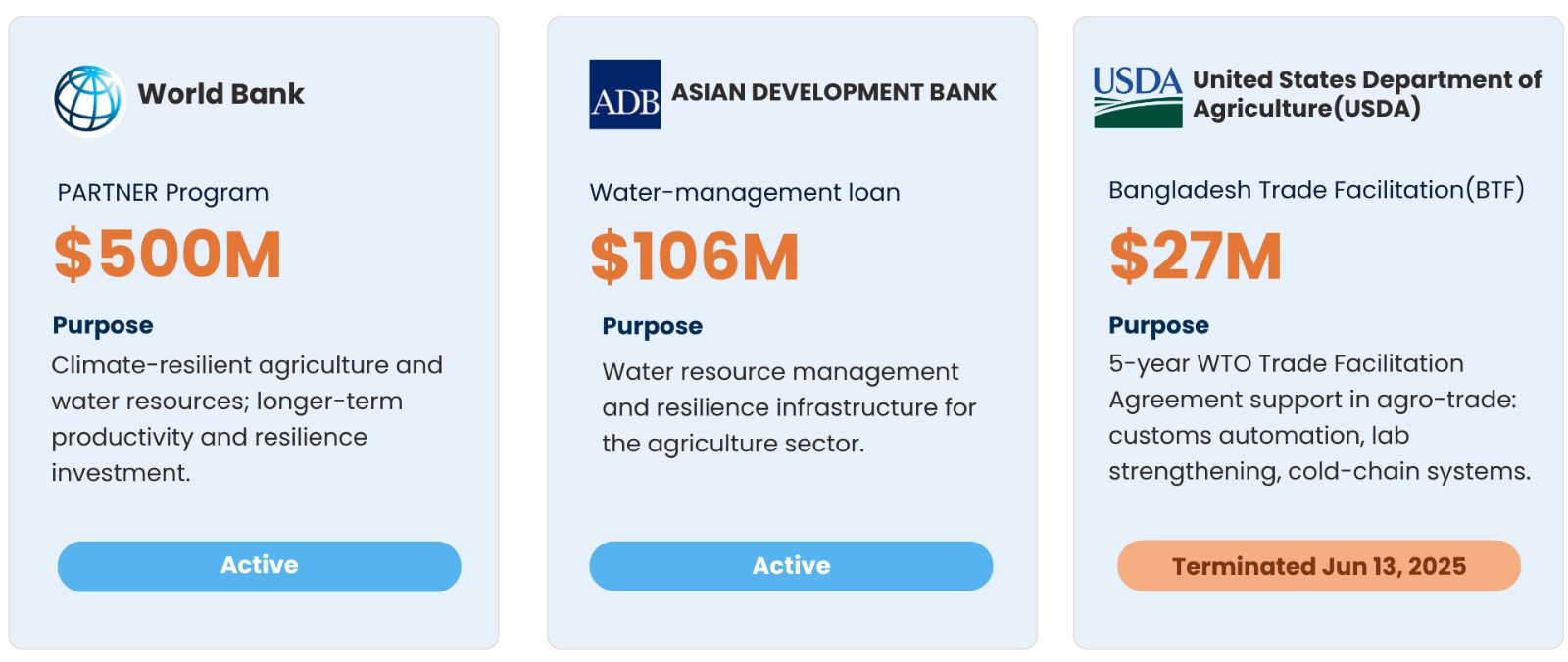
Figure 1. Major International Investments Supporting Bangladesh’s Agricultural Sector[5][6]
Bangladesh’s food processing market is already worth about USD 8 billion and is growing at roughly 8 percent per year.[7] The government recognizes it as a priority export-diversification sector. Processed food exports have grown by 16.6 percent per year, and exporters now ship more than 700 products to over 140 countries under preferential trade schemes in 52 markets.[8]
Meanwhile, agritech ventures such as iFarmer, iPage, Agroshift, and Fashol in Bangladesh have attracted over USD 15 million in funding, reflecting growing investor interest in technology-enabled agriculture. These enterprises create roles in finance, market access, input and advisory delivery, processing, branding, logistics, and digital platforms. These roles align more closely with young people’s aspirations for higher income, innovation, and entrepreneurship than traditional farm work alone.
Globally, a growing number of countries are using climate-smart mechanization, digital tools, and value-chain management to turn youth into key innovators and entrepreneurs across modern agrifood systems.
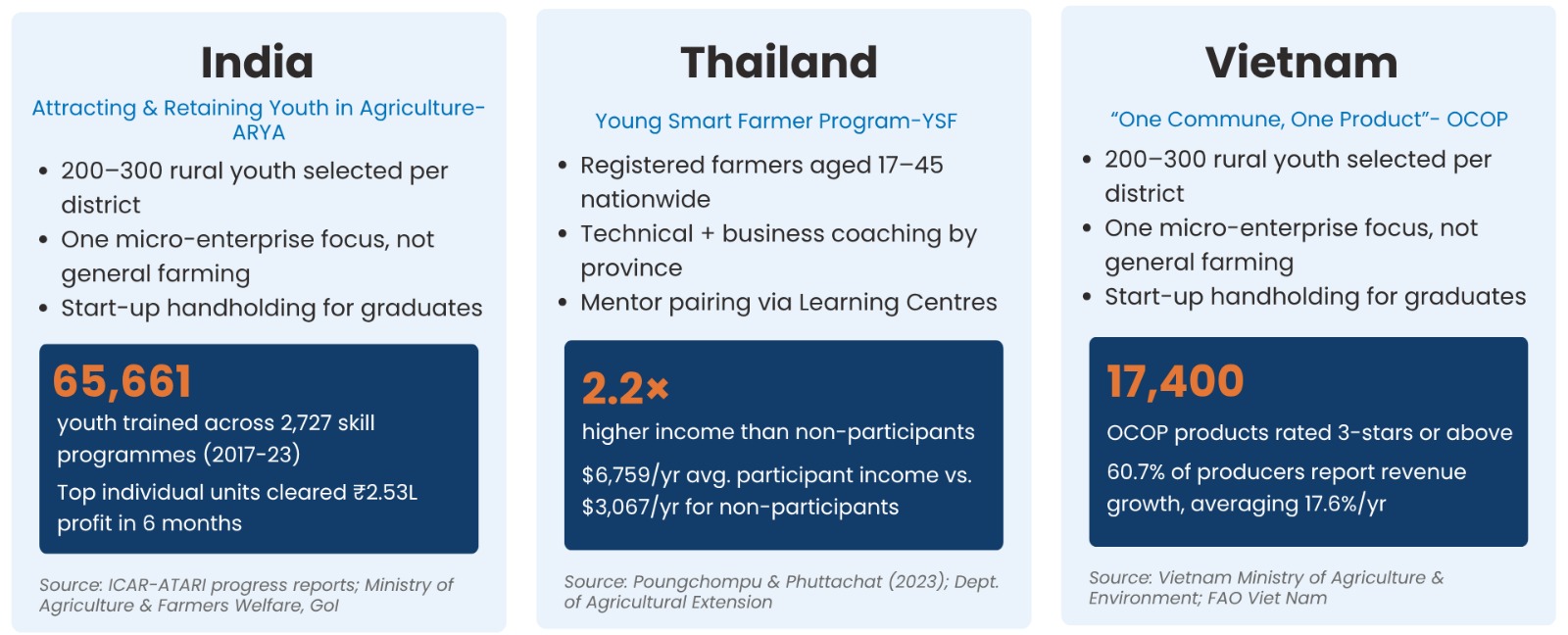
Figure 2: Youth Agripreneurship Initiatives in Peer Countries
Bangladesh, with its large smallholder base, is only beginning to unlock value-chain opportunities in agro-processing, export-oriented crops, and agritech. Agriculture and related activities contribute close to 11.66 percent of GDP when upstream and downstream linkages are considered.
Yet processed food exports remain modest compared to raw and semi-processed products. Currently, more than 75 percent of agricultural produce is still sold unprocessed.[8] This imbalance highlights significant scope for youth-driven upgrading into branded, higher-value processed goods that capture more income from each unit of production.
Recent budgets and policy statements suggest that agriculture is shifting from subsidy-heavy support to a more investment-oriented approach. The proposed FY 2026–27 budget allocates Tk 28,881 crore to agriculture, with Tk 7,946 crore for development spending and a near-doubling of the Ministry of Agriculture’s ADP allocation.[9] This indicates greater emphasis on mechanization revival, climate-smart irrigation, canal excavation, cold storage, and packing facilities rather than only input subsidies.
Parallel initiatives to draft an Agripreneurship Start-up Policy and an Agricultural Cooperative Policy aim to improve youth access to technology and credit through organized value-chain platforms. Policy instruments for agro-processing now revolve around tax rebates, duty-free imports of capital machinery, and cash incentives for processed food exports.
However, these supports are largely structured around formal bank finance and established firms. As a result, youth-led SMEs find them harder to access. For example, the Agro Food Processing Industry Promotion Policy 2022 (Clause 4.8.2.1) requires 25% of project costs to come through a bank loan to qualify for incentives. This systematically excludes entrepreneurs who use equity financing or blended financing. It is especially restrictive in cold-chain segments, where lenders perceive higher risk because of high power costs and demand uncertainty.
In parallel, Bangladesh Bank’s Agricultural and Rural Credit Policy and Program for FY 2025–26 sets a Tk 39,000 crore target for agricultural and rural lending. It also maintains refinance schemes and 4 percent concessional loans for pulses, oilseeds, spices, and maize. The FY 2026–27 budget also proposes new startup and youth entrepreneurship funds. This signals an effort to complement earlier, more firm-focused instruments with financing tools better suited to first-time youth agro-entrepreneurs.[9]
However, awareness and effective uptake among young agripreneurs remain limited. Ecosystem studies and opinion pieces show that a majority of youths lack information about specific schemes. They also find banking procedures complex and struggle with collateral, documentation, and land-title requirements. As a result, only a small fraction of youth-led agribusinesses access these facilities.
For many young agripreneurs, the real bottleneck is not the loan target but the conditions attached to it. Formal agricultural products typically require clear land titles, registered mortgages, guarantors, and a long list of documents. These include trade licenses, tax IDs, financial statements, and feasibility reports, which are difficult for young founders to assemble. On top of these technical hurdles, softer barriers also matter. Bank staff often favor safer, established clients, while many rural youths face gaps in financial literacy and have limited mentoring. This makes it harder for them to understand products, structure proposals, and negotiate terms.[10]
Bangladesh’s youth-led agricultural transformation will need a clear, phased roadmap rather than scattered projects. First, national skills and education systems should embed agribusiness, value-chain management, and agritech into Technical and Vocational Education and Training (TVET), university, and extension curricula. This would help young people specialize in concrete enterprises such as seed production, mechanization services, cold-chain logistics, or agro-processing instead of generic farming.
Second, rural agribusiness hubs and incubators such as Orange Corners Bangladesh and other entrepreneurship support programs could nurture youth-led agribusinesses and startups. They can provide enterprise-specific training, mentorship, business development support, and shared infrastructure such as packhouses, processing facilities, storage, and digital advisory services. This would lower entry barriers, reduce initial investment costs, and improve the long-term viability of new agribusinesses.
Third, policymakers must redesign financial instruments to support youth-led ventures and businesses through loans with lower collateral requirements, credit guarantees, and blended finance. Financing products should be tailored to agricultural seasonality. Public refinance facilities and impact investment should complement them to enable both agribusinesses and innovative startups to scale.
Fourth, policymakers could formalize land-access solutions such as cooperative farming, lease markets, and contracts with producer organizations. This would enable young farmers with limited land access to engage in commercially viable agricultural value chains.
Finally, government and partners need to systematically track income, jobs, exports, and climate-resilience gains from youth-led agro-processing, services, and agritech. They should use this evidence to steer future industrial incentives, credit targets, and budget allocations toward models that clearly absorb young workers and raise rural productivity rather than reinforcing jobless growth.[11]
The article was authored by Tasnuva Jahan Lamiya, Trainee Consultant and editorial support was provided by Naziba Ali, Business Consultant at LightCastle Partners. For further clarifications, contact: [email protected]
Our experts can help you solve your unique challenges
Stay up-to-date with our Thought Leadership and Insights