


GET IN TOUCH
- Please wait...

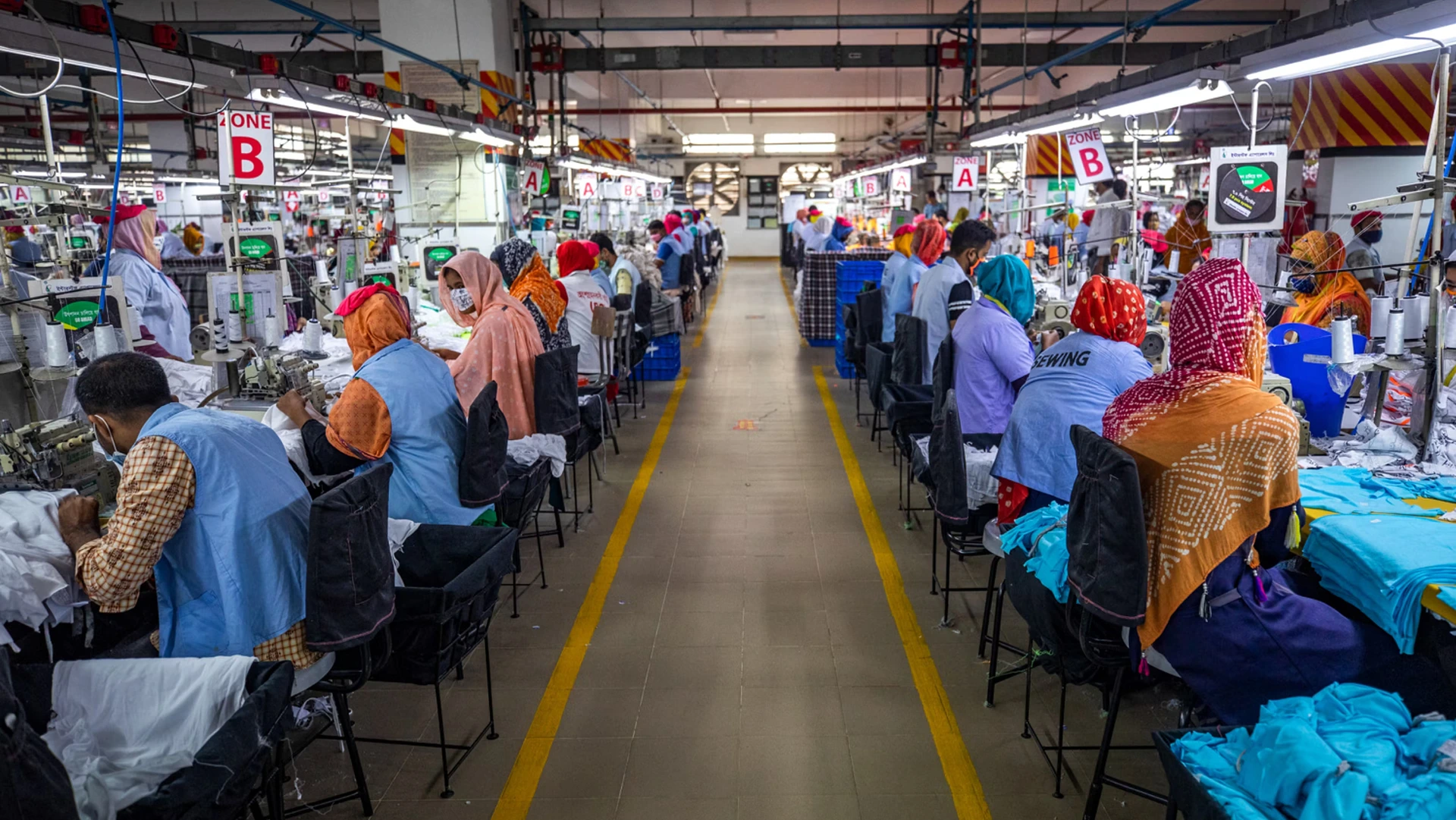
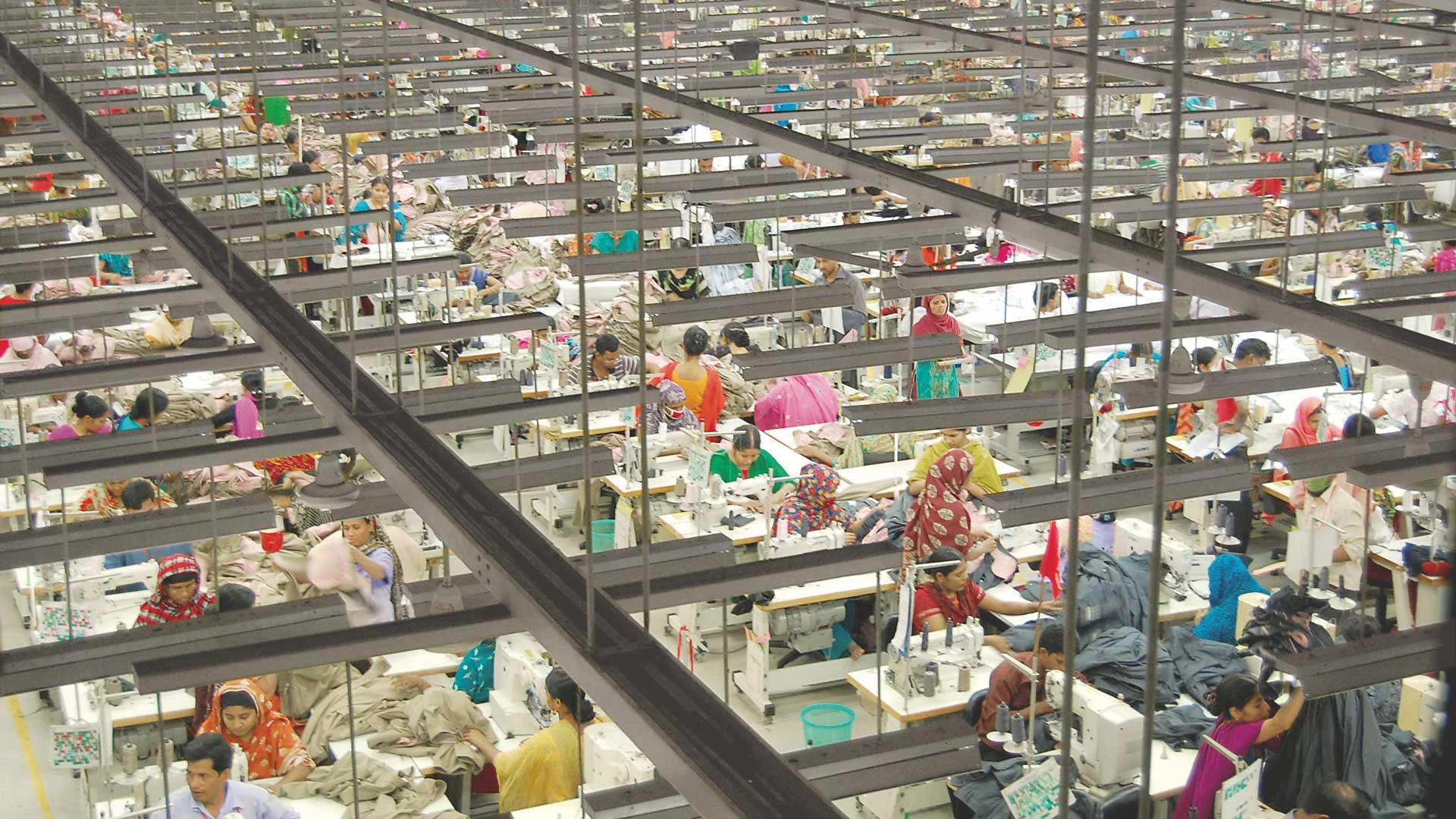
Bangladesh’s readymade garment (RMG) industry is both the country’s greatest economic achievement and one of its most pressing human challenges. The sector accounts for 84% of total export earnings. It directly employs more than four million workers, and over half are women. [1] The industry remains the backbone of Bangladesh’s development story. However, many workers still earn wages that fall short of the cost of living. They also face limited access to healthcare, unmet reproductive health needs, inadequate housing, and persistent psychosocial stress. Together, these challenges have created a crisis. Conventional compliance frameworks have failed to resolve it. As global buyers strengthen due diligence requirements and Bangladesh prepares for LDC graduation, worker wellbeing has become a strategic priority. The question is no longer whether worker wellbeing matters. Instead, it is whether the sector can respond quickly enough.
Against this backdrop, LightCastle Partners convened the closed-door diagnostic roundtable, “Beyond Wages: Safer Jobs and Better Lives for Workers in the RMG Sector,” on 9 July 2026 at the Renaissance Dhaka Gulshan. The event formed part of the Bunon 2030 initiative. It falls under the Oporajita Phase 2: Just Transition for Women in the RMG Ecosystem programme. The H&M Foundation, Sweden, and COS support the programme. The Asia Foundation manages it as the backbone organization.
The session brought together representatives from the Ministry of Labour and Employment, the Department of Inspection for Factories and Establishments (DIFE), the Asian Development Bank, the Bangladesh Institute of Labour Studies (BILS), and UNFPA. It also included industry associations, global buyers, manufacturers, worker organizations, academic institutions, and development partners. Participants represented CARE, Save the Children, WaterAid, Solidaridad, Moner Bondhu, BGMEA, Primark, Shasha Garments, Urmi Group, the Institute of Health Economics at the University of Dhaka, the National Coordination Committee for Workers Education, and the Bangladesh National Garments Employees League. Together, they examined institutional, workplace, health, and policy priorities. Their goal was to strengthen worker wellbeing across Bangladesh’s RMG sector.
The keynote session opened with a central argument that shaped the discussion. Worker wellbeing cannot be measured through wages alone. Bangladesh revised the minimum wage to BDT 12,500 in 2023. However, the increase covers only about 71% of the Anker-method living wage benchmark developed by Christian Aid and the Anker Research Institute. [2] The gap is even wider in practice. Food inflation has consistently outpaced wage growth in recent quarters. According to Bangladesh Bureau of Statistics data, food inflation reached 8.8% year-on-year in Q2 2026. During the same period, wage growth remained close to 8.2%. [3] As a result, workers have lost purchasing power over time. This trend has created a wage-nutrition trap. Workers who cannot afford adequate food struggle to maintain adequate productivity.
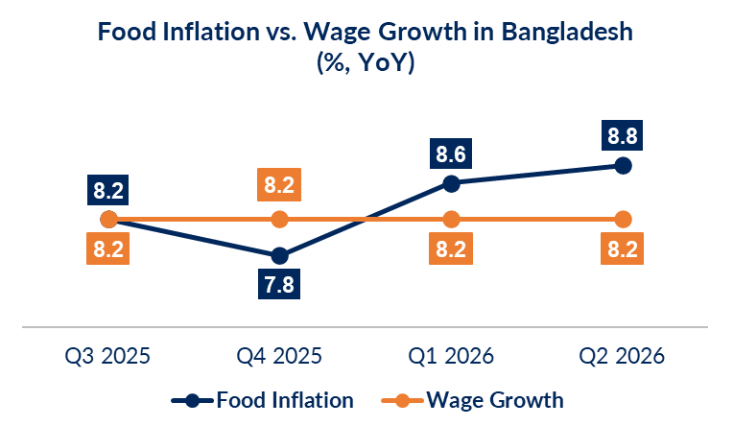
Figure: Food inflation Vs Wage Growth in Bangladesh
The nutrition data shows that this is more than a moral concern. Anaemia among women garment workers reduces productivity and increases absenteeism. As a result, factories and the wider economy bear measurable costs. Many women workers also prioritize feeding their children over themselves. Consequently, poor nutrition becomes a structural feature of household economics rather than an individual choice.
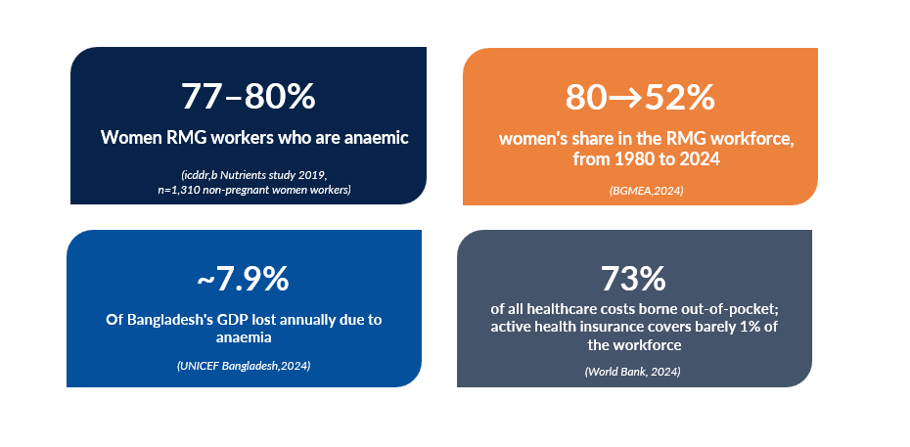
Figure: The Wellbeing Crisis in Numbers: Key Indicators from Bangladesh’s RMG Workforce
The challenges extend beyond nutrition. Reproductive health services and maternity protection remain weak despite existing legal entitlements. Mental health and psychosocial stress also require greater attention. Production pressure, long working hours, and workplace harassment continue to affect workers’ wellbeing. At the same time, climate-related risks are creating new challenges. Extreme heat inside factories and flooding that disrupts daily commutes add to workers’ physical burden. Access to affordable healthcare also remains limited. As a result, many workers delay treatment or pay substantial medical expenses out of pocket.
Each of these challenges affects absenteeism, productivity, and workforce retention. Together, they weaken the sector’s long-term competitiveness. The continued decline in women’s participation in the RMG workforce further suggests that current working and living conditions do not provide enough support to retain them.
Bangladesh has a strong legal foundation for worker wellbeing. The Bangladesh Labour Act 2006, the Bangladesh Labour Rules 2015, and the Bangladesh Labour Welfare Foundation Act 2006 provide for first aid, healthcare, maternity protection, childcare, group insurance, and welfare financing. The 2022 Rules introduced four weeks of paid miscarriage leave. They also revised maternity benefit calculations. National nutrition policies identify workplaces as key entry points for reducing anaemia and micronutrient deficiencies. In addition, the Mental Health Act 2018 and Bangladesh’s 2025 ratification of ILO Convention 190 strengthened the legal framework. Together, they promote treatment, dignity, and protection from violence and harassment.
However, the main challenge is not the absence of laws. It is whether these protections reach the workers who need them most. In many cases, they do not. High worker thresholds exclude many Tier-2 and Tier-3 subcontracting factories from key provisions. At the same time, compliance monitoring often focuses on whether facilities exist. It pays less attention to whether they are properly staffed, accessible, hygienic, and trusted by workers. Reporting and compensation for occupational diseases also remain weak.
Table 1: Policy Framework vs. Implementation Reality
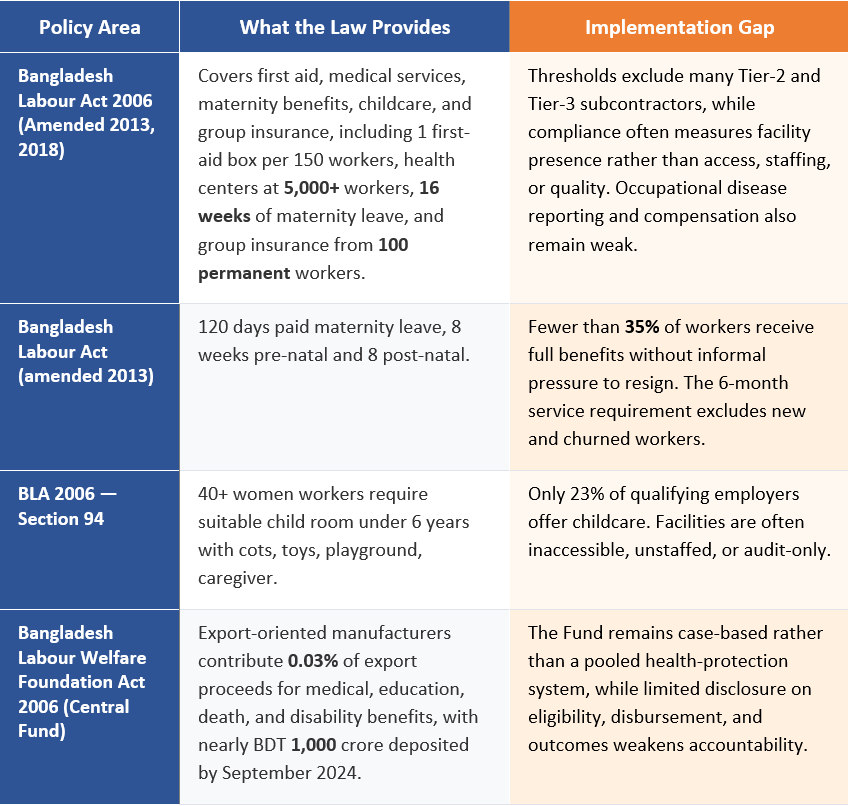
Source: Bangladesh Labour Act 2006, Bangladesh Labour Rules amendment 2022
The wider institutional gap is equally significant. The Central Fund still operates as a case-based welfare mechanism rather than a pooled health-protection system. In addition, limited disclosure on eligibility, disbursement, and outcomes reduces public awareness and weakens accountability. The Ministry of Health and Family Welfare (MoHFW) also faces structural constraints. Its service delivery remains largely rural-focused, leaving many urban factory workers underserved. Public clinics typically operate from 9 AM to 5 PM. These hours often overlap with factory shifts, making healthcare difficult to access.
To address these gaps, the keynote proposed a tripartite health-protection model. The model would transform existing welfare financing into a more systematic and accountable mechanism. The session also called for stronger coordination among the Ministry of Labour and Employment (MoLE), the Department of Inspection for Factories and Establishments (DIFE), and the Ministry of Health and Family Welfare (MoHFW). Although their worker health mandates overlap, the three institutions remain weakly connected in practice.
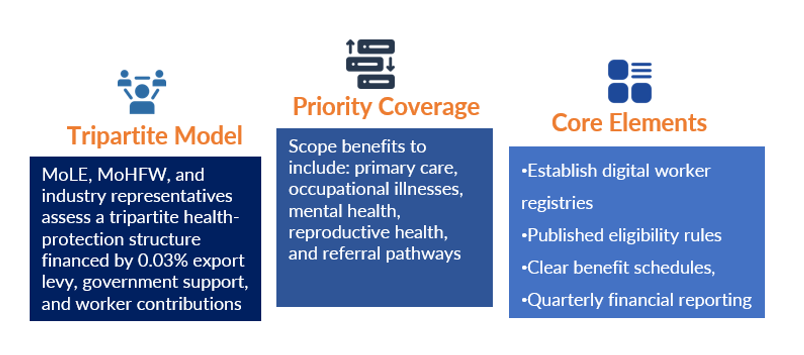
Figure: Worker Wellbeing Roadmap: Government Actions for Consideration
Hassan James, Senior Program Officer at the Center for Communication Action Bangladesh (C-CAB), explained how the Oporajita project addresses one of the RMG sector’s most persistent challenges. The project seeks to make positive health behaviours sustainable in communities with limited resources, low digital access, and deep-rooted social stigma.
The project classifies worker health risks into three interconnected areas. Physical health risks include occupational hazards as well as nutrition- and housing-related conditions. Mental health challenges remain equally serious. Social stigma often labels psychological illness as “madness,” making formal care difficult to access. Climate-related risks have also become more severe. Extreme heat, flooding, and difficult commutes place additional pressure on workers. For example, many workers reported carrying extra clothing because flooded roads leave them soaked before reaching factories. Although each incident seems minor, the cumulative effect reduces concentration, morale, and overall health.
The project’s communication strategy reflects another structural challenge. Conventional digital campaigns fail to reach many women garment workers. Although 80% of workers believe training can improve their lives, only 8% of female RMG workers own smartphones. As a result, social media and app-based outreach cannot serve as primary communication channels.
The session highlighted an important conclusion. Worker behaviour cannot change sustainably if interventions focus only on individual workers. Families, communities, and workplaces must also participate in the change process. Otherwise, stigma, misinformation, and economic constraints will continue to undermine individual-level interventions.
During the roundtable, Zakia Naznin, Programme Lead at WaterAid, presented a complementary perspective. She showed that modest infrastructure investments can improve productivity and worker confidence. Importantly, these improvements do not require major capital investment or lengthy policy reforms.
WaterAid’s “factory-community-school” approach addresses WASH service gaps, menstrual hygiene management, water safety planning, and handwashing facilities. It covers the three environments where workers and their families spend most of their time. The findings also revealed significant infrastructure gaps. In some factories, the toilet-to-worker ratio for women reached 1:27. This falls well below a reasonable standard for dignity and hygiene.
These gaps are particularly evident in reproductive health and maternity protection. Although legal entitlements exist, many factories still fail to provide reliable and trusted workplace support.
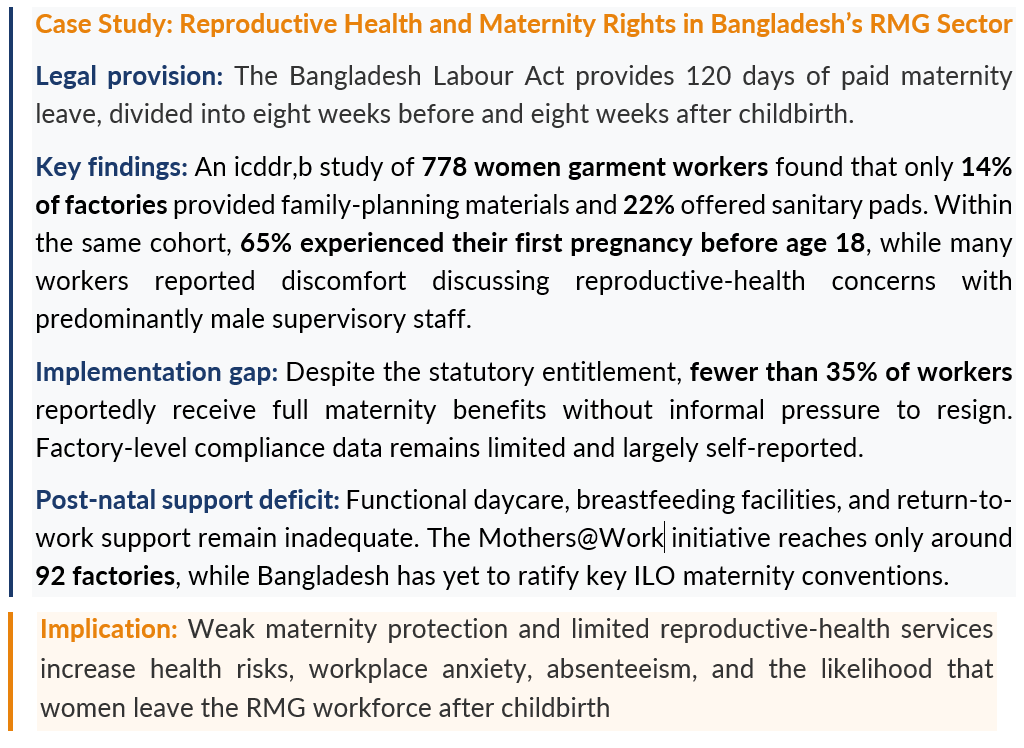
Source: Bangladesh Labour Law; Maternity Protection and Childcare System in Bangladesh; icddr,b Study.
The findings show that legal entitlements alone cannot guarantee reproductive health and maternity protection. Workers also need confidential healthcare, functional childcare, breastfeeding support, and safe return-to-work pathways. Without these services, pregnancy and motherhood continue to increase absenteeism, workplace anxiety, and workforce attrition.
These findings also reinforce the need to connect factory services with community healthcare, WASH initiatives, and behaviour-change programmes. An integrated approach can improve both worker wellbeing and long-term workforce retention.
The session brought together perspectives from trade unions, government representatives, factory management, development partners, and academics. Despite their different roles, participants shared a common message. Bangladesh already has successful pilot initiatives, supportive legal frameworks, capable institutions, and committed stakeholders. However, the sector still lacks the coordination needed to turn these separate efforts into an integrated wellbeing system.
Dr. Shahidur Rahman, Professor at BRAC University, noted that fire and building safety became sector-wide priorities after the Rana Plaza tragedy. However, psychosocial wellbeing has not received a similar institutional response. Many workers continue to experience stress from production pressure, low wages, long working hours, harassment, and financial insecurity. At the same time, symptoms such as sleep disruption, appetite changes, and depression often go unrecognized. Dr. Rahman also argued that factory-level interventions alone cannot solve these challenges. Many women leave the sector because of financial and psychological pressures within their communities. He highlighted the “rent trap” as one example. In this situation, landlords increase rents after wage hikes and absorb much of the intended financial benefit.
ABM Faqrul Alam, Head of Sustainability at Urmi Group, explained that the company bases its worker-relations approach on ILO Conventions C155, C87, and C98. In practice, the company operates an anonymous grievance system that accepts QR code submissions and voice recordings. It also established Babuland, a childcare centre developed with BRAC. The centre provides a welcoming learning environment and serves two meals a day.
Sajal Kanti Roy, Senior Ethical Trade Executive at Primark, presented another example. Through a partnership with VisionSpring, Primark provided eye screenings to more than 500 workers. The programme used a co-payment model that encouraged ownership and increased service utilization. Primark has also started training factory-based para-counsellors. They provide early mental health support before problems become more serious.
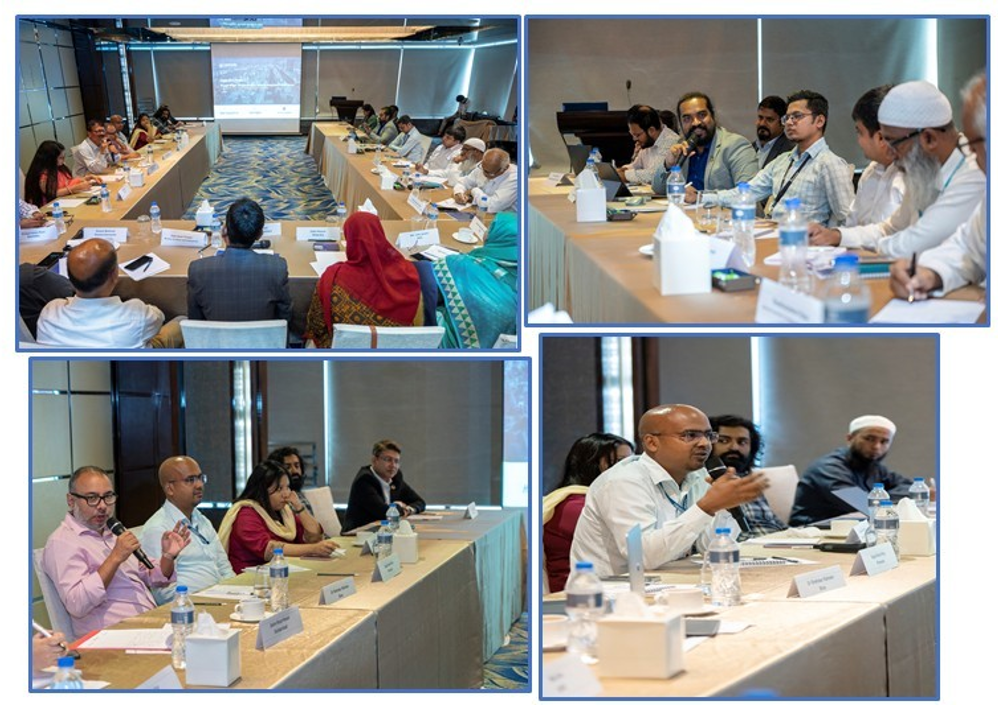
Together, these examples demonstrate distinct but complementary mechanisms. These include worker ownership, rights-based labour relations, anonymous grievance systems, childcare, and peer mental health support. Collectively, they offer practical lessons for a wider sector-level approach.
Peer garment-exporting economies also provide useful benchmarks. India’s Employees’ State Insurance (ESI) Act offers sector-wide health coverage for factory workers. The country’s 2017 amendment also guarantees 26 weeks of paid maternity leave. [4] Vietnam’s Social Insurance Law 2024 provides six months of fully paid maternity leave through a dedicated social insurance fund. [5] Cambodia’s National Social Security Fund (NSSF) follows a tripartite employer-worker-government contribution model. It also supports a universal health coverage roadmap that targets 80% population coverage by 2035. [6,7] Bangladesh already has a strong legal foundation. However, the country must accelerate implementation.
Bangladesh has already shown that coordinated sector-wide action is possible. The response to Rana Plaza demonstrated this clearly. The next challenge is more complex. It involves nutrition, mental health, reproductive health, climate adaptation, and psychosocial stress. Unlike structural safety failures, these issues do not emerge through a single event. Instead, they accumulate over time. The consequences include higher absenteeism, early workforce exits, declining participation by women, and greater exposure to buyer and regulatory compliance requirements.
Government, factories, buyers, unions, and development partners all share responsibility for this transition. Under the EU’s new GSP framework, Bangladesh will retain Everything But Arms (EBA) preferences for three years after LDC graduation. After that period, access to GSP+ will depend on ratifying and effectively implementing 32 international conventions on human rights, labour rights, climate and environmental protection, and good governance. [8] Investment in worker wellbeing is therefore both a moral responsibility and a commercial necessity. It will also help protect Bangladesh’s long-term access to the European market.
The roundtable reached a clear conclusion. Bangladesh already has pilot initiatives, policy frameworks, and proven solutions. What the sector still lacks is the institutional commitment to connect them. It must move from isolated projects to systems that serve more than four million workers. Ultimately, productivity and worker dignity are not competing priorities. When treated as mutually reinforcing, they provide the strongest foundation for the future of Bangladesh’s RMG sector.
This article has been authored by Faiza Tahiya, Business Analyst at LightCastle Partners. For further inquiries or clarifications, please contact: [email protected]
Our experts can help you solve your unique challenges
Stay up-to-date with our Thought Leadership and Insights