


GET IN TOUCH
- Please wait...

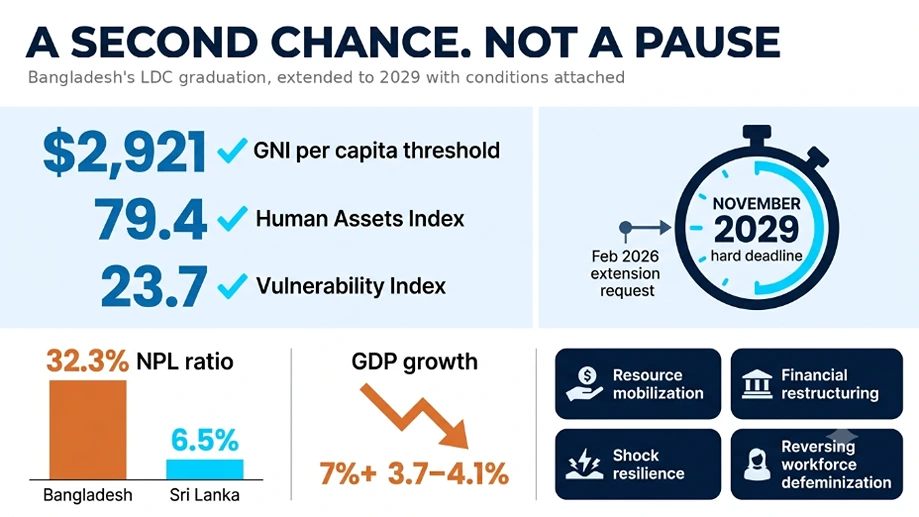
Bangladesh meets all three Least Developed Country (LDC) graduation criteria “by wide margins,” according to the United Nations Committee for Development Policy (CDP). On gross national income per capita, Bangladesh stands at $2,921 against a graduation threshold of $1,346; on the human assets index, it scores 79.4 against a minimum of 66; and on the economic and environmental vulnerability index, it scores 23.7 against a ceiling of 32, comfortably clearing every LDC graduation benchmark set by the CDP.(I)
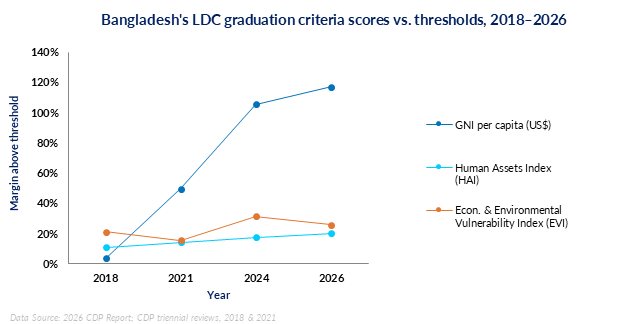
Figure 1. Bangladesh’s LDC Graduation Criteria Scores
Bangladesh isn’t falling short of readiness; it’s hitting a bad moment to use the readiness it already has. Yet in February 2026, the Government of Bangladesh formally requested a three-year extension of its preparatory period. The request would push the graduation date from November 2026 to November 2029. In May 2026, the CDP recommended granting the request.
Read closely, the CDP’s assessment says as much about what Bangladesh must do next as it does about why the delay was granted.
Extensions of this kind do not happen often, but they do have precedent. The Solomon Islands received a three-year extension in 2023 following severe natural disasters and internal instability. Angola secured a similar deferral through diplomatic channels after a global oil price shock.(ii) Bangladesh’s request follows the same pattern. It cites external shocks as grounds for the standard three-year window, rather than representing a novel or unusually generous accommodation by the CDP.
The Government’s request cited nine shocks, which the CDP separates into two groups. The first group includes four shocks that the CDP had already comprehensively considered by 2024. The second includes five shocks that have emerged or intensified since then.
The first group is familiar. It includes the prolonged aftereffects of COVID-19 and a sluggish recovery, the Russia-Ukraine war’s spillover effects on global energy and food markets, tightening global financial conditions, and delays in the recovery of international trade. The CDP had already reviewed all four in 2024. At the time, it concluded that no further extension was necessary.
The second group is what changed. Since 2024, Bangladesh has faced disruptions from conflicts in the Middle East and the Red Sea. The CDP notes that the shock escalated sharply with the outbreak of war in Iran on 28 February 2026. The conflict threatened the liquefied natural gas supply, as Qatar alone provides 78 percent of Bangladesh’s LNG imports.
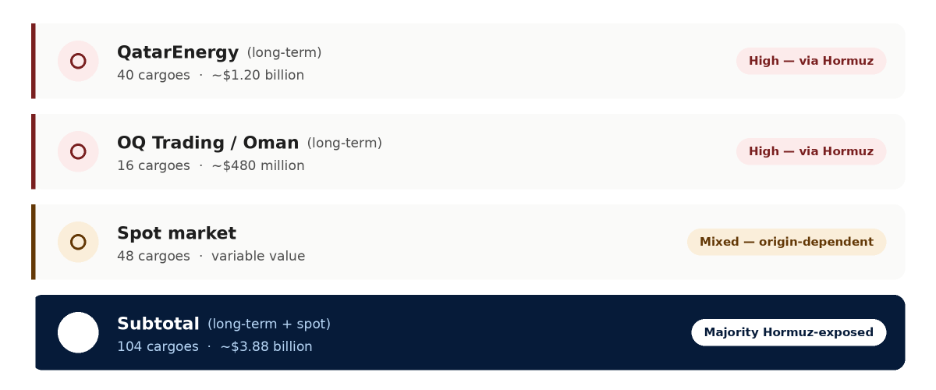
Figure 2. Bangladesh’s LNG import exposure through the Strait of Hormuz, 2025
The 14th WTO Ministerial Conference failed to reach consensus on extending several LDC-specific flexibilities in subsidies, intellectual property, and agriculture. This added legal and institutional uncertainty on top of the trade-preference question.(III)
Domestically, the CDP identified newly reported irregularities in the banking sector, a change of government following the July 2024 uprising, and a worsening funding crisis for the 1.09 million Rohingya refugees still hosted in Bangladesh. The 2025 Joint Response Plan remains badly underfunded.(IV) This burden falls directly on the same narrow fiscal base discussed in the following sections. Host-community support and camp infrastructure continue to draw on government resources, even when donor funding shortfalls are nominally the responsibility of the international community.
None of these developments, on their own, would threaten graduation eligibility. Together, however, they arrived just as Bangladesh was expected to finalize its preparations. The CDP therefore viewed them as a case for buying time, not for reconsidering the graduation decision itself.
The macroeconomic picture explains why the CDP took the request seriously. Real GDP growth has slowed from more than 7 percent in recent years to an estimated 4.1 percent in 2025. Both the IMF and UN DESA further cut their 2026–27 forecasts between the start and middle of 2026 as the Middle East conflict unfolded.(V) The IMF’s January 2026 Article IV Consultation put growth at 3.7 percent in FY2025, down from 4.2 percent in FY2024 and 5.8 percent in FY2023.(VI)
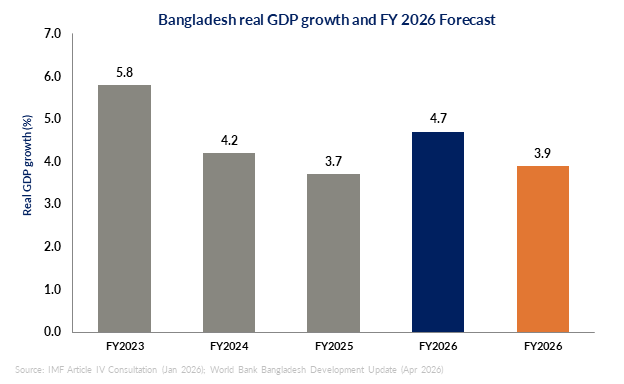
Figure 3. Bangladesh’s Real GDP Growth Over the Years (FY2023–FY2026)
The World Bank’s Bangladesh Development Update, released separately in April 2026, projected FY2026 growth at 3.9 percent. Although the two institutions relied on different datasets, they highlighted the same three compounding risks: a stressed banking sector, weak revenue mobilization, and subdued private investment.(VII) Inflation projections for 2026 also rose to 9 percent, well above the implicit target of 5–6 percent. Bangladesh’s dependence on imported fuel and food drove much of this increase.
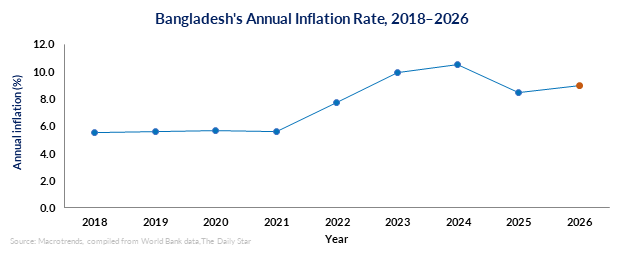
Figure 4. Bangladesh’s Inflation Rate, 2018–2026
Note: The 2026 figure (orange marker) reflects a partial year in progress.
These three risks are not independent. Instead, they reinforce one another in a specific sequence. A narrow revenue base limits the government’s fiscal space. Limited fiscal space constrains its ability to recapitalize failing banks without new borrowing. An undercapitalized banking sector, in turn, cannot support the private investment that economic growth depends on.
Starting with revenue, the National Board of Revenue collected Tk 370,874 crore in FY2024–25. This fell Tk 92,626 crore short of its revised target. As a result, the tax-to-GDP ratio declined to 6.8 percent, one of the lowest in the world for countries at a comparable stage of development.(VIII) On the broader measure of total government revenue, Bangladesh collects around 8 percent of GDP. That is the lowest ratio in Asia and only slightly above conflict-affected Yemen and Sudan. By comparison, Pakistan collects 12 percent, Sri Lanka 13.68 percent, and Bhutan 26.97 percent.(IX)
This fiscal constraint also made the banking sector’s problems more difficult to contain. When the Government nationalized and merged five insolvent Islamic banks, it had to absorb institutions holding roughly 7 percent of system deposits and a 70 percent non-performing loan ratio. The intervention carried a fiscal cost equal to 0.5 percent of GDP.(X) A government with the revenue base of Sri Lanka or Bhutan could have absorbed that cost far more easily.
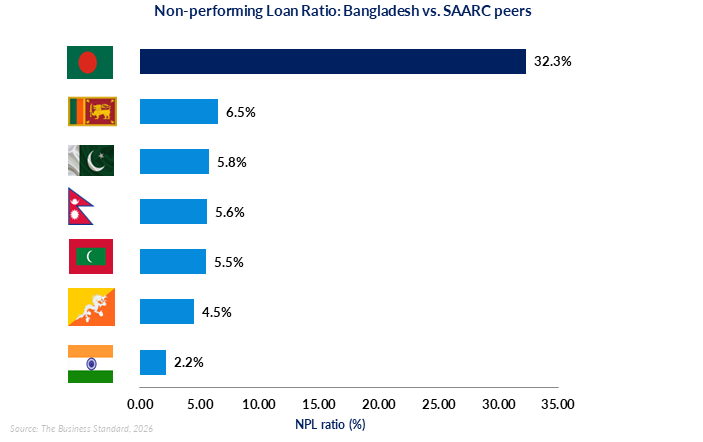
Figure 5. Non-Performing Loan Ratio of Bangladesh vs. SAARC Peers
The banking figures themselves should concern a business audience most. The system-wide non-performing loan (NPL) ratio reached 30.6 percent in December 2025.(XI) That figure was already exceptionally high by regional standards. It climbed further to 32.26 percent by the end of March 2026, placing Bangladesh second globally after war-affected Ukraine. It is also roughly five times higher than Sri Lanka, the next-closest SAARC peer, at 6.5 percent.(XII)
The capital-to-risk-weighted-assets ratio has also fallen into negative territory. This is well below the 12.5 percent regulatory minimum. It also stands in sharp contrast to Pakistan’s 20.8 percent, Sri Lanka’s 19.4 percent, and India’s 17.2 percent.(XIII)
The IMF’s Executive Board went so far as to highlight “the urgent need for a credible banking sector reform strategy consistent with international standards” as a precondition for restoring stability. Read alongside the revenue figures above, this language implicitly acknowledges that reform capacity and fiscal capacity are two sides of the same constraint.(XIV)
The revenue gap is structural rather than incidental. Bangladesh’s direct tax-to-GDP ratio stood at just 2.62 percent in 2018, compared with a South Asian average of 4.6 percent and a global average of 8.5 percent.(XV) This suggests that the shortfall is not simply the result of informality. Instead, it reflects a tax base that has remained narrow for decades.
Nor is this a one-year problem. The NBR has missed its original revenue target for 14 consecutive years and its revised target for 10 years.(XVI) Several factors reinforce one another. An estimated 84 percent (XVII) of the workforce operates in the informal economy and remains largely outside the tax net. At the same time, only about 3 percent (XVIII) of citizens file income tax returns.
These are the vulnerabilities the extension is intended to address, not the LDC graduation criteria, which Bangladesh continues to meet comfortably.
Trade competitiveness is not pausing while Bangladesh negotiates its extension. The European Union, which receives around two-thirds of Bangladesh’s exports, will continue to provide duty-free, quota-free access under the Everything But Arms (EBA) scheme for three years after graduation. However, the successor GSP+ scheme covers a narrower 66 percent of tariff lines. It also requires substantially higher domestic value-added content. In addition, it introduces safeguard thresholds that could remove preferential treatment from products if Bangladesh exceeds 6 percent of total EU imports or 37 percent of GSP-covered imports. Apparel exports are likely to cross that threshold.(XIX)
UNCTAD’s modelling projects a 28 percent decline in exports under a shift from EBA to standard GSP. It projects a 32 percent decline under a full loss of preferences.(XX) Competitive pressure is also increasing, regardless of Bangladesh’s graduation timeline. The EU and India concluded FTA negotiations in January 2026. Vietnam will also gain zero-tariff access to the EU from January 2027. Both developments will intensify competition for the market share Bangladesh has built.
Not every signal points in the same direction. The Bangladesh–Japan Economic Partnership Agreement, signed in February 2026, grants duty-free access to roughly 97 percent of Bangladesh’s export basket, including ready-made garments. It is a rare example of trade diplomacy getting ahead of the graduation deadline rather than reacting to it.(XXI)
The picture in the United States is different. The U.S. offers no LDC trade preferences. Even so, Bangladesh has retained its position as the second-largest apparel exporter. It has done so despite reciprocal tariffs increasing trade-weighted rates from 15 percent to 25 percent between January 2025 and February 2026. This suggests that Bangladesh’s competitiveness, where it exists, remains resilient to tariff shocks. At the same time, it reminds policymakers that LDC graduation is only one of several trade risks the country must manage simultaneously.
Whether three years will be enough depends less on current performance than on the direction of key indicators. On the two indicators the CDP explicitly highlights are banking sector health and revenue mobilization, the trend before this assessment was negative rather than improving. The NPL ratio rose from 30.6 percent to 32.26 percent in a single quarter. Over the same period, the tax-to-GDP ratio declined from 7.2 percent in FY2024 to roughly 6.6–6.8 percent in FY2025.
A fixed deadline works as a credible forcing mechanism only if the underlying indicators move toward the target. The available evidence suggests the opposite. These metrics moved further away from the desired outcome in the months leading up to the CDP’s assessment. Viewed in that context, the CDP’s insistence on sequencing reforms into short-, medium-, and long-term phases carries a different meaning. Its explicit statement that it will not support another extension appears less like confidence that three years will be enough and more like an effort to avoid facing the same shortfall again in 2029.
It is also important to be precise about what enforces this deadline. No formal penalty exists for failing to deliver the reforms the CDP recommends. Graduation remains legally conditional only on meeting the three quantitative criteria: GNI per capita, HAI, and EVI. It does not depend on progress in banking, revenue, or labour-market reforms.
If Bangladesh still meets those three thresholds in 2029, it will graduate regardless of how much of the reform agenda it has completed. The CDP’s leverage is therefore narrower than it may appear. It has made clear that it will not support another extension request. As a result, 2029 becomes a hard deadline because institutional goodwill will have been exhausted, rather than because of any binding legal rule.
One reform test case already exists, even though it predates the CDP’s assessment. In mid-2025, the National Board of Revenue unveiled its Medium and Long-Term Revenue Strategy. The strategy aims to raise the tax-to-GDP ratio to 10.5 percent by FY2034–35. It sets out a decade-long roadmap to prepare Bangladesh for both LDC graduation and its Sustainable Development Goals commitments. The strategy also reflects conditionalities attached to the IMF’s ongoing USD 4.7 billion loan programme.(XXII)
The strategy has drawn criticism on two fronts. Economists at the Centre for Policy Dialogue argue that the 10.5 percent target is itself inadequate for Bangladesh’s post-graduation revenue needs. They also note that the strategy stops short of a clear, time-bound agenda for taxing property, wealth, and inheritance. These remain the weakest components of Bangladesh’s direct tax base.(XXIII)
The banking sector presents a similar picture. There are visible signs of progress, but significant risks remain. In June 2026, the World Bank’s Board approved USD 450 million for a Financial Sector Support Project. The project targets the same vulnerabilities identified by the CDP. These include deposit protection, Bangladesh Bank’s supervisory capacity, and preparations for restructuring state-owned banks.(XXIV) In the same month, Bangladeshi authorities formally requested a new IMF-supported financing arrangement to anchor the broader reform programme.(XXV)
Yet the NPL ratio continued to rise during the same period. It increased from 30.6 percent in December 2025 to 32.26 percent by March 2026. Five state-owned banks drove much of this increase, as their defaulted loans remain both concentrated and unresolved.
The pattern across revenue and banking reform is the same. The institutional machinery is clearly moving. However, the underlying indicators have yet to improve. That gap is precisely what the CDP’s 2029 deadline is intended to close.
For exporters, investors, and development partners, the practical implication is clear. The planning horizon has shifted by three years, but the urgency has not diminished. If anything, the CDP’s conditionality raises the standard for what “ready” must mean by 2029.
The extension gives Bangladesh time to stabilize a banking sector under genuine strain. It also creates space to rebuild fiscal capacity after years of chronic under-taxation and diversify an export base that remains heavily concentrated in one sector and a shrinking number of preferential markets. However, it does not alter the trajectory of EU safeguard measures, competitor FTAs, or the structural pressures facing preference-dependent trade.
There is already early evidence that the reforms demanded by the CDP are underway, rather than waiting for the extension to become formal. However, these developments do not guarantee that Bangladesh will implement the reforms at the pace or scale the CDP expects. They do, however, show that the institutional machinery is already moving rather than merely making promises.
Bangladesh was never in danger of failing to qualify for graduation. The question the CDP has now put into writing is whether the country can use this second chance to become resilient enough that it will no longer need another one.
This article has been authored by Sakina Binte Belayet Business Consultant at LightCastle Partners. For further inquiries or clarifications, please contact: [email protected]
i. Committee for Development Policy. (2026, May). Crisis assessment: Bangladesh. United Nations Department of Economic and Social Affairs.
ii. Committee for Development Policy. (2026, May). Crisis assessment: Bangladesh. United Nations Department of Economic and Social Affairs.
iii. International Institute for Sustainable Development. (2026, March 30). World Trade Organization 14th Ministerial Conference outcomes: Small wins, progress on reform, and digital trade as deal-breaker.
iv. UNHCR. (2025, March 24). 2025–26 Joint Response Plan for the Rohingya Humanitarian Crisis. UNHCR Data Portal.
v. International Monetary Fund. (2026). Bangladesh: 2025 Article IV consultation—Press release; staff report; and statement by the Executive Director for Bangladesh (IMF Staff Country Report No. 26/24).
vi. International Monetary Fund. (2026). Bangladesh: 2025 Article IV consultation—Press release; staff report; and statement by the Executive Director for Bangladesh (IMF Staff Country Report No. 26/24).
vii. World Bank. (2026, April 8). Urgent reforms needed to restore macro stability, sustain growth, and create jobs in Bangladesh [Press release].
viii. Habib, A. (2026, June 10). Bangladesh’s revenue-to-GDP ratio just above Sudan, Yemen. The Daily Star.
ix. Habib, A. (2026, June 10). Bangladesh’s revenue-to-GDP ratio just above Sudan, Yemen. The Daily Star.
x. World Bank. (2026). Bangladesh Contingent Emergency Response Project (CERP) (Report No. PADA001167).
xi. The Business Standard. (2026). Bangladesh has world’s second-highest NPL rate after war-hit Ukraine.
xii. The Business Standard. (2026). Bangladesh has world’s second-highest NPL rate after war-hit Ukraine.
xiii. International Monetary Fund. (2026). Bangladesh: 2025 Article IV consultation—Press release; staff report; and statement by the Executive Director for Bangladesh (IMF Staff Country Report No. 26/24).
xiv. International Monetary Fund. (2026, January 30). IMF Executive Board concludes 2025 Article IV consultation with Bangladesh (Press Release No. 26/029).
xv. Adam Smith International. (2025). Fixing the tax system in Bangladesh: A long road ahead.
xvi. The Daily Star. (2026). NBR set to miss tax target for 10th year in a row.
xvii. Mowla, G. (2026, March 23). Bangladesh’s employment fails to keep up with GDP growth. Dhaka Tribune.
xviii. Adam Smith International. (2025). Fixing the tax system in Bangladesh: A long road ahead.
xix. UNCTAD. (2025). Trade preferences outlook 2025: Navigating in times of uncertainty (UNCTAD/DITC/TSCE/2026/1). United Nations Conference on Trade and Development.
xx. UNCTAD. (2025). Trade preferences outlook 2025: Navigating in times of uncertainty (UNCTAD/DITC/TSCE/2026/1). United Nations Conference on Trade and Development.
xxi. Ministry of Commerce. (2026, February 6). Press release: Signing of the Bangladesh-Japan Economic Partnership Agreement (BJEPA). Government of the People’s Republic of Bangladesh.
xxii. National Board of Revenue. (2025). Medium and Long-Term Revenue Strategy FY2025–26 to FY2034–35.
xxiii. Fahmida Khatun. (2026). LDC graduation: What needs to be done after applying for an extension. Centre for Policy Dialogue.
xxiv. World Bank. (2026, June 24). World Bank helps Bangladesh strengthen its banking sector [Press release].
xxv. International Monetary Fund. (2026, June 3). Bangladesh authorities’ request for a new IMF-supported program (Press Release No. 26/182).
Our experts can help you solve your unique challenges
Stay up-to-date with our Thought Leadership and Insights