


GET IN TOUCH
- Please wait...

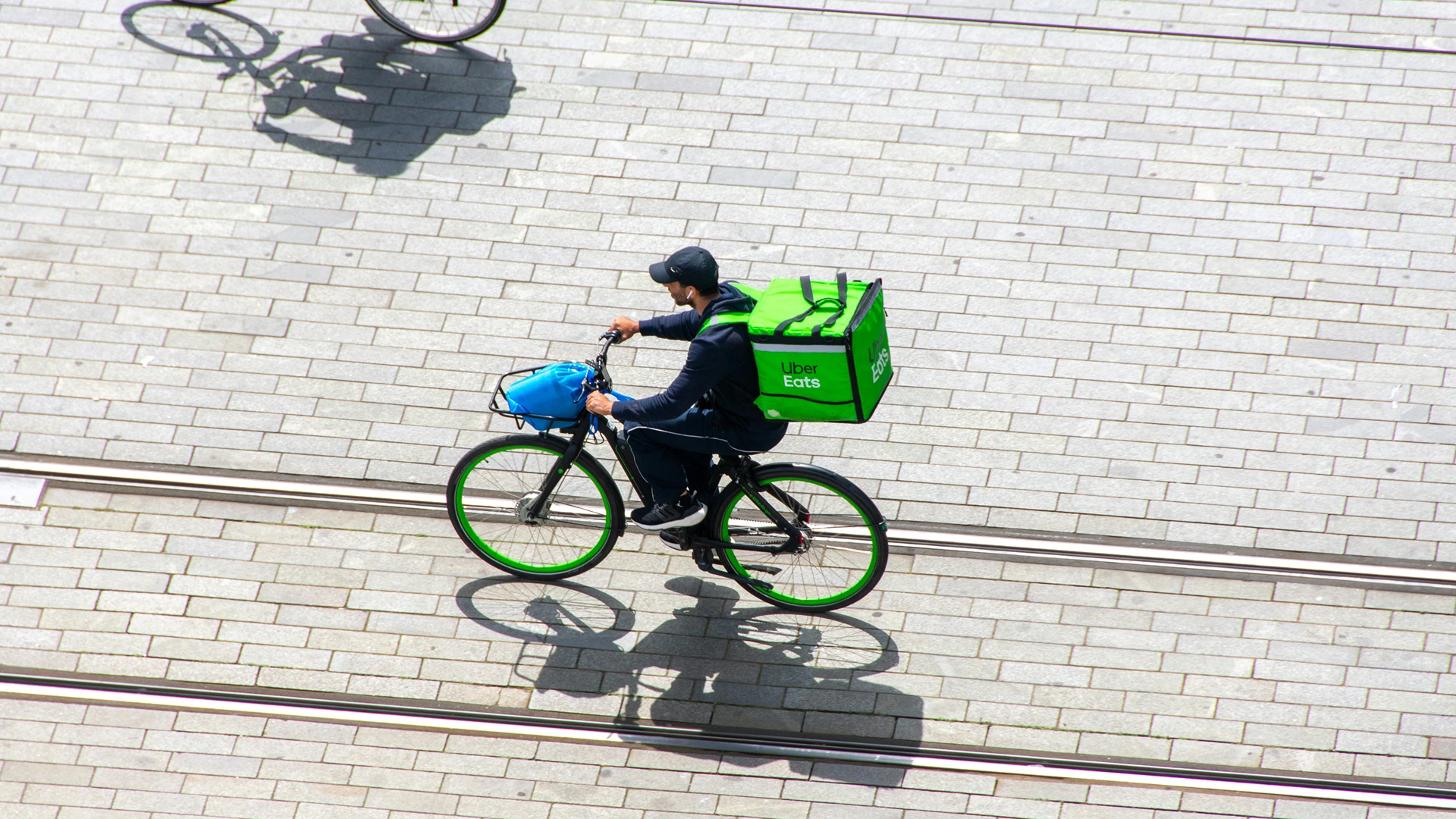
The global rise of the platform economy has fundamentally disrupted traditional labour structures, nowhere more visibly than in Bangladesh. For over a decade, riders for platforms like Pathao and Uber and delivery personnel for Foodpanda and Daraz operated in a legal vacuum.
Platforms classified these individuals as “partners” or “independent contractors.” As a result, they did not receive the protections provided by the Bangladesh Labour Act (BLA) 2006. However, the Bangladesh Labour (Amendment) Act, 2026 marks a landmark moment for the country’s platform workforce.
For the first time, the Bangladesh Labour Act (BLA) 2006 names riders and delivery workers for gig-based platforms within its trade union chapter. This opens a route to union formation that did not previously exist for this segment of the workforce.
It is worth being precise about what this does and does not change:
The amendment does not bring platform workers within the Act’s core definition of “worker” under Section 2 (65). It also does not extend the Act’s full suite of entitlements to them.
Instead, it recognises them specifically for organising purposes. This is a narrower but still meaningful legal opening.
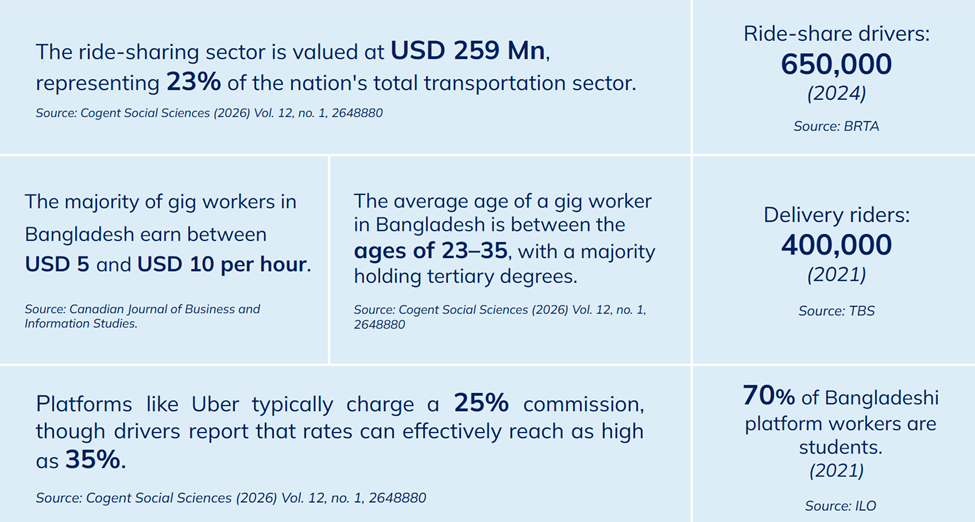
Figure: Key statistics of the platform economy in Bangladesh
Bangladesh’s platform economy also includes a fast-growing cloud-based digital-services workforce. However, their income patterns, working conditions, and policy needs differ significantly from those of location-based motorcycle riders logged into an app.
So, while the law has changed, what does this mean for thousands of ride-hailing or delivery platform workers? Many remain vulnerable to invisible algorithmic controls that bypass traditional legal oversight.
In practice, the Employment Injury Scheme Fund under Section 151A remains an instrument initially designed around the ready-made garment sector.
Road-based platform workers remain outside its current coverage despite facing significant accident exposure. The Bangladesh Jatri Kalyan Samity reported that motorcycles accounted for 41% of road deaths in March 2026.
There is also no portable, cross-platform benefits registry. A rider who works for Pathao in the morning and Foodpanda in the evening therefore cannot accumulate a single continuous entitlement record.
The amendment prohibits blacklisting outright under Section 195(1). However, it provides no mechanism for reviewing algorithmic account-throttling that can produce a similar outcome without a formal record.
Each of these is a genuine gap, and further rulemaking may address them over time. However, none most directly shapes a rider’s day-to-day working life.
That is determined elsewhere: by how the pay algorithm works and how many hours a person must remain logged into an app to earn a liveable income.
The platform economy is marketed as a frontier of “be your own boss” flexibility. Yet, for thousands of riders weaving through traffic for these platforms, this autonomy can become an economic mirage.
The “piece-rate trap” underpins this sector. This payment structure compensates workers per delivery or per kilometre rather than for their time.
Per-kilometre rates may account for time spent. However, platforms largely do not disclose how they value the time workers spend searching for a task, waiting, travelling to it, and completing it.
This lack of transparency makes it difficult for workers to predict their effective earnings accurately. Time spent waiting for a task or navigating traffic to reach one may go unpaid. This creates an invisible pool of uncompensated labour.
Traditional employment guarantees a wage floor for every hour spent on the clock. By contrast, the piece-rate model shifts most operational risk onto the worker. Headline earnings therefore provide an incomplete measure of what workers actually earn.
This distinction matters because workers also bear many of the costs of generating that income.
Fairwork Bangladesh accounts for expenses such as fuel, vehicle maintenance, mobile data, commissions, and other work-related costs when calculating effective earnings. Its 2023 study covered 113 platform workers across 11 platforms.
The study found that 20 workers had net standardised income below the minimum-wage threshold used in the assessment. Seven recorded negative net income after work-related costs.
These findings come from an interviewed sample rather than the entire platform workforce. However, they demonstrate the gap that can exist between gross platform earnings and actual take-home income.
The result is that flexibility can also transfer greater income risk to workers. When demand is weak, assignments are scarce, or workers lose time to traffic and waiting, they may have to absorb the loss. At the same time, they must continue paying the costs of remaining active.
Fairwork’s findings also show that some workers compensate for low effective earnings by working substantially longer hours.
The issue, therefore, is not that platform work necessarily pays less than every conventional job. Rather, the piece-rate model makes the relationship between working time, costs, and income less transparent.
It also shifts more of the risk of securing an adequate income onto workers. Understanding this distinction is essential when assessing whether improvements in the platform economy have translated into genuinely fairer pay.
The gap between headline earnings and net platform income is a well-documented pattern.
Fairwork Bangladesh annually rates selected local location-based platforms against five principles: fair pay, fair conditions, fair contracts, fair management, and fair representation.
In its earliest assessment in 2021, none of the ten major platforms, including Pathao, Uber, and Foodpanda, scored above one point out of ten.
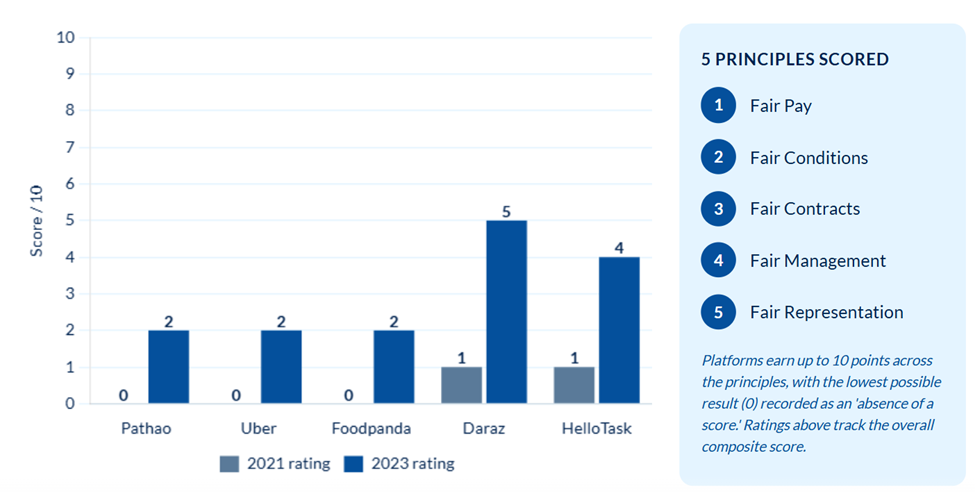
Figure: Scores (out of 10) of Selected Platforms Assessed in Fairwork Bangladesh Ratings (DataSense & Oxford Internet Institute)
Even stronger performers in the latest 2023 round remained short of a strong score on Fair Pay specifically. Daraz scored around five out of ten overall, while HelloTask scored around four.
Under Fairwork’s methodology, each of the five principles, including Fair Pay, carries two points. Platforms typically earn the first point by meeting basic wage conditions. They earn the second only by demonstrating that workers receive at least the local living wage.
Across successive Fairwork reports, the pattern remains consistent. Legal recognition has advanced year by year, while pay structures have largely failed to clear the second, living-wage threshold.
Classical labour supply theory suggests that declining wages should eventually reduce labour supply. As work becomes less attractive relative to leisure, workers should supply fewer hours.
Bangladesh’s platform economy, especially in congested cities like Dhaka, demonstrates a different dynamic.
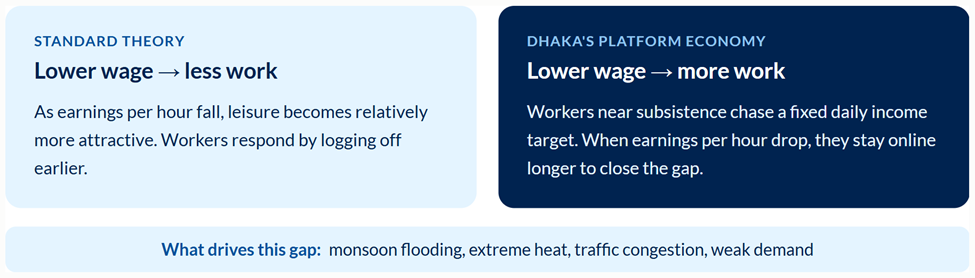
This reversal comes down to what workers are optimising for. Because many operate at or near subsistence levels, their main constraint is a fixed daily income target rather than a fixed number of working hours.
When effective hourly earnings decline because of monsoon flooding, extreme heat, traffic congestion, or weak demand, workers do not necessarily log off earlier. Instead, they may extend their working hours to compensate for lost earnings.
Platform incentive structures reinforce this behaviour. Rather than simply responding to market demand, commission systems actively shape labour supply.
For example, platforms often differentiate commission rates between peak and off-peak periods. This increases the economic penalty of working outside high-demand windows.
In addition, some daily trip incentive structures reduce commission rates as workers complete more trips on the same day. These incentives encourage riders to remain online longer to unlock more favourable earnings.
For workers who have already fallen behind their daily income target, this can create a cycle of extended working hours. In some cases, these hours may exceed 100 per week simply to maintain a basic standard of living.
This cycle becomes particularly dangerous during extreme weather.
During monsoon flooding, storms, or heatwaves, delivery demand often spikes. Platforms may respond by raising rates or offering surge-pay incentives to attract riders.
Workers chasing a fixed daily income target may find these incentives difficult to refuse, even when conditions are hazardous. Riders may therefore remain online precisely when they face the greatest risk because that is when earnings are highest.
This problem is neither isolated nor without precedent. It forms part of a broader pattern in which the piece-rate model transfers risk onto workers while obscuring the true cost of their labour.
Addressing it requires moving beyond the current regulatory framework. Reform has so far focused on organising rights without directly engaging with the underlying pay mechanism.
This gap is not unique to Bangladesh, and other jurisdictions have already started addressing it.
Several have tested mechanisms that speak directly to the problem. These range from algorithmic disclosure and portable benefits to weather-linked protections.
A more complete response from policymakers and regulators would need to address the pay mechanism directly. It would complement the organising rights already extended through the 2026 labour law amendment.
| Strategic Provision for Bangladesh | Global Comparative Model | Key Mechanism of Success | Policy Justification & Context |
| Algorithmic Transparency & Human-in-the-Loop | EU Platform Work Directive (2024) | Mandatory disclosure of how algorithms assign tasks and set pay; bans automated suspension without human review. | Prevents shadow banning by ensuring every disciplinary action is explainable and appealable to a human manager and legal courts. |
| Portable Benefits & Multi-App Social Security | India: Code on Social Security (2020) | Aggregators contribute 1–2% of turnover to a National Social Security Fund linked to a worker’s Universal Account Number (UAN). | Requires a national database and registry of platform workers as a first step; without it, credits cannot be tracked across platforms. Once in place, this registry allows insurance and pension credits to follow the worker even if they switch between platforms (e.g., Pathao to Foodpanda) |
| Sector-Specific Injury & Commuting Insurance | Singapore: Platform Workers Bill (2024) | Requires platforms to provide the same level of work-injury compensation as traditional employers for “on-the-road” accidents. | Addresses the gap left by the Employment Injury Scheme Pilot by identifying and protecting against sectoral operational hazards, which may vary depending on the type of platform work. |
| Fair Pay Floor & Expense-Linked Minimums | Australia: “Closing Loopholes” Act (2024) | Empowers the Fair Work Commission to set minimum standards specifically for “employee-like” platform workers. | Ensures base pay covers the real-world costs of fuel volatility, insurance, and vehicle maintenance in an 8-hour a day window. |
| Public Red-Alert Safety Overrides | New York City: Delivery Worker Laws (2022) | Legally mandates that platforms cannot penalise workers for refusing trips during “Extreme Weather Events” declared by the city. | Neutralises psychological compulsion to work in extreme weather events by banning surge-pay incentives during heavy rain, storms or severe heatwaves. |
| Training & Rights Awareness Programs | ILO-BMZ Gig Economy Initiative / Digital Opportunity Trust (DOT) Kenya: Gig Workers’ Courses | Government-NGO partnerships (e.g., Bangladesh Labour Foundation) to provide modular, vernacular training on legal rights and digital literacy. | Empowers workers to document algorithmic bias, utilize formal grievance procedures under the new BLA Amendment and learn digital skills, financial literacy, and soft skills – needed to navigate the platform economy. |
Table 2: Global Comparative Models for Platform Work Regulation: Strategic Provisions for Bangladesh
Several of these approaches map directly onto Bangladesh’s specific gaps.
In June 2026, the ILO adopted its first binding global standard for this issue, the Decent Work in the Platform Economy Convention (No. 193). It sets baseline protections for platform workers regardless of how they are classified.
Bangladesh had already identified many of the same gaps. In its 2025 report, the Labour Reform Commission recommended a universal worker definition, a digital labour ID system, and specific protections for gig workers.
The eventual ordinance reflected only part of those recommendations. Fuller implementation is now expected to depend on the accompanying Labour Rules amendment, which remains under discussion.
Singapore’s Platform Workers Bill closes the road-injury coverage gap that Section 151A leaves open.
A turnover-based contribution modelled on India’s approach could also fund injury and old-age coverage. It could do so without cutting into the piece-rate income workers depend on to meet their daily targets.
The 2026 BLA amendment is a genuine step forward. It arrives at a moment when getting platform labour policy right carries added weight.
Alignment with ILO Conventions 87 and 98 is connected to Bangladesh’s efforts to preserve trade preferences as it approaches LDC graduation.
The recognition acknowledges that, in the 21st century, an office is often a motorcycle and a boss is often an app.
It also suggests that the more consequential next step for regulators, platforms, and workers lies in how the underlying pay algorithm is structured and disclosed. The question is not only how the employment relationship is labelled.
Closing that gap would go a considerable way toward ensuring that legal recognition and material improvements in working conditions move together.
The article was authored by Areeba Rahman, Business Analyst, and editorial support was provided by Ainan Tajrian, Senior Business Consultant at LightCastle Partners. For further clarification, please contact here: [email protected]
Our experts can help you solve your unique challenges
Stay up-to-date with our Thought Leadership and Insights