




GET IN TOUCH
- Please wait...


Global AI adoption in the workplace has accelerated considerably over the past two years. According to ActivTrak’s 2026 State of the Workplace report, 80% of employees now use AI tools, up from 53% in 2023. Time spent in AI tools has increased eightfold over the same period. A separate analysis found that 91% of businesses report using at least one AI technology in 2025, and 92% plan to increase AI investment over the next three years. As AI tools become embedded in professional workflows, the shift is proving less dramatic and more incremental than early predictions suggested. For most knowledge workers, the transition is not about replacement but about reconfiguring how routine tasks are performed.
However, the nature of this adoption is worth examining. ActivTrak’s data indicates that AI is functioning as an additional productivity layer rather than a substitute for existing work. Among employees tracked before and after AI adoption, time spent on email increased by 104%, chat and messaging by 145%, and business management tasks by 94%. No measured activity category decreased. AI appears to be expanding the scope of what workers can do rather than reducing the volume of what they are required to do.

The Gap Between Adoption & Integration
A recurring finding across multiple studies is the gap between AI tool adoption and meaningful workflow integration. Gallup research indicates that only 15% of employees say their organisation has communicated a clear plan for integrating AI into business practices. Meanwhile, ManpowerGroup’s 2026 Global Talent Barometer identifies a notable paradox: regular AI usage increased by 13% to reach 45% of workers, while confidence in using technology fell by 18%. This growing uncertainty has contributed to a phenomenon described as “job hugging,” where 64% of workers plan to remain with their current employer rather than risk transitions in an uncertain market.
The data suggests that the primary barrier to productive AI integration is not technical capability but organisational readiness. A 2026 survey of 2,078 U.S. workers found that 45% have had to fix or redo work produced by a colleague who relied too heavily on AI, and 57% of managers report having corrected AI-generated outputs from their teams. These figures point to a training deficit rather than a technology deficit: employees have access to AI tools but often lack the guidance to apply them effectively.
What effective AI Integration Looks Like in Practice
Effective AI integration in knowledge work tends to follow a pattern. Rather than wholesale automation of job functions, it involves identifying discrete, time-intensive tasks that are structured enough for AI to handle reliably. In consulting, research, and advisory contexts, this includes tasks such as:
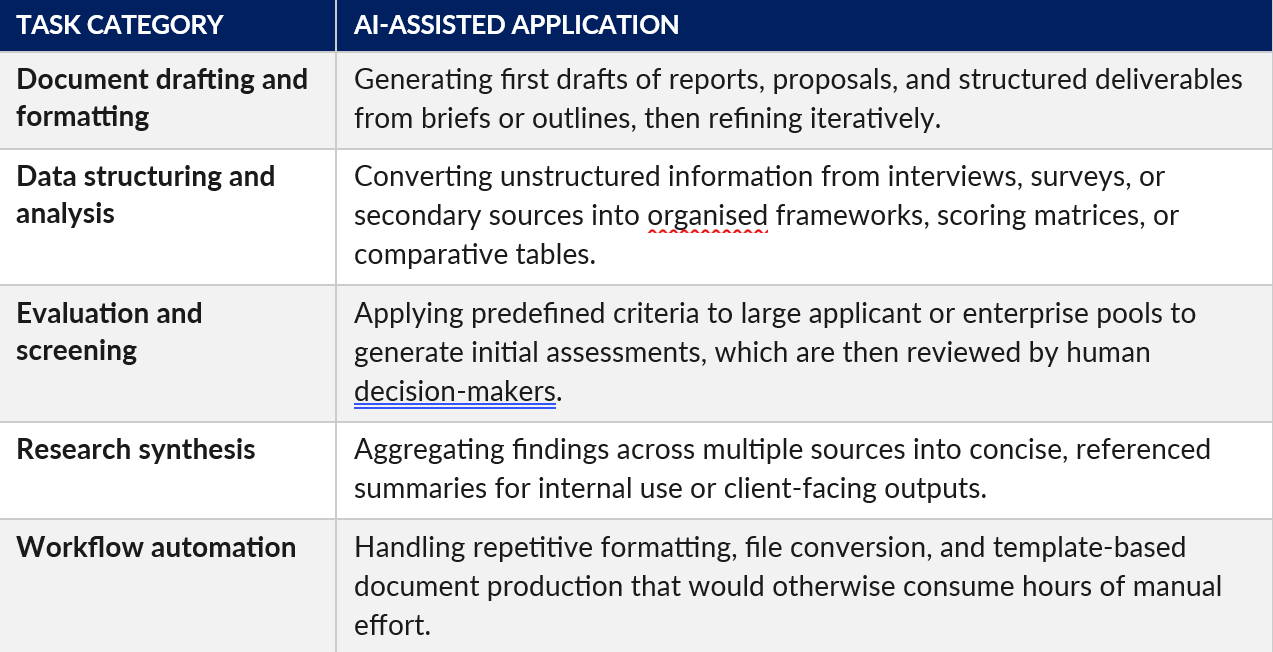
The emergence of “vibe coding” — a term coined by AI researcher Andrej Karpathy in early 2025 to describe building software through natural language prompts rather than traditional programming — illustrates this shift. By mid-2025, Y Combinator reported that 40% of its newest batch was using some form of AI-assisted coding methodology. The practice has since expanded beyond developers: product managers, researchers, and consultants are using conversational AI interfaces to produce functional tools, dashboards, and automated workflows without formal engineering training.
Karpathy himself updated the framing in February 2026, noting that LLM capabilities had advanced beyond his original concept of AI-assisted prototyping. His revised preferred term, “agentic engineering,” describes a workflow where the user orchestrates AI agents and provides oversight rather than writing code directly. The distinction is important: the human role shifts from execution to direction, but does not diminish.
From a Displacement Narrative to an Implementation Framework
Much of the public discourse around AI and employment has been framed in displacement terms. Forecasts of hundreds of millions of jobs at risk have contributed to widespread anxiety. However, the emerging evidence presents a more nuanced picture. Gallup data shows that 45% of employees using AI report improvements in productivity and efficiency. Research compiled by Azumo indicates that industries with higher AI exposure have experienced 10% productivity gains, 3.9% job growth, and 4.8% wage growth compared to less-exposed sectors.
The analogy is not automation replacing manual labour; it is closer to the adoption of spreadsheet software in the 1980s and 1990s. Accountants were not replaced by Excel — but accountants who could not use Excel were eventually replaced by those who could. The same dynamic appears to be emerging with AI: the tool augments the worker’s capacity rather than substituting for their judgement, but proficiency with the tool becomes a baseline professional expectation.
The critical variable, across all available data, is training. Forty-eight percent of employees rank training as the most important factor in successful AI adoption. Yet organisational investment in AI literacy remains inconsistent. The gap between tool availability and user competence is where much of the friction — and the anxiety — currently resides.
Implications for Bangladesh
These global trends carry particular relevance for Bangladesh. The country’s draft National AI Policy 2026–2030 acknowledges that AI adoption remains “nascent and largely concentrated in isolated pilot projects within fintech, e-commerce, and academic research.” The policy identifies AI literacy and skills development as a critical priority, noting that awareness and technical expertise “remain limited among youth, professionals, and policymakers.”
The scale of the challenge is significant. A recent analysis in The Business Standard noted that Bangladesh is not mentioned once in Stanford University’s 2026 AI Index, a 423-page global audit of AI development. South Asia as a region has only two state-backed AI supercomputing clusters, compared to 44 in Europe and 85 in China. Research by the Bangladesh Institute of Development Studies indicates that approximately 33% of educated unemployed individuals lack the digital skills needed to secure employment — a gap that is likely to widen as AI tools become more prevalent.
At the same time, there are grounds for measured optimism. Bangladesh has a young population — approximately 47% under the age of 25 — and a growing digital services sector. The country’s EdTech market is projected to grow from USD 358 Mn to USD 2.56 Bn by 2033. The practical question is whether AI literacy programmes can scale quickly enough to convert demographic potential into productive adoption. The experience of other emerging economies suggests that targeted interventions — integrating AI familiarity into existing vocational training, professional development, and university curricula — are more effective than standalone digital literacy campaigns.
Looking Ahead
The available evidence suggests that AI’s impact on professional work is following an integration trajectory rather than a displacement trajectory. The technology is not eliminating jobs so much as reshaping how tasks within those jobs are performed. For organisations and individuals, the strategic priority is not whether to adopt AI tools but how to develop the institutional capacity and individual competence to use them effectively.
For Bangladesh, this reframing carries practical implications. Policy efforts focused exclusively on high-level AI governance or advanced R&D infrastructure, while important, may not address the more immediate need: equipping the existing workforce with the literacy and confidence to integrate AI into their daily professional practice. The gap between access and application is where the most consequential interventions are likely to occur.
This article was authored by Parisa Omar, Business Consultant at LightCastle Partners. For further clarifications, contact here: [email protected].
Our experts can help you solve your unique challenges
Stay up-to-date with our Thought Leadership and Insights