



GET IN TOUCH
- Please wait...


The emergence of Bangladesh as the second-largest online labour supplier in the world [i], with approximately 650,000 registered freelancers, contributes an estimated USD 500 million annually to the economy [ii]. The foundation for this growth came from a specific and replicable strategy: entering the global cloud work market through high-volume, standardised digital tasks. Graphic design, web design, digital marketing, data entry, and content creation gave a generation of young Bangladeshis a route into the international economy without migration.
While this has been a rational growth strategy, it has enabled employment and market access for many. The question now is how this strategy will evolve with the shifting tides in the cloud market.
In standard description, the freelance economy in Bangladesh is treated as a single sector. However, it is better understood as a few structurally distinct segments. These range from templated and repeatable work to iterative and configurable work to architectural and judgement-intensive work. All segments fall under the umbrella of the freelance economy, but face AI differently. They also need to be dealt with differently.
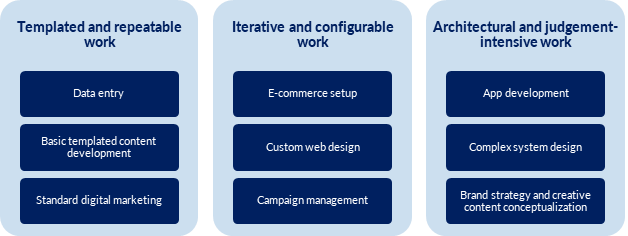
Figure 1 Types of Freelancing Work
The AI Occupational Exposure (AIOE) Index of the World Bank found that the overall mean AI exposure score of Bangladesh sits at 43 out of 100, below the global average of 47. This reflects the country’s current occupational mix, dominated by agriculture and lower-skill services [iii]. The study also found that workers with post-secondary education are most exposed to AI. With Bangladesh’s active freelance workforce being 80.8% tertiary-educated [iv], the country’s freelancers face a higher AI exposure profile. AI exposure indicates the potential for further impact. However, the nature of the impact could differ based on the level of complexity and human dependency of the work. This requires a tiered approach to understanding AI exposure across different freelance work segments.
The high-substitution effect of AI is where the global evidence of AI-driven compression is clearest. In the short term, a 21% decrease in job posts has been noted for writing and content-related categories within eight months of ChatGPT’s introduction, alongside a 17% decrease in image-creation job posts following the launch of image-generating AI tools [v]. The remaining jobs in these affected categories shifted toward greater complexity and higher pay. This further increased the divide between high-skill, high-wage jobs and low-skill, low-wage jobs.
At the spending level, the share of business expenditure directed to freelance labour marketplaces fell from 0.66% in Q4 2021 to 0.14% by Q3 2025, while spending on AI model providers rose from near zero to approximately 3% over the same period, with more than half of previously active platform buyers having exited freelance marketplaces entirely by 2025 [vi]. The categories facing the sharpest decline are logo design, basic copywriting, social content, and simple data entry; the templated and repeatable work.
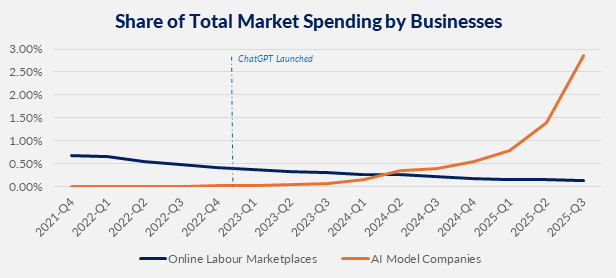
Figure 2 Global business spend shifting from freelance marketplaces to AI model providers, Source: Ramp Economic Labs (2026) [vii]
The scale of that broader shift is substantial. It is estimated that approximately 57% of current work hours in the USA are already technically automatable, driven by the rapid capability expansion of AI agents [viii]. More than 70% of skills currently demanded by employers are used in work activities that are both automatable and non-automatable, meaning the exposure is rarely binary. Most skills face partial rather than full automation pressure, as AI system enhancement is still an ongoing process. AI-augmented work is gaining traction, with increased demand for AI data annotation and labelling and AI video generation and editing [ix]. This presents the nuanced exposure to AI across the three categories of work.
For Bangladesh’s freelancers, this non-binary framing is important. Some of the templated and repeatable work and the iterative and configurable work face automation of their core deliverables. Architectural and judgement-intensive work faces automation of its lower-complexity inputs. Human judgment remains the value-add at each tier’s upper end. With creative content development as one of the leading outputs created by Bangladeshi freelancers, this inference clearly directs toward the importance of moving up the value chain. This means shifting to AI-augmented content development while keeping pace with market demand and the possible productivity gains.
Web development and app development, Bangladesh’s other major freelance concentration, sit in a materially different position. The mechanism is specific: web development tasks involve system architecture, code integration, debugging, and client-directed customisation. These require ongoing coordination and evolve dynamically across a project. For this category of work, AI functions as a productivity accelerator rather than a task substitute. Upwork’s In-Demand Skills report of 2026 corroborates this direction, with AI integration and AI chatbot development among the fastest-growing sub-skills within coding, suggesting demand is concentrating in AI-adjacent development work [x].
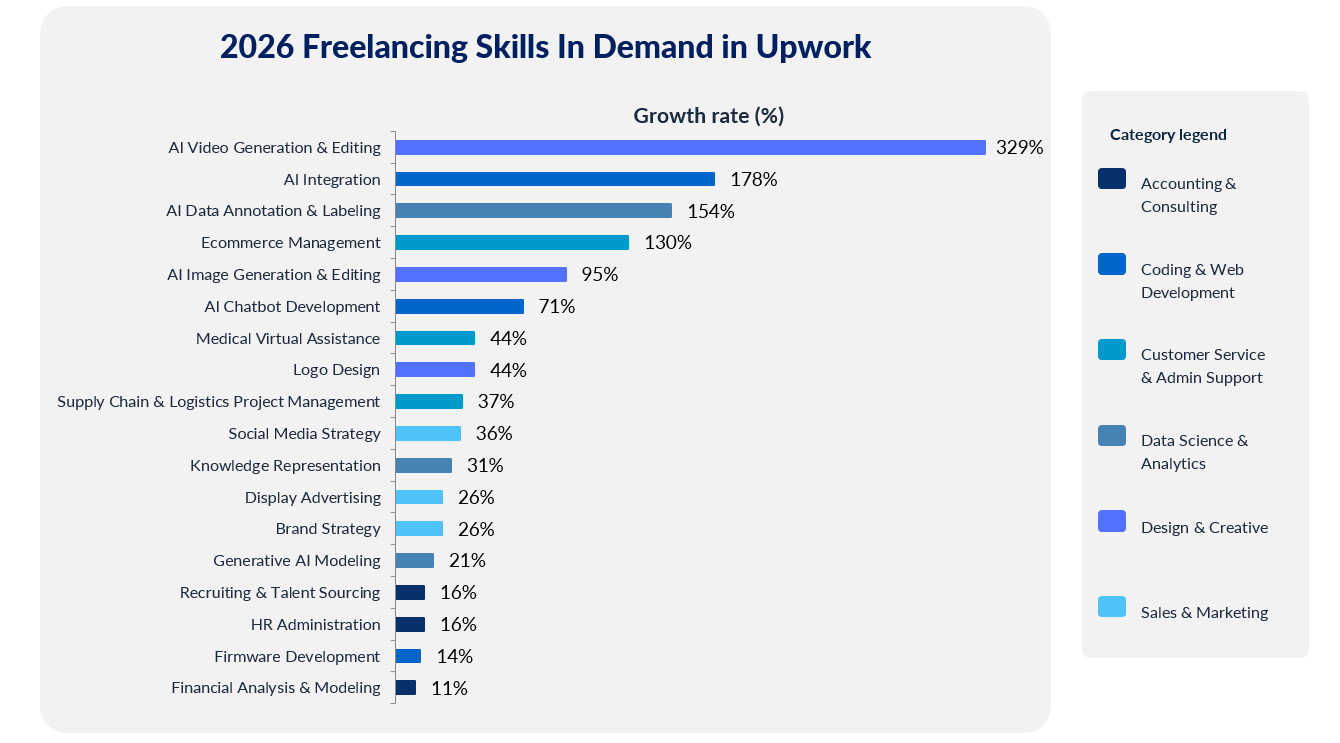
Figure 3 Fastest Growing Skills by Category in Upwork, for 2026, Source: Upwork (2026) [xi]
Within development work, AI exposure has created layers of differentiation. Tools such as Lovable, Bolt, and AI-assisted coding environments now handle functional frontends and template-level web builds from natural language prompts. These tools encounter consistent limitations as project complexity grows. Custom logic, complex state management, security implementation, and enterprise-grade integrations require substantial human intervention. The result is a working distinction within development:
The critical observation for Bangladesh is that a strong and pivotal shift is required for the country to promote and scale skill development measures toward the configurable and architectural layers. It also needs to enhance capacity for AI integration for the template-execution layer. With a high concentration of freelancers from tertiary education, this shift also needs to be integrated into the curriculum of universities and skills training providers. This means embracing the augmented use of AI while putting architectural and human-dependent skill building at the core.
Bangladesh’s largest public skills programme for freelancers, the ICT Division’s Learning and Earning Development Project, trained 53,000 freelancers in its first phase, with course categories concentrated in graphics design, web design, and digital marketing [xii]. These were rational interventions for the 2016–2023 market, but less well matched to 2026. Web design training at that phase targeted template-level tasks such as WordPress and CMS implementation, precisely the layer that AI builders now handle most competently. Similarly, digital marketing training created a pipeline into social media management that AI content tools now automate at the output layer. The newer initiatives are addressing the need to concentrate on AI-based training.
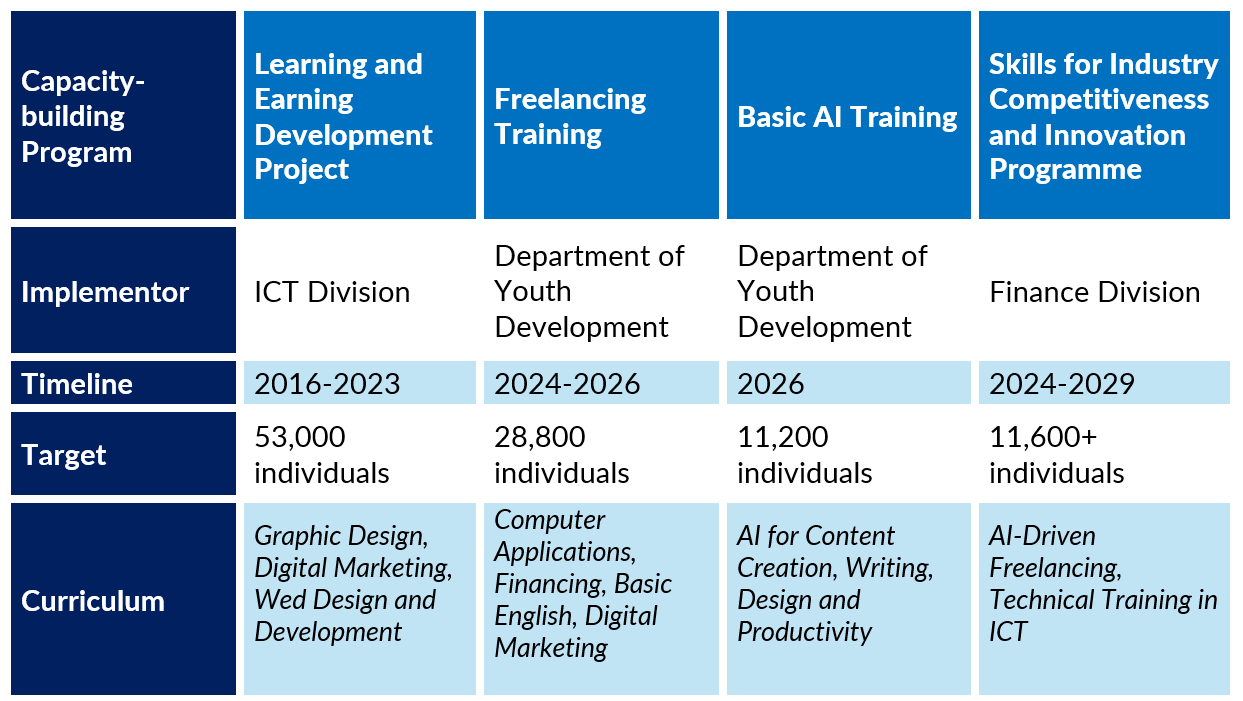
Table 1 Some government-run programs on freelancing or AI-driven skills
While such initiatives are appreciable, the focus on market demand-specific upskilling preparedness has yet to gain scalability, especially considering the existing 650,000 freelancers. The focus is more towards expanding the freelancing workforce, with some programs still specializing in basic freelancing skill development to enable market entry.
To cater to the upskilling gaps, some private training providers have moved faster into advanced curricula, but they reach a fraction of the workforce served by government programmes. Currently, there is also no common credentialing framework connecting private training outcomes to platform-visible skill signals.
While not necessarily a freelancing skill preparedness focus, the tertiary education arena is also adopting a few measures to enhance the capabilities of graduates in leveraging AI for productivity and labour market alignment:
These shifts in the tertiary education system indicate movement in the positive direction toward a market-ready workforce. The effectiveness of such shifts will depend on the comprehensiveness and market alignment of the curriculum and its dynamism in addressing the rapidly evolving market scenario.
The direction of travel, from template-execution and routine digital tasks toward AI-complementary, higher-value cloud work, was always the correct long-term trajectory for Bangladesh’s freelance economy. What has changed is the urgency. AI tools are compressing the template tier faster than institutional training cycles can respond. A few priority interventions could be considered.
Bangladesh built a globally significant freelance economy by mastering the tier of digital work most accessible to entry-level participants, and AI is now the most capable entry-level participant in that tier. The structural exposure to AI is real and concentrated in the creative and template-execution segments. It is also partially present within web development at its lower-complexity end.
The shift toward AI-complementary, architecture-tier, and tool-directed work has always been the right trajectory. What AI has done is compress the time available to make that shift deliberately, before the market makes it by default. Bangladesh needs to keep up and, to some extent, leap forward through proactive measures to meet the emerging needs of the market.
The article was authored by Ainan Tajrian, Senior Business Consultant at LightCastle Partners. For further clarification, please contact here: [email protected]
[i] OII. (2020). Online Labour Index 2020. Oxford Internet Institute. Link
[ii] Sultana, S. (2026). Bangladesh’s $500M Industry Growth, Gaps, and the Need for Social Safety Nets. Social Security Policy Support (SSPS) Programme of Government of Bangladesh. Link
[iii] Demombynes, G. et al. (2025). The Exposure of Workers to Artificial Intelligence in Low- and Middle Income Countries. World Bank Group. Link
[iv] Alam, M. et al. (2021). IT Freelancing in Bangladesh: Assessment of Present Status and Future Needs. Journal of Economics and Business, The Asian Institute of Research. Link
[v] Demirci, O. et al. (2023). Who Is AI Replacing? The Impact of Generative AI on Online Freelancing Platforms. SSRN. Link
[vi] Stevens, R. (2026). Payrolls to Prompts: Firm-Level Evidence on the Substitution of Labor for AI. Ramp Economics Lab. Link
[vii] Stevens, R. (2026). Payrolls to Prompts: Firm-Level Evidence on the Substitution of Labor for AI. Ramp Economics Lab. Link
[viii] Yee, L. et al. (2025). Agents, robots, and us: Skill partnerships in the age of AI. McKinsey Global Institute. Link
[ix] Liu, T. et al. (2026). Upwork In-Demand Skills 2026: A Market View of Skills Demand in an AI Economy. Upwork. Link
[x] Liu, T. et al. (2026). Upwork In-Demand Skills 2026: A Market View of Skills Demand in an AI Economy. Upwork. Link
[xi] Liu, T. et al. (2026). Upwork In-Demand Skills 2026: A Market View of Skills Demand in an AI Economy. Upwork. Link
[xii] BIRA. (2023). Impact Assessment of Learning and Earning Development Project (LEDP). Bangladesh Institute of Research and Advocacy. Link
[xiii] Hasan, M. R. (2025). Strategic education policy is key to a job-ready Bangladesh. The Daily Star. Link
Our experts can help you solve your unique challenges
Stay up-to-date with our Thought Leadership and Insights