


GET IN TOUCH
- Please wait...


Bangladesh’s working-age population reached 122 million in 2024. Yet, a 31.1 percent youth Not in Education, Employment, or Training (NEET) rate and a labour income share of just 48.5 percent of GDP reveal a sharper paradox: the economy is growing while its workforce is being left behind.1 Against this backdrop, Bangladesh’s orange economy is creating new opportunities for employment, entrepreneurship, and creative enterprise.
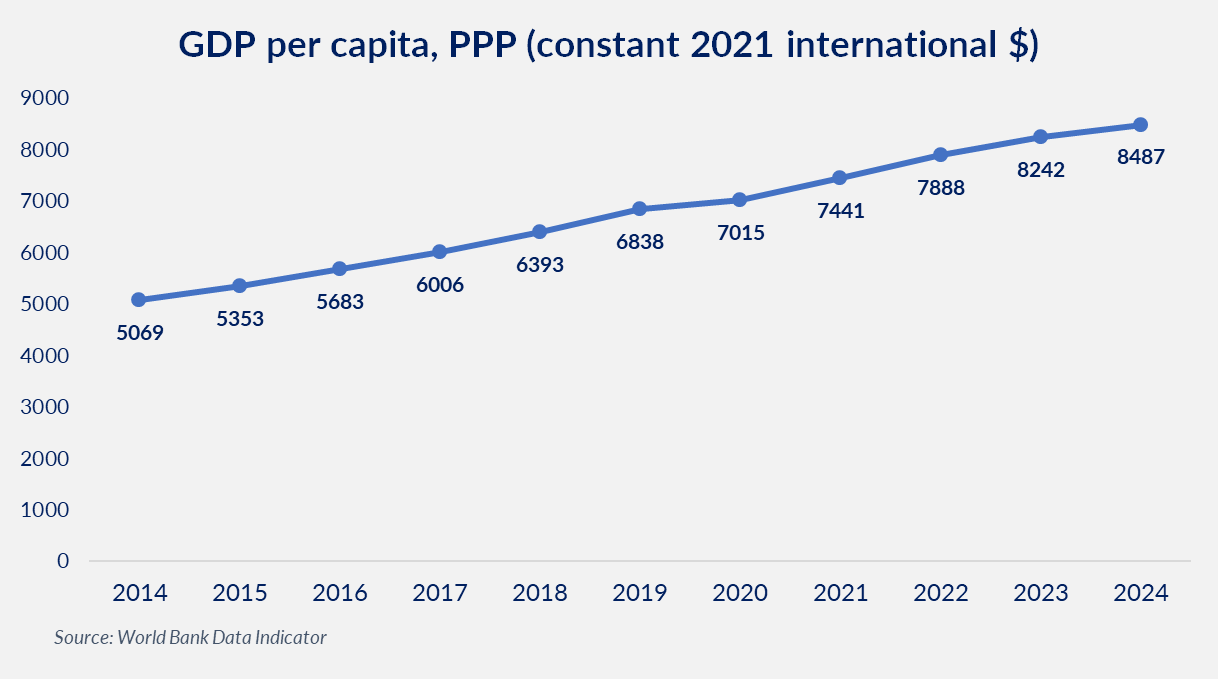
A sustainably growing economy generates expanding employment alongside expanding output. Yet Bangladesh faces a concern of formal paid employment, failing to keep pace with economic growth, leaving the economy increasingly exposed. If an external shock were to strike, the question is whether Bangladesh’s productive base, long supported by its youth population, retains the resilience to absorb it.
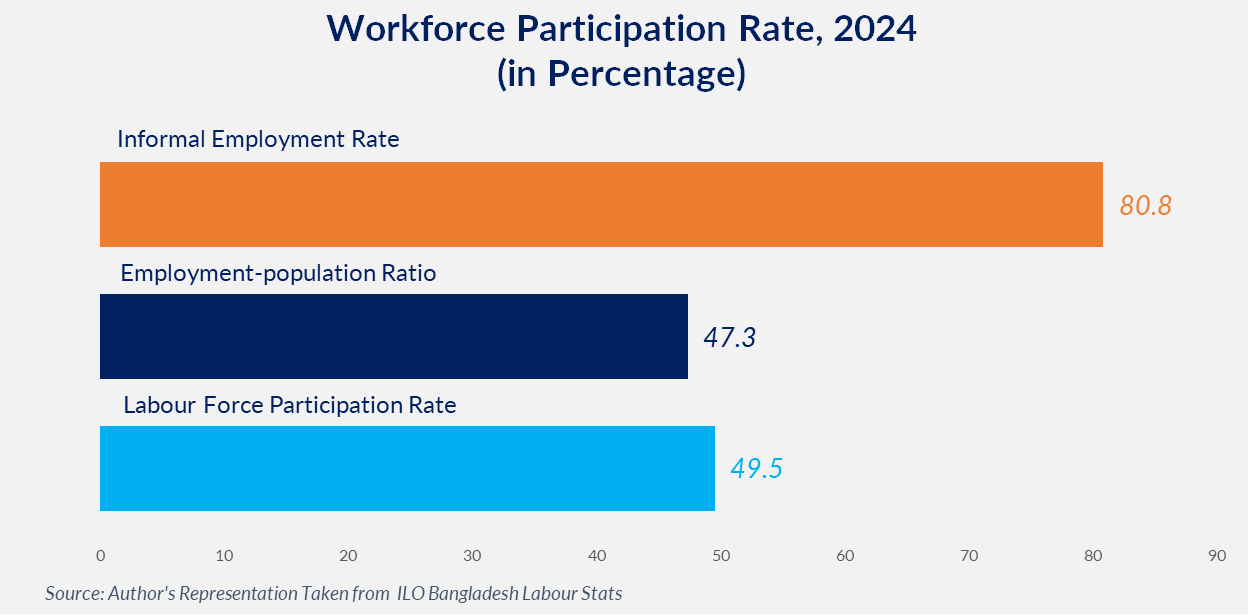
The labour force participation rate shows that roughly half the population engages in some form of income-generating activity, producing a moderate employment-to-population ratio on the surface. Yet the underlying composition tells a harsher story. The majority of employment growth is occurring in the informal sector, which means Bangladesh’s low unemployment numbers are masking an employment quality crisis.
It is within this landscape of rising informal employment that Bangladesh has quietly nourished an entirely distinct economic segment, one now drawing attention for its scale and speed, known as the Orange Economy.
The “Orange Economy” is mostly known as the range of economic activities within the cultural and creative industries. This term was co-coined by Iván Duque Márquez, former President of Colombia and Felipe Buitrago Restrepo, an economist and former Minister of Culture, who described it as a USD 4.3 trillion global “empire of the mind” that transforms creative ideas into intellectual property-driven goods and services. The World Bank uses the term interchangeably with creative and cultural industries, and by any measure, the sector is a formidable one globally, sustaining a labour force of 144 million workers while outperforming traditional sectors in resilience.2
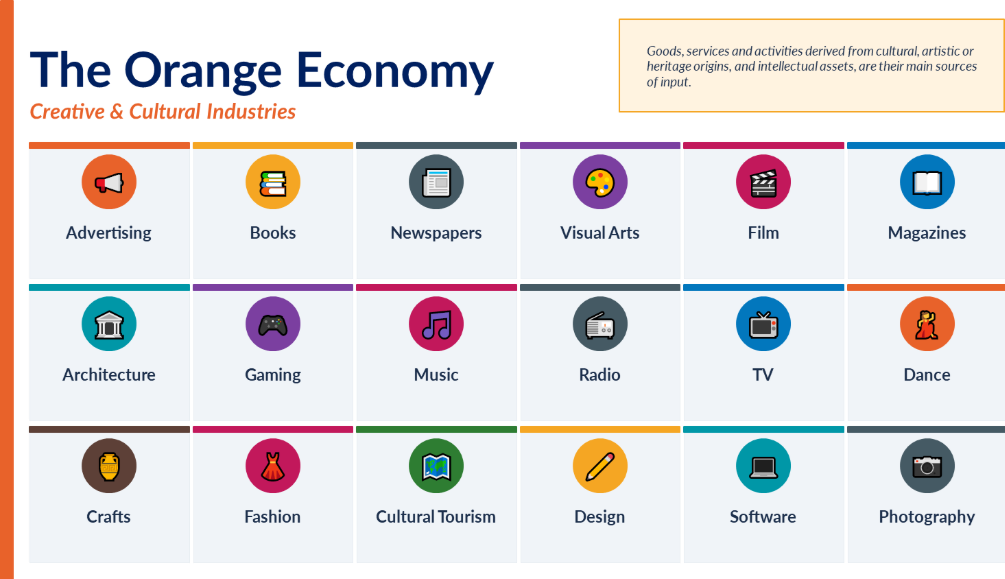
In Bangladesh’s context, this sector carries a significance that extends well beyond its current size. In a country where more than 80 percent of employment is informal, the Orange Economy became an organic absorber of labour that the formal economy has failed to reach. The Economic Census 2024 by the Bangladesh Bureau of Statistics found that employment in Arts, Entertainment and Recreation reached 112,829 in 2024, a 237 percent increase from just 33,441 in 2013.4
In Bangladesh, the orange economy integrates employment by serving as a rapidly expanding, though largely informal, engine for job creation that outperforms traditional sectors like agriculture and industry in terms of growth pace.
Bangladesh scored 6.7 out of 10 on the Human Flight and Brain Drain Index 2024,5 a figure that speaks directly to the economy’s failure to offer its educated and ambitious youth a credible future at home. Those who stay, unable to find formal employment worthy of their skills, are quietly turning toward self-employment, freelancing, and the creative trades that the Orange Economy encompasses. This is not a failure of ambition. It is an adaptive response to the ongoing gaps in formal labour markets, and it is generating measurable economic value that current frameworks simply do not count.
The rising generation of content creators, influencers, designers, artists, athletes, freelancers and storytellers is already economic actors, generating income, building audiences and contributing to output. Yet they remain largely classified as cultural contributors rather than productive workforce participants, leaving one of the country’s fastest-growing labour segments outside the core policy framework entirely.
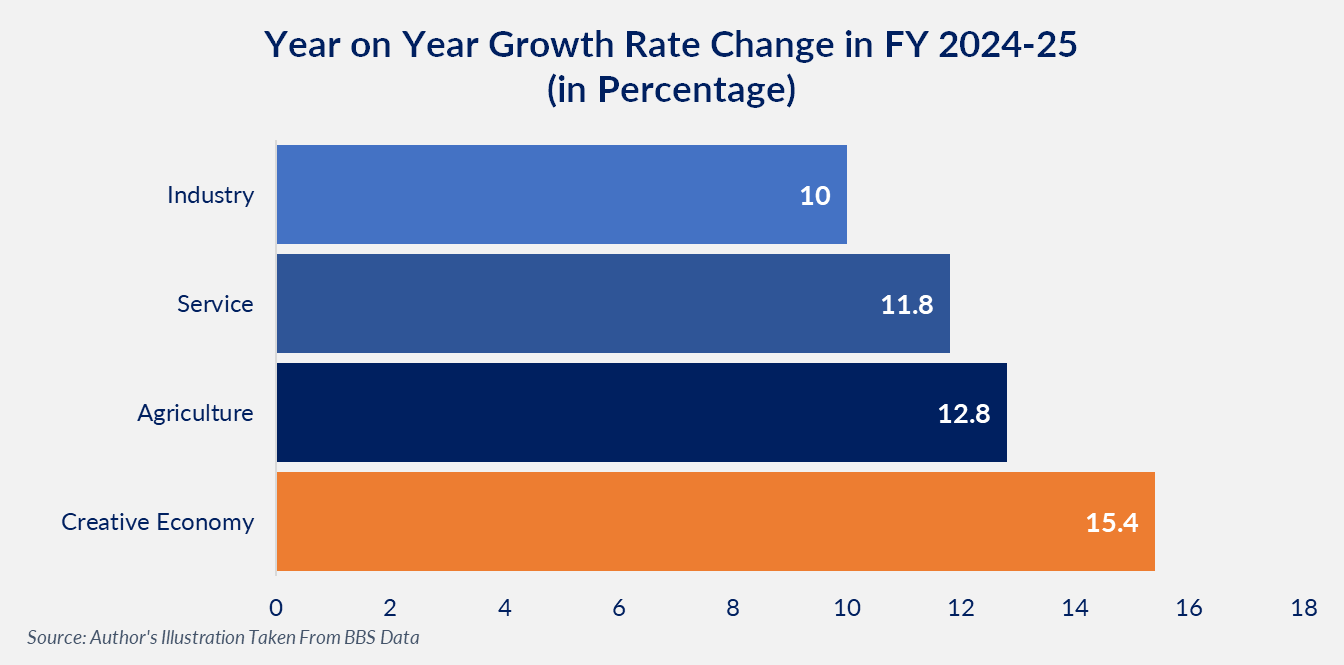
While the creative/ orange economy currently operates from a relatively small base, its growth rate outpaces traditional sectors like agriculture, services, and industry. This rapid expansion highlights that with strategic formalization, the sector is well-positioned to transform its high-speed momentum into a significant source of formal employment for the country.
The Orange Economy’s potential contribution to GDP and formal employment is considerable, yet informality continues to suppress what that contribution actually registers. At present, the sector accounts for just 0.17 percent of GDP6, a figure that understates its actual footprint, since the majority of its activity occurs in the informal economy and goes entirely uncounted by national accounts. A sector growing faster than any traditional engine of the economy is being consistently overshadowed by those very engines, simply because policy has not yet caught up with the reality on the ground.
To include entertainment, sports and recreation as part of the formal sector and ensure proper employment rights, the case of India’s entertainment industry offers an instructive starting point.
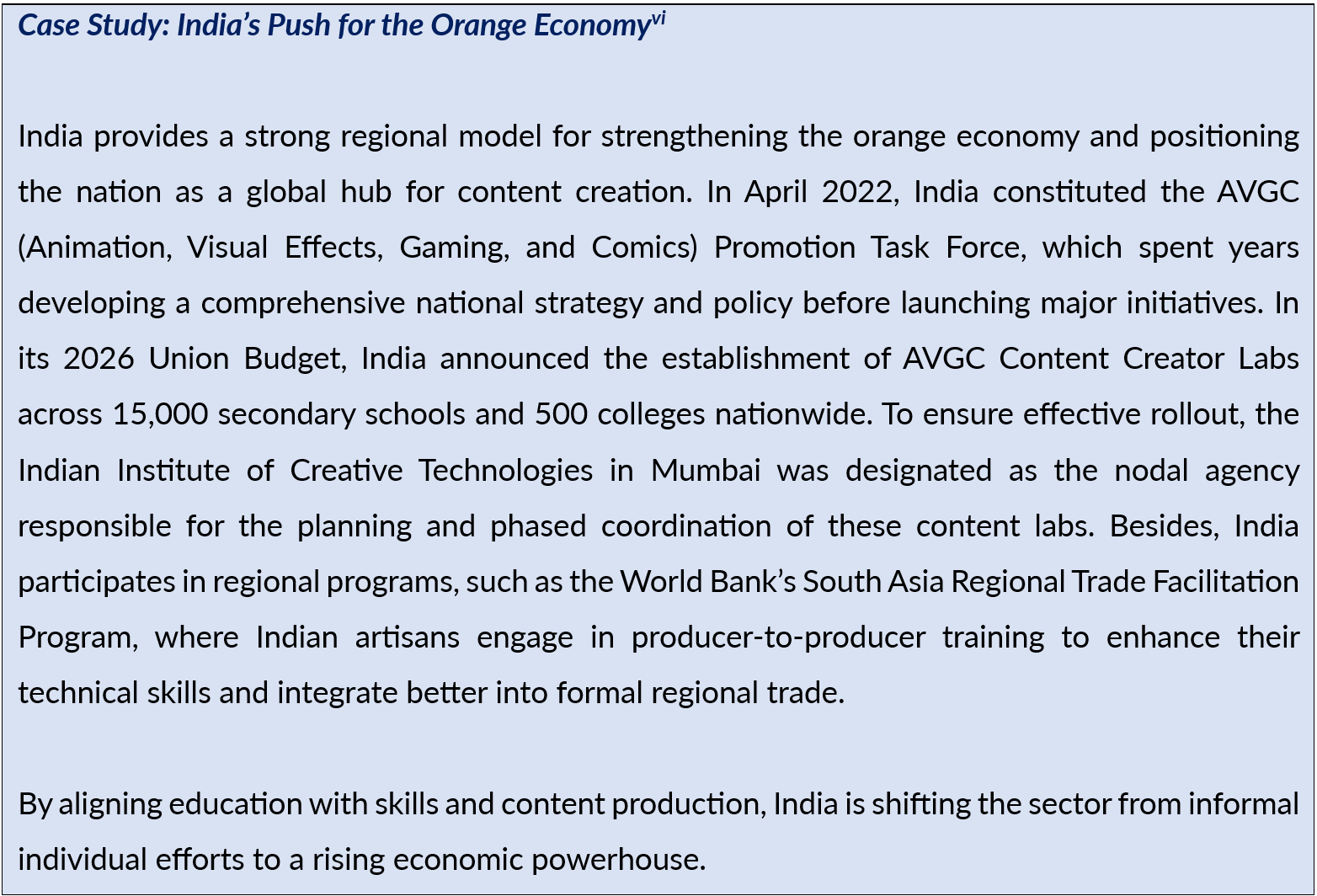
1. Establishing a national policy framework is the formal recognition of the sector under a national strategy. Creating a dedicated task force to develop comprehensive policies ensures that artists and athletes are viewed as economic actors rather than just cultural contributors.
2. Integrating social protections will help to address job insecurity; governments should integrate creative workers into national pension and benefit schemes. Successful models, such as Peru’s Artists’ Social Rights Fund, provide health care and social security to sector workers regardless of their specific employment relationship.vi
3. Professionalizing via certification and training will help formalize the sector. This will assist in moving beyond informal “craft” to professional commerce. This includes providing technical and vocational training that leads to official certification, as well as incorporating “art-preneurship” and financial management into curricula.
4. Improving data and mapping will help in formalizing the orange economy with accurate measurement. Governments can use the UNESCO Framework for Cultural Statistics (FCS) to collect comparable data, allowing them to estimate the sector’s scale and design effective evidence-based policies.
5. Supporting workplace safeguards should be mandated through training programs. These should include instructions on worker safeguard practices, such as the use of protective equipment and the implementation of health insurance plans, which are hallmarks of formal employment.
Bangladesh stands at an inflection point. The Orange Economy is not a future aspiration; it is an active, growing, and measurable reality already absorbing labour that the formal economy has failed to reach. A 237 percent employment surge in a single decade, occurring almost entirely without policy support, demonstrates the sector’s organic momentum. The question is no longer whether the Orange Economy matters; it is whether Bangladesh’s policy architecture will move fast enough to count it, protect it, and scale it before the window for any kind of reform narrows. The nations that formalize their creative economies earliest will hold a durable advantage in the global competition for talent, investment, and inclusive growth.
This article was authored by Sadia Karim, a Business Consultant at LightCastle Partners. For further clarifications, contact us here: [email protected]
Our experts can help you solve your unique challenges
Stay up-to-date with our Thought Leadership and Insights