


GET IN TOUCH
- Please wait...

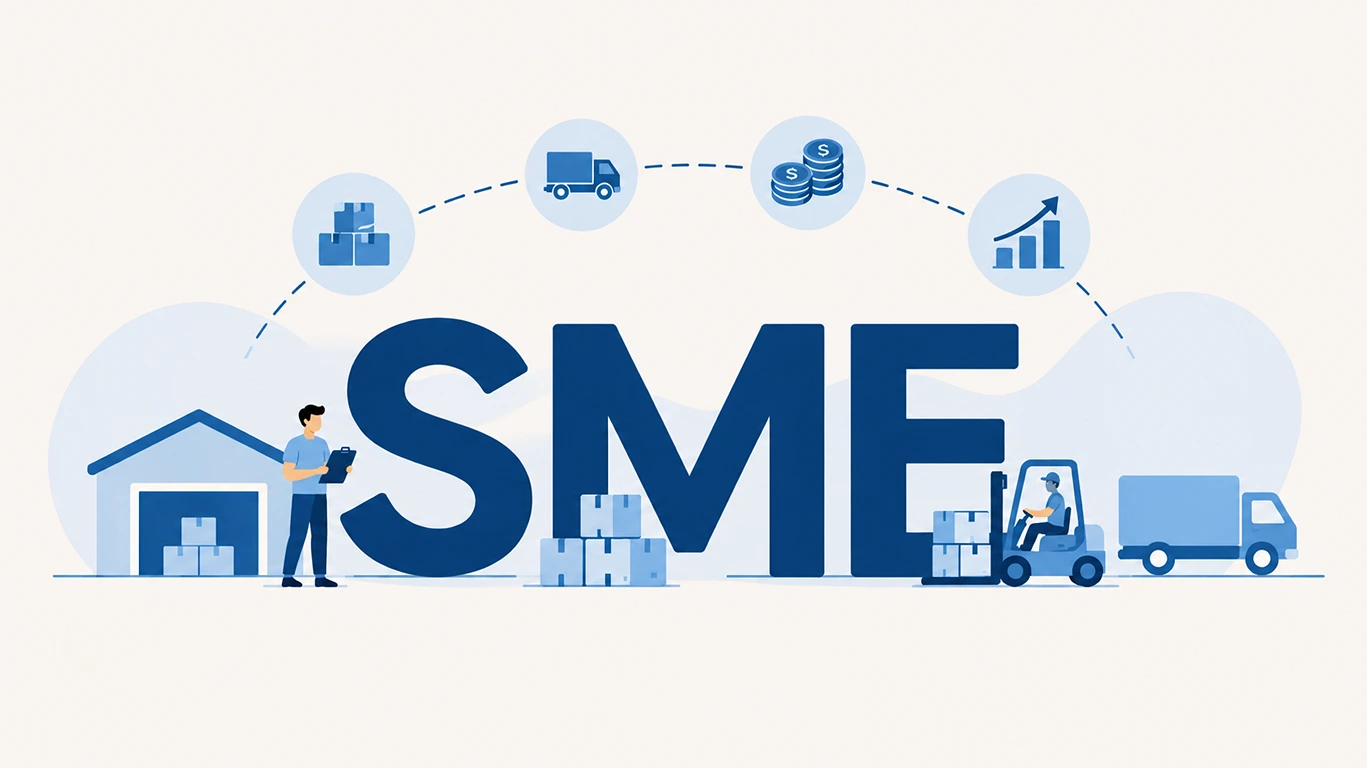
When we ask an SME owner in Bangladesh where most of their money is spent on, the answer is familiar. It’s usually the same few things, such as raw materials, employee salaries, utility bills, rent for warehouses and factories, etc. But for the most part, the supply chain goes unmentioned. However, an inefficient supply chain causes more loss than many of these obvious costs.
The supply chain needs to be thoroughly studied and executed by SMEs because of how it affects their overall business performance. Although Bangladesh’s cottage, micro, small and medium enterprises (CMSMEs) account for about 90% of industrial units and 80% of industrial employment, they only contribute about 27-30% of GDP.[1] Hence, when this sector underperforms, it inevitably affects the entire economy.
Many SME owners buy materials in bulk to fulfill large orders or because of the possibility of losing orders due to long lead times. Some of these materials stay in excess on the shelves for months. This blocks a lot of cash that could otherwise have been used for other purposes. Conversely, stocking out early causes enterprises to lose valuable orders and customers.
One of the most inefficient units of a supply chain is moving materials or parts from one place to another. A World Bank transport specialist said in 2025 that logistics absorbs 16% of Bangladesh’s GDP, against a global average of 10%, with 35% to 54% of that linked to inefficient transport systems.[2] An earlier World Bank study put logistics costs between 4.5% of sales for leather footwear and 47.9% for horticulture products, and found that 35% of truck trips ran empty.[3]
While large exporters and corporations are well equipped to quickly identify these supply chain mismanagements and correct them, a small firm does not have sufficient resources to do so. The World Bank estimated that a comprehensive package of logistics improvements could reduce logistics costs for tradable goods by 35% and increase Bangladesh’s exports by approximately 20%.[4] Logistics costs are built into the cost of every unit a firm ships, so cheaper and faster transport lets an exporter either cut its price or keep a larger margin, which is how lower logistics costs turn into higher exports. For a small firm that cannot absorb these costs as easily as a large exporter, that difference can decide whether it wins an export order.
Many small firms do not forecast actual costs; rather, they operate by paying for urgent necessities such as rush orders, faster shipping or the spot market. Moreover, small buyers often order small volumes from suppliers on verbal agreement, which adds to the costs when expected quality is not met or timely delivery fails. Not to mention, these small volumes or orders require them to pay more per unit as well. Likewise, reliance on a single supplier increases the risk of longer lead times, poor quality or failed delivery.
There is a significant gap between the cost of procuring raw materials and the final payment after delivering the orders to larger buyers. Most of the time, suppliers expect instant payment but larger buyers need longer to complete their payment. While some buyers pay 25-30% advance, the remaining cost still needs to be financed by the firm. It would be very helpful if this gap could be financed. However, formal financing options for SMEs are thin in Bangladesh. The Bangladesh Institute of Bank Management found that only 9% of banks’ trade finance reached SMEs in 2022, down from 10% in 2021, and that rejected applications are a major obstacle.[5] This causes SME owners to turn quickly to high-interest credit schemes, and the supply chain inefficiencies often go unnoticed.
Informal book-keeping and instinct-based decisions leave owners unaware of supply chain bottlenecks such as lead times, supplier reliability or landed cost per product. But with time, expectations of buyers are also rising. They prefer sourcing products from firms with better traceability and transparency. As Bangladesh prepares to move out of least-developed-country status (now deferred to November 2029), UNCTAD projects a 32% decline in the country’s total exports, with about 77% of the projected loss linked to the erosion of the EU’s duty-free access.[6] With tariff advantages fading, efficiency becomes one of the few ways left to defend price competitiveness.
The following steps may help an SME owner to understand and apply corrective measures to the hidden costs in a supply chain.
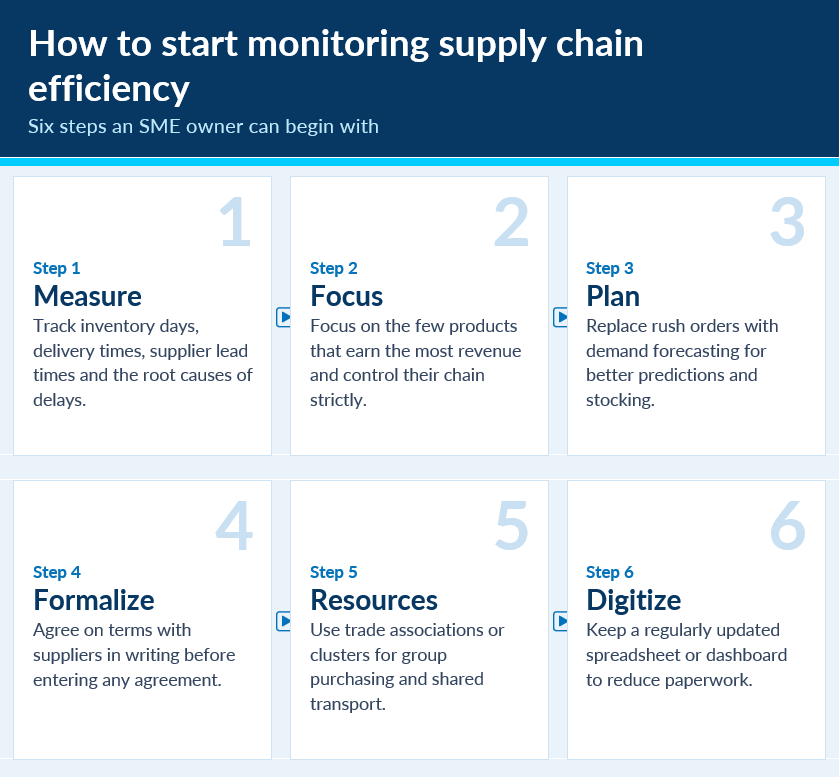
Supply chain inefficiency acts as a slow outage, rather than a dramatic failure. For this reason, in many businesses, this problem goes untreated. But the cumulative cost of trapped extra stock, order movements and lost orders can exceed many other obvious costs. For Bangladesh’s SMEs, the first improvements usually demand discipline rather than capital. And with rising competition in every sector, discipline might be the only attribute that sets apart the performance of a firm.
The article was authored by Naoshin Anzum Islam, a former Business Analyst at LightCastle Partners. For further clarification, please contact [email protected].
[1a] Friedrich Naumann Foundation. (2024, May 17). A brief overview of SMEs in Bangladesh: Challenges and the way forward. https://www.freiheit.org/bangladesh/brief-overview-smes-bangladesh-challenges-and-way-forward
[1b] LightCastle Partners. (2026, October). Financing Bangladesh’s SMEs: Bridging the capital gap through innovation and patient capital. https://lightcastlepartners.com/insights/2026/10/sme-financing-bangladesh-capital-gap/
[2] Star Business Report. (2025, August 17). Logistics costs eat up 16% of GDP. The Daily Star. https://www.thedailystar.net/business/news/logistics-costs-eat-16-gdp-3964946
[3] Herrera Dappe, M., Kunaka, C., Lebrand, M., & Weisskopf, N. (2020). Moving forward: Connectivity and logistics to sustain Bangladesh’s success. World Bank. https://documents1.worldbank.org/curated/en/465691618552426339/pdf/MovingForward-Connectivity-and-Logistics-to-Sustain-Bangladesh-s-Success.pdf
[4] The Business Standard. (2019, November 13). Reducing logistics costs could boost Bangladeshi exports by 20%: World Bank. https://www.tbsnews.net/international/business/high-logistic-costs-reduce-profits-businesses-bangladesh-world-bank
[5] Bangladesh Institute of Bank Management (BIBM). (2025, March). International trade finance and SME: Bridging the gap (Research Monograph No. 75). https://zarss-bibm.s3-ap-southeast-1.amazonaws.com/bibm_org/publications/publication_attachment/NOGOOVKRQkSnutlmleIbYj1Jc5nkRlBSmsjPkGhp.pdf
[6a] United Nations Conference on Trade and Development (UNCTAD). (2026). Trade preferences outlook 2025: Navigating in times of uncertainty. https://unctad.org/system/files/official-document/ditctsce2026d1_en.pdf
[6b] United Nations. (n.d.). Bangladesh graduation status. United Nations LDC Portal. https://www.un.org/ldcportal/en/content/bangladesh-graduation-status
Our experts can help you solve your unique challenges
Stay up-to-date with our Thought Leadership and Insights