


GET IN TOUCH
- Please wait...


Sustainability consulting is being reshaped by the retreat of public money, and Bangladesh, along with much of the Global South, sits on the fault line.
Climate change shows no sign of slowing, and by several measures it is getting worse. August 2026 was the hottest August ever recorded,¹ and 2026 is on course to be the second warmest year on record, possibly the warmest.² For two decades, sustainability consultants have been among those equipping governments, companies and communities to respond.
That support system is now weakening. Foreign aid is collapsing. The five largest donors all cut their aid in 2025, the United States most deeply, and the OECD expects a third straight year of decline in 2026.³ This hits climate action directly. Adaptation rarely earns a return, so poorer countries depend on public money from abroad to pay for it, and that money came to only $26 billion in 2023, according to UNEP.⁴ Cuts to aid are therefore also cuts to climate protection. The UN, which has carried the global climate agenda for three decades, is shrinking. ESG, the framework that brought sustainability into company boardrooms, has become a dirty word in Washington.
The shift is in who pays for sustainability work, and why. Much of it used to be funded by donors and governments to deliver public benefits. A growing share is now paid for by companies to meet their own commercial needs. Two figures from 2025 capture the shift. Rich countries cut foreign aid by 23.1 percent, the steepest fall the OECD has ever recorded.⁵ Yet global climate finance rose to a record of about $2.1 trillion, according to an early estimate by the Climate Policy Initiative.⁶
In short, money is leaving the parts of sustainability that serve the public good, while the parts that earn a return keep growing.
The retreat reaches well beyond aid agencies, to the institutions that research, convene and campaign on climate. The UN abolished about 2,900 posts this year.⁷ The Ellen MacArthur Foundation, a leading circular economy charity, has put jobs at risk, citing “a tougher funding climate.”⁸ Greenpeace is contesting a $345 million court judgment that it says could bankrupt its US arm.⁹ The White House has proposed cutting the National Science Foundation’s budget by more than half.¹⁰
The consulting market shows the same shift. Part of it stems from the public retreat itself. Verdantix, a London research firm that tracks the sector, now sizes the sustainability consulting market at about 70 percent of its earlier estimate, partly because of regulatory uncertainty as Washington rolls back climate rules and Brussels loosens its reporting law.¹¹ The wider staff cuts at KPMG, McKinsey and Accenture have other causes: AI lets fewer people do the same work, overall demand for consulting has flattened, and Washington has cut federal consulting contracts.¹²
The Global South feels it more sharply. In a 2025 survey of 364 African civil society groups, 38 percent of those funded by the US government had lost more than half of their budgets for the year.¹³ In Bangladesh, the US aid freeze suspended more than 100 projects worth $550 million and cost over 20,000 jobs. Large organisations that once ignored contracts under $2 million now compete for $100,000 projects, and many laid off professionals have turned to freelance consulting.¹⁴ The result is a crowded market, with more consultants chasing fewer contracts and selling much the same services.
Other crises have moved to the front of the queue, among them wars in Ukraine and Iran, an energy price shock, trade conflicts and heavy public debt. In the World Economic Forum’s Global Risks Report 2026, extreme weather fell from second to fourth place among the risks expected over the next two years, and geoeconomic confrontation took the top spot.¹⁵
The wars have pushed defence and energy security to the top of budgets. NATO allies have pledged to spend 5 percent of GDP on defence by 2035,¹⁶ and the Iran war all but closed the Strait of Hormuz in March.¹⁷
Washington has left the Paris Agreement, started withdrawing from the UN climate treaty that every other country belongs to, and rolled back clean energy tax credits.¹⁸ Europe, under populist pressure, has cut the number of companies covered by its main sustainability reporting law by about 90 percent.¹⁹ The Net Zero Banking Alliance, convened by the UN, shut down in October 2025 after the largest American, Canadian and European banks walked out.²⁰
Call it a painless stroke: serious damage, with no pain sharp enough to force a response. For most governments and companies, this is still business as usual. Floods and heatwaves make headlines, then fade from view. Underneath, the damage keeps building.
Carbon dioxide emissions from fossil fuels reached a record 38.1 billion tonnes in 2025, and at that rate the carbon budget for limiting warming to 1.5°C will be used up in about four years.²¹ UNEP projects 2.8°C of warming this century under current policies.²² Warm water coral reefs, on which nearly a billion people depend, are already passing their tipping point.²³ Carbon dioxide emissions are increasingly becoming a measurable business and policy concern.
The human cost is already visible. Heat killed about 546,000 people a year over the past decade, 23 percent more than in the 1990s, according to the Lancet Countdown.²⁴ Climate change caused an estimated 16,500 extra heat deaths in European cities in summer 2025 alone.²⁵ In Bangladesh, heat cost 250 million workdays and up to $1.78 billion in 2024.²⁶ Worse is coming. The WMO gives a 75 percent chance that average warming over 2026 to 2030 will exceed 1.5°C, and an 86 percent chance that one of those years will beat the 2024 record.²⁷ The ILO projects that heat will erase about 5 percent of South Asia’s working hours by 2030, the equivalent of 43 million jobs.²⁸ The World Bank estimates that climate impacts could force up to 19.9 million Bangladeshis to leave their homes for other parts of the country by 2050.²⁹
Until recently, sustainability consulting in the Global South ran on a simple model. Donors and development banks paid, consultants designed and ran programmes, and the goal was public impact rather than profit.
In Bangladesh, the Katalyst programme demonstrated how to fix markets instead of handing out inputs, and IDCOL’s solar home programme, built with donor money and technical advisers, brought electricity to more than 4 million homes.³⁰
But the model never finished the job. The voluntary carbon market, meant to fund clean projects in poorer countries, shrank to $535 million in 2024, about a quarter of its peak.³¹ A 2024 review found that cookstove projects had delivered real emission cuts equal to just 11 percent of the credits issued for them.³² Global negotiations have stalled as well. COP30 in Belém ended without any mention of fossil fuels in its main decision and set a distant 2035 goal for tripling adaptation finance.³³ Governments still spent $916 billion supporting fossil fuels in 2024, according to the OECD and the International Energy Agency, about three times the $300 billion a year that rich countries have promised developing countries in climate finance by 2035.³⁴
This is the real cost of the funding retreat. The markets, institutions and rules needed for a sustainable economy are only half built, and the people who were building them are losing their funding.
The market for sustainability consulting is still growing worldwide. Verdantix, counting sustainability advice alone, valued it at $12.4 billion in 2024.³⁵ Environment Analyst, which also counts environmental services such as impact assessment, put the wider market at $65.5 billion in 2025.³⁶ What has changed is who pays. Growth now comes mostly from companies protecting their revenue, assets and market access.
FIGURE 1: SERVICES THAT PROTECT REVENUE ARE GROWING AS PUBLIC GOOD WORK FADES
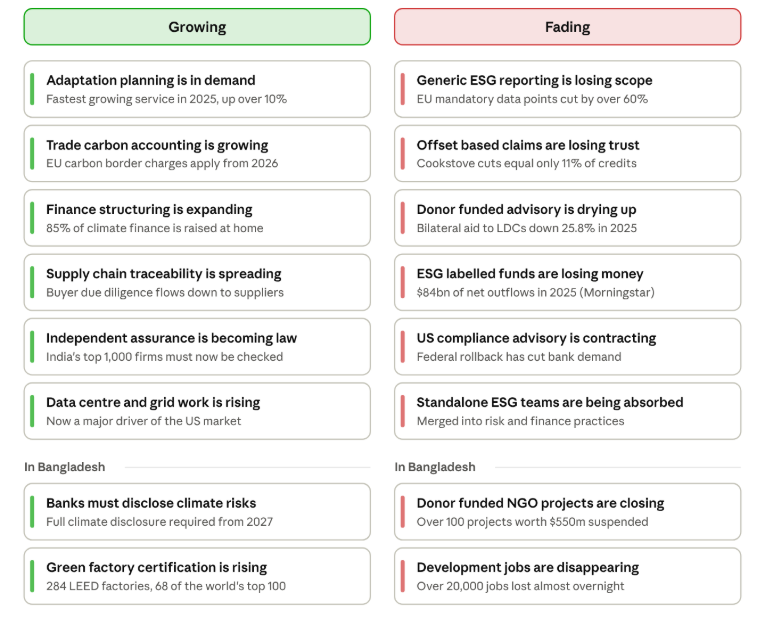
Source: Environment Analyst, European Commission, OECD, Climate Policy Initiative, Morningstar, SEBI, Bangladesh Bank, The Business Standard and Daily Observer (2025 to 2026).³⁷
The fading services mostly sold reassurance, such as reports, offsets and labels. The growing ones sell what clients cannot do without, such as market access, cheaper finance and assets that survive floods. Missing from both lists is the work nobody pays for, such as adaptation for poor communities, clean cooking and local institution building. A transformation led by whoever pays will follow the highest returns, and those rarely match the greatest needs.
As the clients change, so does the work itself, and with it the skills a consultant needs to stay relevant. Routine reporting is shrinking, and the demand that remains is more technical. A March 2026 study of sustainability hiring finds employers want greenhouse gas accounting, data analysis and sector knowledge, and that entry level roles are most exposed as AI takes over data cleaning and drafting.³⁸
When software drafts a report in hours, value moves to people who can check the numbers and turn them into investment decisions. India’s top 1,000 listed companies must now have their core sustainability data independently checked.³⁹ Consultants will need deeper technical skills, a move from writing reports to implementing projects and structuring finance, and, as verifiers, independence from the clients they check. Some firms are already moving. The engineering group WSP bought Ricardo, a UK consultancy with energy and environmental engineering expertise, for about £363 million in 2025, having earlier bought Climate Finance Advisors, a Washington firm that advises on climate aligned investment.⁴⁰ India has also made independence a rule: a firm that assures a listed company’s core sustainability data may not sell it consulting or other services.⁴¹
Climate change affects everyone, yet no government, company or institution treats solving it as its own job. Each actor has a different first priority, and climate rarely comes first. Only 15 of the 195 parties to the Paris Agreement filed new climate plans by the UN’s February 2025 deadline.⁴² Investors follow returns, so mitigation, which can earn money, draws far more finance than adaptation, which mostly cannot.
FIGURE 2: EVERY POWER HAS ITS OWN REASON TO ACT. ONLY THE UN STILL SPEAKS OF DUTY
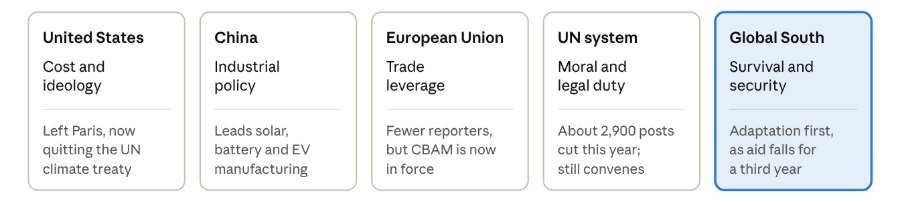
Source: Author’s analysis based on UN, UNEP, OECD, European Commission, WRI and IEA material (2025 to 2026).
Those who need help most have the weakest voice. Fewer than 60 heads of state or government confirmed attendance at the COP30 leaders’ summit, and the leaders of the United States, China and India stayed away.⁴³ Half of the women’s organisations working in humanitarian crises told UN Women in 2025 that they might close within six months.⁴⁴ Humanitarian action increasingly depends on whether local organisations have the capacity and funding to respond.
Will it take a disaster? The likelier danger is a slow buildup of harm, with no single moment that forces a response. Mark Carney, then Governor of the Bank of England, called this “the tragedy of the horizon”: the worst impacts of climate change fall beyond the time frames that businesses, politicians and regulators plan for, so none of them has a direct incentive to act.⁴⁵
FIGURE 3: THE TRAGEDY OF THE HORIZON: THE WORST CLIMATE COSTS FALL BEYOND PLANNING CYCLES
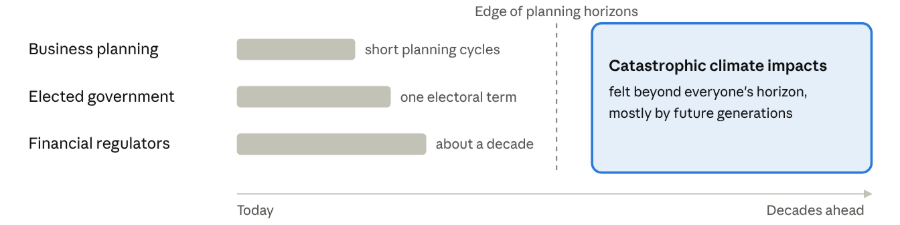
Source: Adapted from Mark Carney’s speech at Lloyd’s of London, 29 September 2015. Schematic, not to scale.
Shocks have forced action before. Bangladesh built one of the world’s best cyclone warning systems only after the storms of 1970 and 1991 killed hundreds of thousands of people. Waiting for heat to force the same response means accepting many deaths first.
If public money keeps shrinking, private money will steer sustainability consulting. When Washington stopped paying in 2025, Bloomberg Philanthropies covered the US share of the UN climate secretariat’s budget, about 22 percent of its core funding.⁴⁶ Most climate finance is already private, and around 80 percent of all of it flows to advanced economies and China.⁴⁷
Private capital has helped drive down the price of solar panels and batteries, but it follows returns. The economic geographer Brett Christophers argues that renewable investment depends on profitability rather than price.⁴⁸ Blended finance, which uses public money to draw in private investors, mobilised only $15.5 billion for climate deals in 2024, and less of it reached the least developed countries.⁴⁹ Private funders also change course: Bill Gates’s Breakthrough Energy cut its climate policy teams in 2025.⁵⁰
Selling climate products is different from solving climate change. Climate finance and fossil fuel emissions both hit records in 2025.⁵¹ That suggests clean energy is mostly being added alongside fossil fuels rather than replacing them, so more climate spending does not by itself mean lower emissions. Climate products can also carry hidden costs further up their supply chains, and electric vehicles are a case in point. NGO investigations found that nickel for electric vehicle batteries has driven forest clearing and coal powered processing in Indonesia.⁵² For consultants, the lesson is to measure success by emissions actually cut, not by money raised or products sold.
Governments are unlikely to fill the gap quickly, because in a crisis they protect the basics first. Bangladesh shows how. When the Iran war threatened its gas imports in March, the government ordered coal plants to raise their output, toward an expected 5,000 megawatts, and warned of power cuts.⁵³ Keeping the lights on came before clean energy goals. The pattern is global. The World Bank expects coal prices to rise by a fifth in 2026 as power companies across Asia and Europe swap expensive gas for coal.⁵⁴ Meanwhile the UN, which might coordinate a joint response, is shrinking, and Washington is withdrawing from both the UN climate treaty and its science panel, the IPCC.⁵⁵
That leaves civil society and academia as the main independent check. Academics exposed the weakness of carbon offsets, and NGOs traced the coal behind battery nickel. Yet both face the funding cuts and lawsuits described above.
The sector needs an overhaul of who pays and who checks. Public money and regulation should set the direction, consultants should be judged on environmental outcomes rather than reports delivered, and independent researchers should verify the results. Otherwise sustainability consulting risks becoming an efficient service for climate business rather than a tool for solving climate change.
The chart below captures the Global South’s problem.
FIGURE 4: MITIGATION DREW 30 TIMES MORE CLIMATE FINANCE THAN ADAPTATION IN 2024
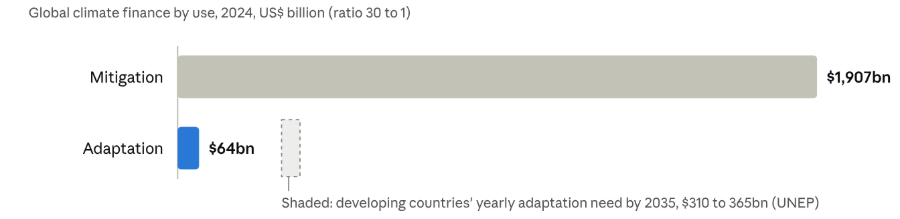
Source: Climate Policy Initiative, Global Landscape of Climate Finance 2026 (2024 flows); UNEP, Adaptation Gap Report 2025 (need range).⁵⁶
For Bangladesh and other developing countries, the money to close that gap is getting harder to find. The squeeze is double. Aid is falling while 3.4 billion people live in countries that spend more on debt interest than on health or education.⁵⁷ The US exit from clean energy partnerships with South Africa, Indonesia and Vietnam left about $45 billion of pledges in doubt.⁵⁸ In late October, the UN General Assembly gave Bangladesh three more years, until November 2029, before it leaves the least developed country group.⁵⁹ That buys time to prepare, but the trade preferences and cheaper finance that come with the status will still end.
Yet a paying market is forming at home. Bangladesh Bank requires banks to make full sustainability and climate disclosures from 2027,⁶⁰ and the Financial Reporting Council adopted the global ISSB standards in July, though who must apply them is not yet settled.⁶¹ Garment buyers demand carbon and traceability data, and Bangladesh has more LEED certified factories than any other country.⁶² The EU’s planned digital product passport for textiles will make such data a legal requirement for exporters to Europe. The rules are due to be adopted in 2027 and to apply about 18 months later, covering each product’s materials, origin and environmental footprint.⁶³
Sustainability consulting will keep growing, but it will grow unevenly. Verdantix expects the market to more than double to nearly $30 billion by 2030, with Asia growing fastest.⁶⁴ Disclosure rules are spreading: 35 jurisdictions have adopted the ISSB standards, and 11 more plan to.⁶⁵ Private investors already supply about 60 percent of climate finance, and their spending has grown by almost a fifth a year since 2019.⁶⁶ The money and the rules point the same way, towards companies that need to measure, verify and protect what they own.
For climate action, that brings real gains and a serious blind spot. Better data and independent checks will make corporate claims more honest, and capital will reach clean energy faster wherever it pays. The work that does not pay, protecting poor communities from heat and floods, will fall further behind just as it becomes unavoidable. Adaptation finance has already stalled.⁶⁷ With warming likely to pass 1.5°C before 2030, adaptation will decide how much damage countries like Bangladesh suffer.⁶⁸
The likely result is climate action that moves fast where it is profitable and slowly where it is most needed. Closing that gap will take public money and clear rules from governments and donors. Consultants can still shape the outcome by measuring results rather than activity, by refusing to sign off on claims that do not hold, and by making the case, in Dhaka and beyond, that the work nobody pays for is the work that matters most.
This article was written by Md. Mubassir Rahman, Principal Business Consultant & Portfolio Manager at LightCastle Partners. For further clarifications, contact here: [email protected].
AfricanNGOs and EPIC-Africa. From Fragility to Fortitude: Building Resilient African CSOs in the Wake of the US Government Funding Collapse. August 2025.
Argus Media. “Bloomberg to Fund UN Climate Body in Lieu of US.” January 2025.
Asia News Network. “Bangladesh Secures Three-Year LDC Graduation Deferment.” October 2026.
Associated Press via WTOP. “What to Know About Greenpeace and the Oil Pipeline Lawsuit That Threatens Its Future.” February 2026.
Axios. “AI and Trump Put Consulting Firms Under Pressure.” August 2025.
Bangladesh Bank. Sustainability and Climate-related Financial Disclosure, SFD Circular No. 06. December 2023.
Bank for International Settlements. “Mark Carney: Breaking the Tragedy of the Horizon, Climate Change and Financial Stability.” September 2015.
Benchmark Gensuite. “BRSR Core Assurance Is Now Mandatory for All Top 1000 Companies.” June 2026.
BIG Innovations Group and Bard College. Sustainability Hiring in a Time of Transition. March 2026.
Carbon Brief. “State of the Climate: Rapidly Developing El Niño Raises Chance of Record Warm 2026.” July 2026.
Carbon Pulse. “Voluntary Market Value Shrinks 29% YoY to $535 mln, Down from Peak of $2 bln.” May 2025.
Climate Home News. “COP30 Fails to Land Deal on Fossil Fuel Transition but Triples Finance for Climate Adaptation.” November 2025. Climate Policy Initiative. “Global Climate Finance Crosses USD 2 Trillion but Pace Needs to Accelerate to Reach Climate Goals.” June 2026.
Climate Policy Initiative. Global Landscape of Climate Finance Snapshot 2026. June 2026.
Computing. “McKinsey Considers Thousands of Job Cuts as AI Reshapes Consultancy Work.” 2025.
Daily Observer. “4 New Garment Factories Get LEED Certification.” May 2026.
DevelopmentAid. “U.S. Exit Disrupts $45 Billion Clean Energy Deal for South Africa, Indonesia and Vietnam.” March 2025.
Diário de Notícias. “Trump, Xi ou Modi: ausências de peso na cúpula de líderes antes do arranque da COP30.” November 2025.
Donor Platform. “Convergence: State of Climate Blended Finance 2025.” 2025.
E&E News. “Nickel Mining for EVs Linked to Higher Emissions: Report.” August 2024.
Eco-Business. “Geoeconomic Conflict Overshadows Climate in WEF Risk Report.” January 2026.
Ellen MacArthur Foundation. “Ellen MacArthur Foundation Begins Consultation on Proposed Changes to Its Structure.” July 2026.
Environment Analyst. “Climate Resilience Outpaces Rest of Global E&S Consulting Market.” October 2026.
Environment Analyst. “Data Centres and Grid Upgrades Buoy US E&S Consulting Market.” 2026.
Environment Analyst. Global Environmental & Sustainability Consulting Market Assessment (October 2026 Edition). October 2026.
Environment Analyst. “WSP Acquires US Climate Finance Advisory Firm.” February 2022.
ESG Dive. “NZBA Votes to Cease All Operations, Abandon Membership Model.” October 2025.
ESG Today. “EU States Give Final Approval to Omnibus Package to Cut Sustainability Reporting and Due Diligence Requirements.” February 2026.
FABBS. “FY27 President’s Budget Request Slashes Funding for Federal Science Agencies, Again.” April 2026.
GeekWire. “Report: Bill Gates’ Breakthrough Energy Cuts Climate Policy Team and Partnership Support.” March 2025.
Global Carbon Project via University of East Anglia. “Fossil Fuel CO2 Emissions Hit Record High in 2025.” November 2025.
Global Tipping Points. Global Tipping Points Report 2025. October 2025.
GreenSutra. “What Conflict of Interest Rules Apply to a BRSR Assurance Provider?.” Citing the SEBI circular of 12 July 2023.
GreenSutra. “What Is BRSR Core Reasonable Assurance and Who Must Obtain It?.” 2026.
IAS Plus. “Bangladeshi Standard Setter Adopts IFRS 18, IFRS 19, IFRS S1 and IFRS S2.” July 2026.
IDCOL. “Solar Home System Program.”
IISD SDG Knowledge Hub. “15 of 195 Parties to Paris Agreement Meet Deadline to Communicate New NDCs.” February 2025.
IISD SDG Knowledge Hub. “ILO Warns of Work-related Heat Stress Causing Job and Productivity Losses.” July 2019.
Jacobin. “Why Private Investment Isn’t Driving a Rapid Green Transition.” February 2024.
La Télé. “Moins de 60 dirigeants pour le sommet sur le climat au Brésil.” October 2025.
London School of Hygiene & Tropical Medicine. “Climate Change Driven Summer Heat Caused 16,500 Additional Deaths Across Europe.” September 2025.
Meteorological Technology International. “August 2026 Was Joint Warmest Month on Record, Copernicus Reports.” September 2026.
Morningstar. “ESG Funds: 2025 Closes With Continued Outflows Amid Persistent Headwinds.” February 2026.
North Dakota Monitor. “Judge Finalizes Order for Greenpeace to Pay $345 Million in North Dakota Oil Pipeline Case.” February 2026.
OECD. “A Historic Decline in Foreign Aid: Preliminary 2025 ODA Data.” April 2026.
OECD. “International Aid Fell Sharply in 2025, Says OECD.” April 2026.
OECD and IEA. “Government Support for Fossil Fuels Remains High Despite a 10% Decline.” December 2025.
OSW Centre for Eastern Studies. “NATO Summit in The Hague: Trump’s Return and a Two-Component 5% of GDP.” June 2025.
Petromindo. “Bangladesh Ramps Up Coal Power as LNG Supply Risks Loom.” March 2026.
Probst et al., Nature Communications. “Systematic Assessment of the Achieved Emission Reductions of Carbon Crediting Projects.” November 2024.
Renoon. “Latest Compliance Update: Digital Product Passport and ESPR Timelines.” March 2026.
S&P Global Sustainable1. “Where Does the World Stand on ISSB Adoption? Q3 2026.” August 2026.
Sabin Center for Climate Change Law, Columbia University. “White House and State Department Announce Withdrawals from International Organizations.” January 2026.
Sustainable Stock Exchanges Initiative. Training handout on ISSB standards for banks in Bangladesh and Nepal.
The Asian Banker. “Strait of Hormuz Closure Set to Deliver Largest Commodity Price Spike Since 2022, World Bank Warns.” April 2026.
The Business Standard. “Bangladesh to Have Half of Entire South Asian Climate Migrants by 2050: WB Report.” September 2021.
The Business Standard. “Bangladesh to Ramp Up Coal Power as LNG Imports Face Uncertainty over Mideast Crisis.” March 2026.
The Business Standard. “How Bangladesh’s Local NGOs Are Surviving the Foreign Aid Collapse.” May 2026.
TheStreet. “Big Four Firm KPMG Cuts 100s of Jobs as Consulting Demand Slows.” May 2026.
Third World Network. “Foreign Aid Witnesses Largest Ever Annual Decline in History.” April 2026.
UN News. “General Assembly Approves $3.45 Billion UN Regular Budget for 2026.” December 2025.
UN Women. “New Survey Shows Half of Women’s Organizations Aiding Women in Crises May Shut Down in Six Months Due to Global Aid Cuts.” May 2025.
UNCTAD. A World of Debt 2025. 2025.
UNEP. Adaptation Gap Report 2025: Running on Empty. October 2025.
UNEP. Emissions Gap Report 2025. November 2025.
Verdantix. “Market Size and Forecast Data Reveal a Growing Sustainability Consulting Market.” 2025.
Verdantix. Market Size and Forecast: Sustainability Consulting 2024 to 2030 (Global). October 2025.
World Bank. “Bangladesh Faces Health and Economic Risks from Rising Temperature.” September 2025.
World Bank Blogs. “Coal’s Unexpected Comeback: Middle East Conflict Drives a Return.” June 2026.
World Economic Forum. “Global Risks Report 2026: Environmental Risks Remain Urgent.” February 2026.
World Health Organization. “Climate Inaction Is Claiming Millions of Lives Every Year, Warns New Lancet Countdown Report.” October 2025.
World Meteorological Organization. “New Report Suggests More Global Temperature Records Ahead.” May 2026.
World Resources Institute. “Statement: The United States Withdraws from the UNFCCC.” January 2026.
WSP. “WSP to Acquire Ricardo, a Global Strategic and Engineering Consultancy Firm.” June 2025.
XBRL International. “Europe Adopts Slimmed Down ESRS and Voluntary Standard.” July 2026.
Our experts can help you solve your unique challenges
Stay up-to-date with our Thought Leadership and Insights