


GET IN TOUCH
- Please wait...

Bangladesh is among the world’s leading mango-producing countries, producing over 2 Mn tonnes annually and ranking 8th globally. The country grows a wide range of commercially viable varieties with strong taste profiles and harvest windows that align with global demand.
However, exports remain extremely limited. They account for less than 0.1 percent of total production, revealing a major gap between domestic capacity and international market participation.
Meanwhile, global demand for mangoes continues to grow across North America, Europe, East Asia, and the Middle East. Buyers offer premium prices for varieties that meet strict quality, treatment, and traceability standards. Bangladesh has expanded its export destinations from 2 countries in FY14 to 22 countries in FY24. Yet export volume and value remain constrained. These limitations stem from systemic bottlenecks rather than weak demand.
Therefore, the opportunity lies beyond increasing production. The sector must strengthen its forward market ecosystem. This requires aligning production with post-harvest infrastructure, certification systems, logistics, and market coordination. Such alignment will allow Bangladeshi mangoes to compete consistently in global markets.
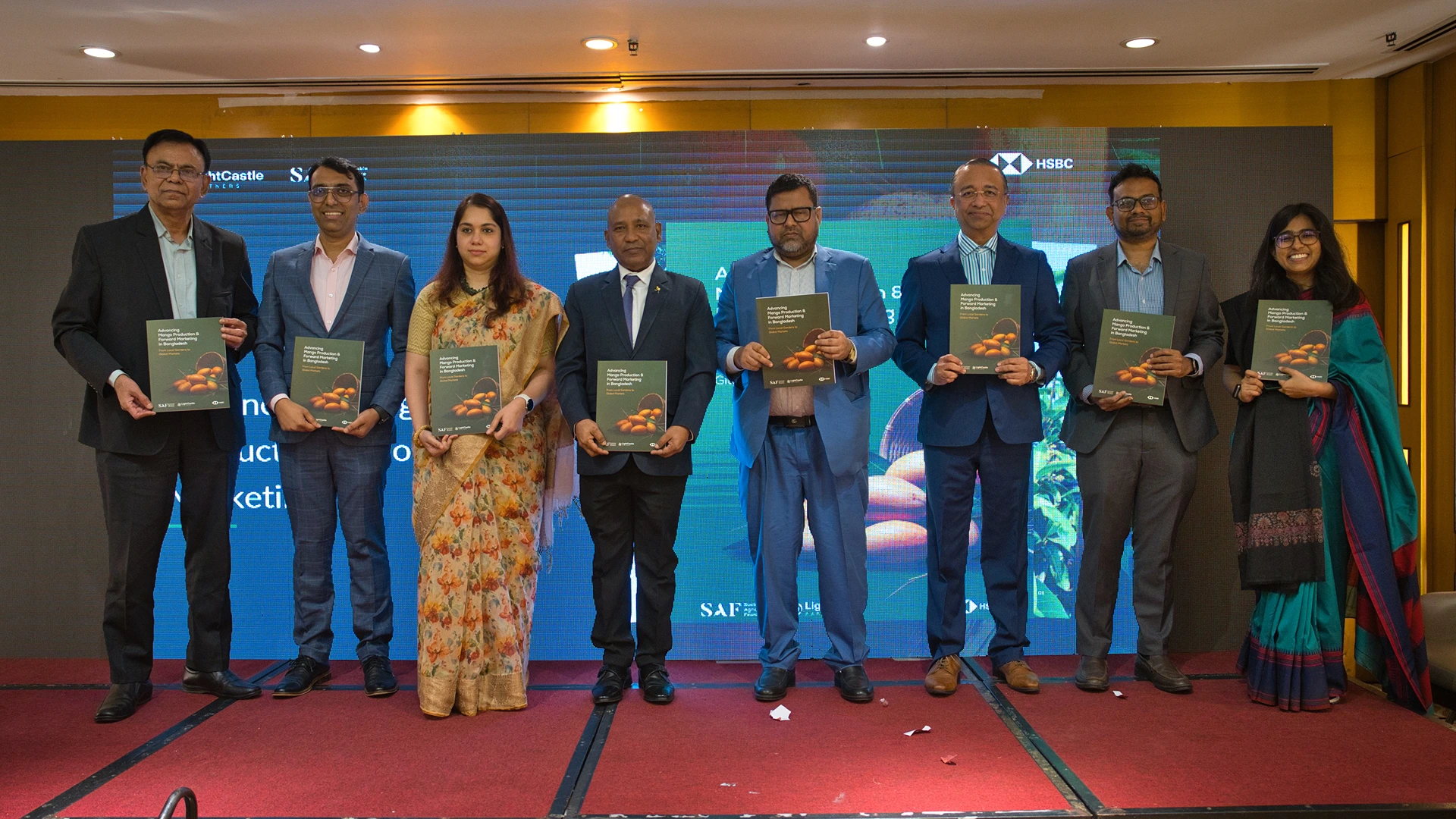
Under the Climate Resilient Agricultural Advancement in Barind (CRAAB) project, implemented by Sustainable Agriculture Foundation Bangladesh and financed through a philanthropic grant from HSBC Bangladesh, the study adopted a value-chain-wide and systems-oriented approach. The analysis examined how Bangladesh’s mango sector can move from production strength to forward-market competitiveness.
Specifically, the study positioned the sector as a forward market system shaped by four interacting components: production practices, post-harvest infrastructure, institutional arrangements, and market access conditions.
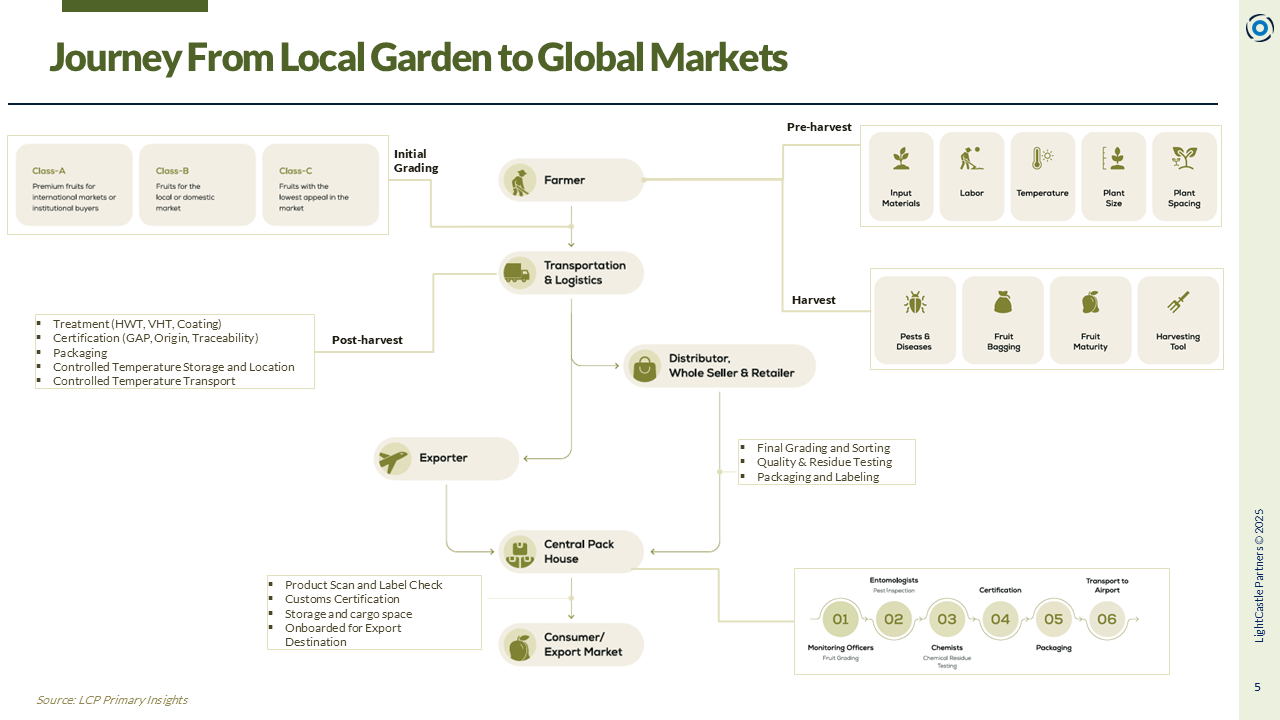
To capture these dynamics, the research mapped the mango value chain end-to-end—from orchard-level practices to aircraft loading for export. The objective was to understand how production, handling, certification, logistics, and market access function together. The analysis also assessed how weaknesses at each stage accumulate and create barriers to export scalability.
Importantly, the study placed strong emphasis on post-harvest treatment and logistics infrastructure. These two nodes determine global competitiveness. The findings showed several critical gaps, including limited Hot Water Treatment (HWT) facilities, the absence of commercially operational Vapor Heat Treatment (VHT) and irradiation facilities, and inadequate cold storage and temperature-controlled transport. These constraints directly affect shelf life, product quality, freight costs, and compliance with destination requirements.
In addition, the study examined institutional and coordination challenges. High certification costs, fragmented compliance processes, and largely informal farmer–exporter relationships limit scale and exclude smallholders. At the same time, weak market intelligence, limited global branding, and airport handling constraints further restrict growth.
By analyzing these issues as interconnected system components, the study moved beyond isolated bottlenecks. Instead, it identified how cumulative constraints shape export outcomes. This systems perspective helped identify key leverage points where coordinated and collaborative interventions can unlock forward market participation.
The findings point toward a shift from incremental improvements to system-level strengthening of Bangladesh’s mango export ecosystem. Future progress will depend on aligning production gains with investments in post-harvest treatment, temperature-controlled infrastructure, improved certification, and stronger market coordination.
First, the strategy recommends expanding decentralized treatment and cold storage facilities near production hubs. This approach will help exporters meet destination requirements while reducing post-harvest losses and logistics costs.
Second, the report proposes scaling group-based certification and digital traceability models. These solutions can lower compliance costs for smallholders while improving transparency and buyer confidence.
Furthermore, the sector must strengthen its market-facing functions. This includes building a stronger national brand and improving access to market intelligence. Such efforts will help position Bangladeshi mangoes in more predictable and higher-value export channels. At the same time, stronger coordination among farmers, exporters, service providers, and regulators will remain essential.
Overall, these priorities signal a transition from a production-led model to a market-integrated export system. By embedding systems thinking into future interventions, Bangladesh can transform its mango sector into a resilient and inclusive export pathway. In turn, this transformation will support rural incomes, reduce post-harvest losses, and contribute to export diversification.
Our experts can help you solve your unique challenges