


GET IN TOUCH
- Please wait...


Many high potential businesses in emerging markets face a common challenge. They are unable to access patient and risk-tolerant capital that allows them to scale. Traditional investors typically seek proven traction, strong financial returns, and scalable models. These enterprises fall into the missing middle. They are too mature for grant funding but too risky for conventional investment.
Without solutions to bridge this gap, many promising ventures remain stuck in pilot mode, unable to reach their growth potential. At the same time, ecosystem enablers such as accelerators, incubators, and advisory firms often lack the incentives or resources to prepare enterprises for fundraising. The result is a fragmented ecosystem with limited investment-ready ventures and low confidence among private investors.
Blended finance has emerged as an effective way to address this challenge. By combining catalytic capital with private investment, blended finance de-risks early-stage enterprises, rewards impact outcomes, and attracts investors who may otherwise be hesitant. Instruments such as Social Impact Incentives, Impact Ready Matching Funds, and outcome-based financing allow enterprises to invest in growth, impact measurement, and operational capacity while aligning with investor expectations.
This approach improves the quality of ventures entering the market, reduces investor risk, and helps establish shared standards for impact measurement and governance. In this way, blended finance strengthens both sides of the market, making enterprises more investable and investors more confident.
A leading example of this approach is the Biniyog Briddhi (B-Briddhi) program in Bangladesh. Launched in 2020 and funded by the Embassy of Switzerland in Bangladesh, B-Briddhi is co-implemented by Roots of Impact and LightCastle Partners. The program manages a blended finance facility and uses instruments such as Social Impact Incentives and Impact Ready Matching Funds to support impact-oriented enterprises. To date, B-Briddhi has disbursed USD 2.2 Mn to 16 impact-driven businesses across sectors such as agriculture, fintech, health, energy, clean tech, mobility, and circular economy. B-Briddhi has acted as a catalyst in multiple ways:
Sustainability in donor-backed programs requires moving beyond short project cycles toward long-term, self-sustaining capital structures. A practical pathway is for donors to co-create impact investment funds in partnership with private sector actors such as banks, corporates, and fund managers who bring investment discipline, deal flow, and portfolio management expertise.
In this model, donors seed the fund with catalytic capital, taking on first-loss or guarantee positions that de-risk private participation. Local financial institutions can contribute matching equity or credit lines, while corporates and family offices can participate as limited partners aligned with ESG or CSR mandates.
To ensure accountability and alignment, donors can help design impact-linked governance frameworks, establishing investment committees that include both development and commercial voices. The fund can operate as a revolving vehicle, reinvesting returns into new ventures while progressively reducing reliance on concessional capital. Technical assistance windows, co-financed by donors and corporates, can strengthen investee readiness and reporting standards. Meanwhile, policy dialogue facilitated by donors can help integrate blended structures into national investment regulations, allowing these vehicles to scale sustainably.
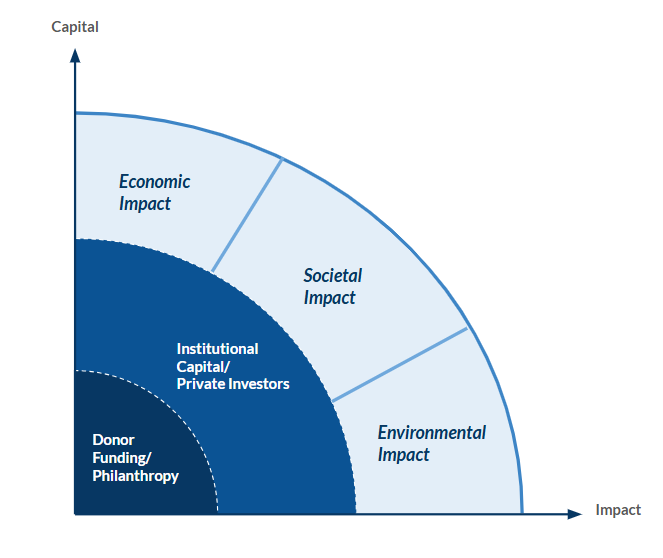
This partnership-based approach turns donor programs from temporary initiatives into permanent market institutions, embedding impact finance within the private sector while preserving the developmental intent. Over time, such funds can evolve into independent entities, crowding in institutional investors and unlocking deeper pools of domestic capital for impact-driven enterprises.
Global experiences reinforce this approach. The Global Health Investment Fund (GHIF) is a USD 108 Mn blended impact fund launched in 2012 that used a public-philanthropic first-loss layer from partners such as the Gates Foundation and KfW to crowd in commercial investors. Managed as a professional investment vehicle, it financed high-impact health enterprises developing vaccines, diagnostics, and therapeutics for underserved markets. The portfolio supported fifteen new products, including a cholera vaccine and mobile vaccine production units, improving health for an estimated 12 million people annually and saving roughly 250,000 lives each year.
Financially, GHIF exceeded its original earnings forecasts, proving that a catalytic first-loss layer can attract commercial investors without weakening financial performance. Its success led directly to two successor vehicles, i) the Adjuvant Global Health Technology Fund, now investing USD 300 Mn across 19 companies, and ii) the Women’s and Children’s Health Tech Fund, a USD 90 Mn fund supporting affordable, life-saving innovations such as portable neonatal incubators already in use in Tanzania, Kenya, Haiti, and Ukraine. Building on this momentum, KfW and GHIC launched the Catalytic Health Investment Platform (CHIP) in 2023, a 20-year initiative with an initial EUR 60 Mn to accelerate global health technologies.
Across GHIF and its follow-on funds, each euro of public capital has mobilized an additional three to four euros in private investment, demonstrating the leverage potential of well-structured first-loss blended finance. These initiatives illustrate that blended structures can both achieve social impact and attract private investment, creating a durable pathway to market sustainability.
For private sector investors, engagement in blended finance programs presents a strong value proposition. Investors benefit from early access to a curated pipeline of high-potential impact enterprises, de-risked by catalytic instruments and structured incentives. They gain first-mover advantage in emerging sectors, positioning themselves to capture long-term returns while influencing market standards.
Participating investors also strengthen ESG alignment in their portfolios and enhance reputation through demonstrated social impact. By co-investing and collaborating in structured initiatives like GHIF, the private sector can help sustain and scale the impact of donor-backed initiatives, creating a self-reinforcing ecosystem that delivers both financial and social returns.
As global capital markets increasingly prioritize Environmental, Social, and Governance (ESG) principles, blended finance programs can play a pivotal role in aligning local impact enterprises with these global standards. By embedding ESG considerations into investment selection, reporting, and governance frameworks, donor-backed initiatives can help enterprises not only access capital but also meet the expectations of institutional investors.
The experience of B-Briddhi, reinforced by global examples such as GHIF, shows that well-designed blended finance programs can bridge gaps between grant funding and commercial investment, strengthen entrepreneur capacity, reduce investor risk, and generate knowledge that benefits the broader market. When donors, private investors, and ecosystem enablers collaborate strategically, development capital can evolve into enduring market institutions. Programs designed with sustainability and private sector engagement in mind can continue to finance and nurture impact-driven enterprises long after initial donor support ends, creating a foundation for resilient and inclusive investment ecosystems.
This article was authored by Ameera Fairooz, a Senior Business Consultant at LightCastle Partners. For further clarifications, contact here: [email protected]
Biniyog Briddhi: Scaling Impact Enterprises of Bangladesh (SIE-B). (n.d.). About SIE-B. https://www.sie-b.org/about/
Biniyog Briddhi. (2025, February). Investor Dealbook: Scaling Impact Enterprises of Bangladesh. https://www.sie-b.org/wp-content/uploads/2025/02/Investor-Dealbook_Feb-2025-low.pdf
KfW Development Bank. (n.d.). Health funds. https://www.kfw-entwicklungsbank.de/SDG-portal/SDG-3/Health-funds/
Our experts can help you solve your unique challenges
Stay up-to-date with our Thought Leadership and Insights