


GET IN TOUCH
- Please wait...

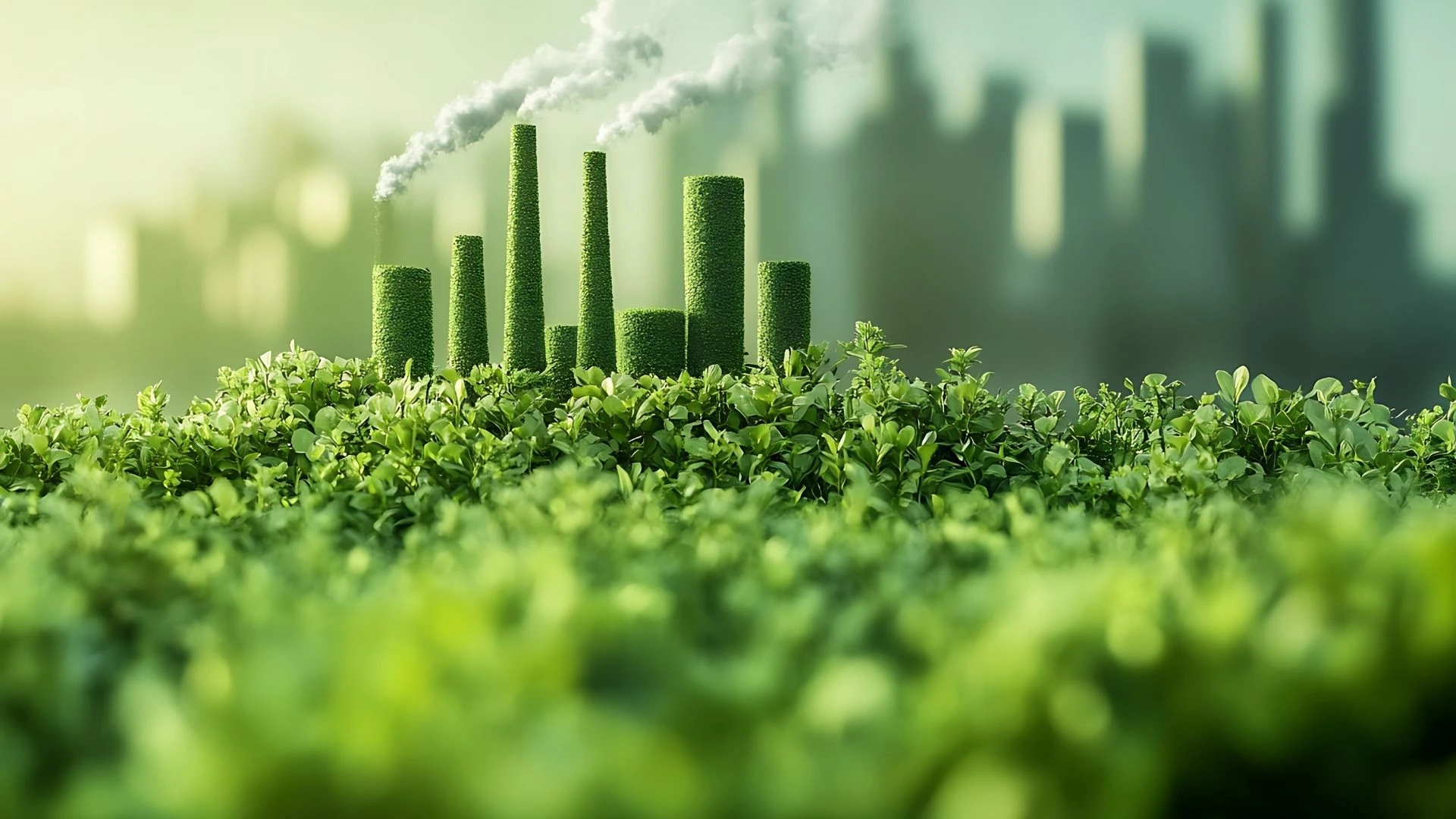
Over the past two decades, climate change has not been an abstract concept for Bangladesh, rather a lived reality. Between 2000 and 2019, the country endured 185 extreme weather events. Placing it among the world’s most climate-affected nations. As of 2025, nearly five million people in Bangladesh are currently living as internally displaced persons. In other words, natural disasters are continuously changing where and how people live and work. Hence why the focus in green transition and labour markets of Bangladesh.
At the same time, Bangladesh finds itself under a different kind of pressure from the global economy. As climate risks intensify, the call to decarbonize is growing louder. Global initiatives such as the EU Green Deal are reshaping the rules of global trade. For Bangladesh’s export-driven industries, going green is no longer optional; it is fast becoming a condition for survival.
Yet this transition, while necessary, is far from painless. Automation can replace routine tasks, energy upgrades can reduce labor demand, and new technologies often arrive faster than workers can adapt. Those most at risk are already vulnerable—workers tied to fossil fuel dependent activities, farmers whose livelihoods are exposed to climate shocks, and women clustered in low-skilled, low-paid roles.
Thus, the intersection of climate urgency and economic transformation raises a critical question: who bears the cost of going green? If the transition is not carefully managed, it risks deepening inequality even as it reduces emissions. This is why a just transition is crucial – it helps workers adapt, learn new skills, and benefit from a greener future.
The International Labour Organization (ILO) defines a Just Transition as the shift to a greener economy in a way that is fair and inclusive and creates decent jobs. A critical concept for Bangladesh, where most workers do not yet have access to what the ILO calls “decent work.” According to the ILO, decent work has four core components:
Across the world, green transition is celebrated as a positive step for both the economy and the planet. Cleaner energy, more efficient production, and lower emissions can help industries grow and compete. But, when this shift centers only on businesses, workers can be left vulnerable. Without deliberate safeguards, many face the risk of income drops, or even worse – job losses.
The risk is particularly pronounced in Bangladesh because the labor market is already vulnerable. About 85% of workers are engaged in informal employment, where minimum wages, job security, and social protection are often missing. When industries adopt greener practices, these workers remain vulnerable, with little protection if jobs are lost or restructured. A case in point is the country’s shift toward renewable energy. Between 2011 and 2016, employment in the solar energy sector grew at a robust annual rate of 18.5%, well above the national average of 1.9%. While this growth highlights emerging opportunities, the effects of the transition on workers in conventional energy sectors remain largely unexplored.
This pattern of change is mirrored in the ready-made garments (RMG) sector, which is also under mounting pressure from global buyers to reduce emissions. To stay competitive, factories are increasingly adopting automation, gradually reducing the demand for low-skilled labor. In 2023 alone, this shift led to an estimated 30% job displacement at the factory level, with women disproportionately affected due to their concentration in easily mechanized roles such as sewing.
In short, environmentally friendly activities do not automatically translate into green jobs. And this is where Just Transition becomes essential. In highly informal sectors such as agriculture, waste management and recycling, making activities more environmentally friendly without (i) ensuring job security and (ii) improving working conditions could leave workers worse off.
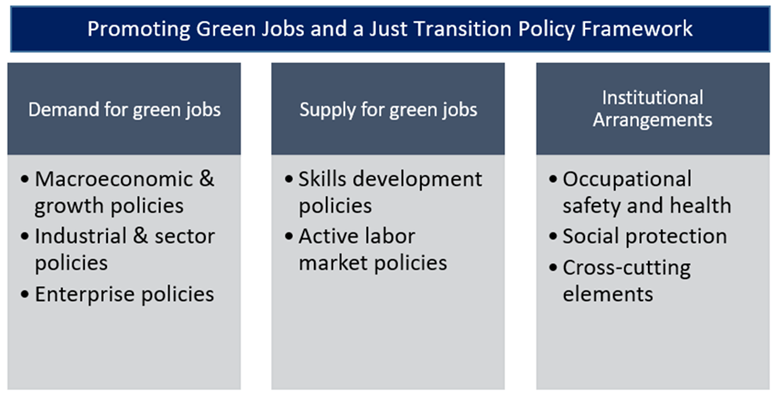
The policy framework for advancing green jobs and a Just Transition is wide-ranging. As reported by ILO, greening of economies and creating decent work opportunities require a country-specific mix of macroeconomic, industrial, sectoral and labor policies.
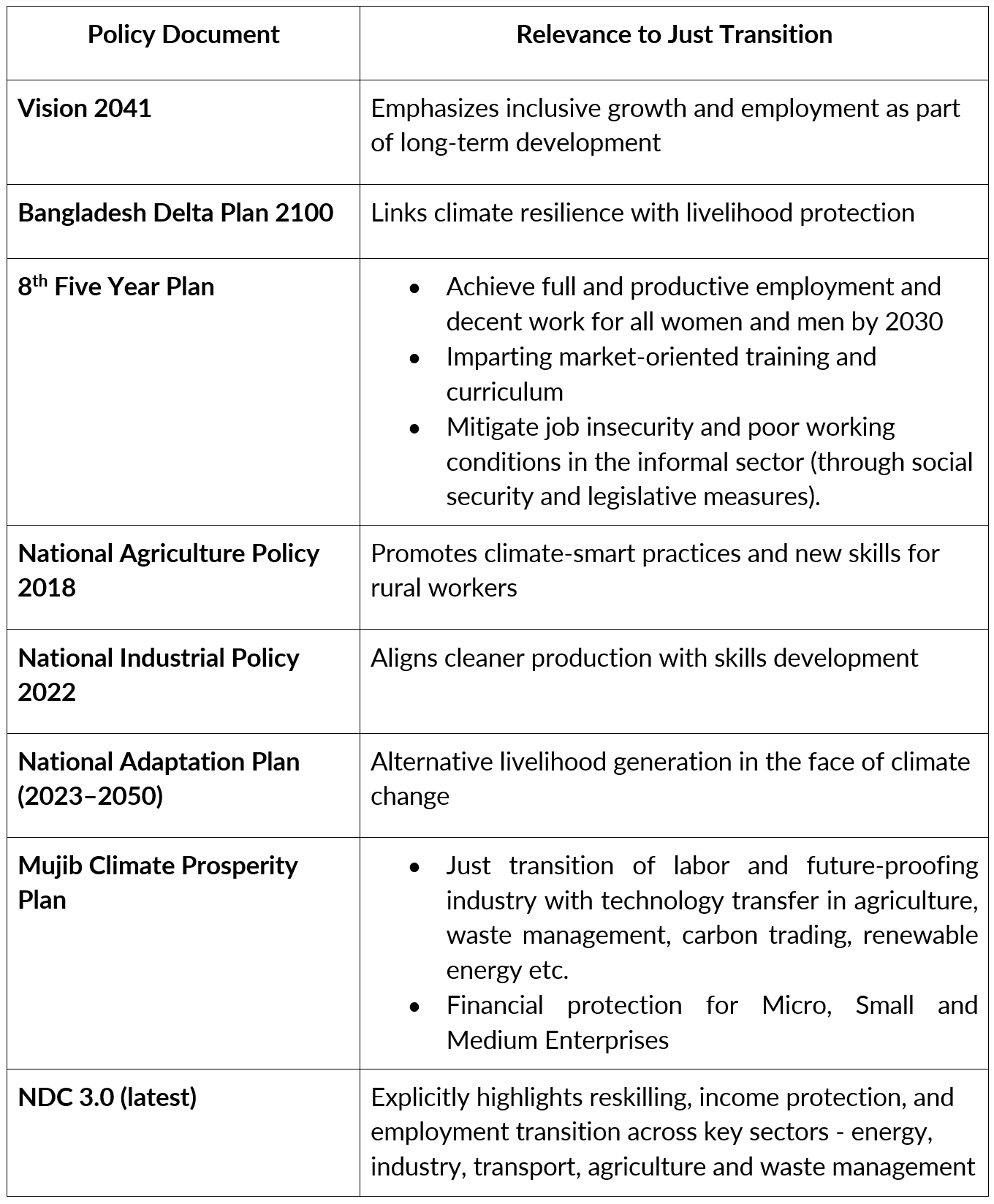
Over the years, the idea that climate action must also protect worker livelihoods has gradually entered Bangladesh’s policy discourse. This shift is most clearly reflected in the country’s updated Nationally Determined Contribution (NDC 3.0), which explicitly acknowledges the human cost of decarbonization. It recognizes that moving away from fossil fuels—particularly in energy-intensive industries—will disrupt existing jobs, and introduces the concept of worker reskilling, income protection, and employment transition.
This explicit recognition builds on earlier policy foundations. Long-term development strategies such as Vision 2041 and the Bangladesh Delta Plan 2100 emphasize inclusive growth, employment generation, and social protection as Bangladesh pursues climate resilience. Several sectoral policies have further reinforced this direction. The National Agriculture Policy 2018 promotes environmentally friendly technologies and training for farmers and rural youth, signaling an effort to align sustainability with productivity. Similarly, the National Industrial Policy 2022 encourages cleaner production, energy efficiency, and circular economy practices, alongside skills development for an increasingly technology-driven industrial base.
A more direct link between climate action and employment outcomes appears in the Mujib Climate Prosperity Plan (MCPP). By framing climate action as a driver of economic growth, the plan highlights opportunities in renewable energy and green industries, while underscoring the importance of skills development and support for MSMEs. Taken together, these policies signal a gradual shift toward just transition thinking.
a. Limited Public and Institutional Awareness
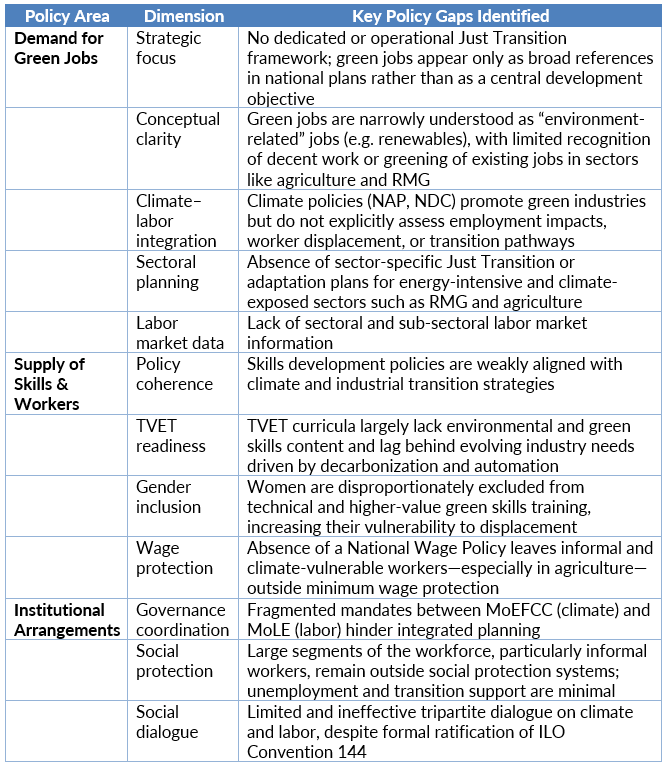
Although just transition is increasingly referenced in national climate discussions, understanding of the concept remains limited beyond policy circles. In climate-sensitive sectors such as agriculture and aquaculture. Adaptation measures are often treated as short-term survival strategies rather than part of a broader employment transition. In the RMG sector, sustainability compliance has advanced rapidly. But workers still remain largely excluded from discussions on how these changes may affect job security or skills. As a result, climate action risks becoming top-down and disconnected from labor realities.
b. Heavy Reliance on Informal and Vulnerable Employment
A major barrier to a just transition is Bangladesh’s high level of informality. Around 85 percent of the workforce is employed informally, with limited access to social protection or labor rights. This is particularly concerning because the most climate-exposed sectors are also the most informal.
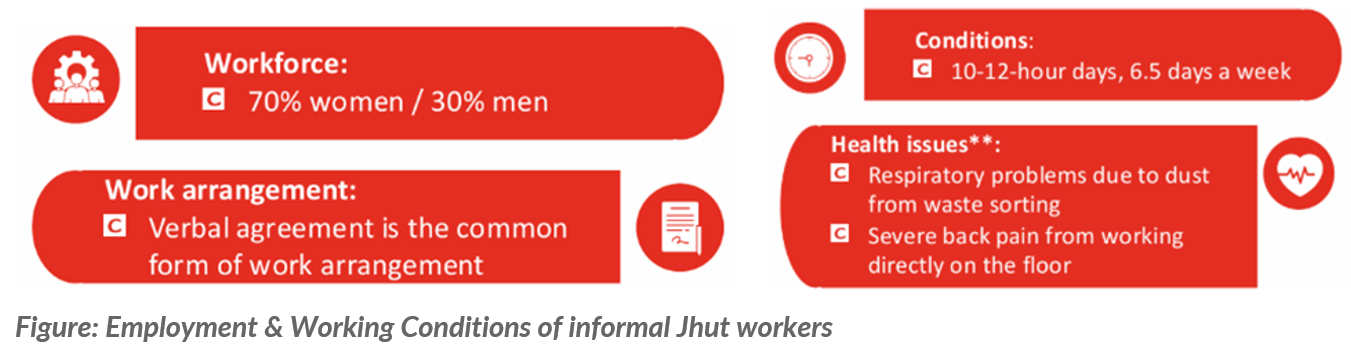
Agriculture alone employs about 45 percent of the labor force. Yet most workers fall outside minimum wage and labor law coverage. Similar vulnerabilities exist across fisheries and aquaculture, while informality also persists in parts of the RMG value chain. The Labour Act 2006 does not recognize the workers involved in textile waste/jhut management. In the absence of legal employment contracts, the workers are subjected to poor working conditions and receive little to no high-value skills training.
c. Skills Gap and Workforce Readiness
There is a significant mismatch between existing skills and those required for green and greening jobs. Current training systems are weakly aligned with industry needs and labor market data on green jobs remains limited. In the RMG sector, women are often excluded from technical training. Even though targeted upskilling in areas such as automation, energy efficiency, and textile waste management can effectively support their entry into skilled green jobs.
d. Financing Constraints and Unequal Access
Financing remains a critical challenge. Bangladesh faces annual climate-related losses of around USD 3 billion. That is equivalent to 1–2 percent of GDP, limiting public investment capacity. While green finance and Bangladesh Bank’s refinancing schemes have been in place, access remains uneven. Larger firms are better positioned to invest in cleaner technologies. While small producers and SMEs struggle with loan covenants. Although Bangladesh Bank provides a BDT 4 billion affordable refinancing program, it faces intense competition among 70 categories of eco-friendly projects. Moreover, banks are frequently dissuaded from disbursing green finance due to elevated transaction cost and longer maturity periods.
e. Policy Gaps
Despite the presence of several climate and development strategies, Bangladesh has yet to establish consistent operational definitions of green jobs and just transition across policy frameworks. Coordination between climate and labor agendas remains limited, and considerations of decent work are not systematically embedded in climate planning.
A just transition is not automatically a win-win. Without targeted policies to (i) safeguard livelihoods and (ii) align skills development with emerging green sectors, the move toward a low-carbon economy can increase economic insecurity.
For the transition to be equitable, workers must actively be involved instead viewed as passive victims of change. Alongside government action, businesses also have an important role to play by anticipating shifts in job requirements, investing in reskilling and upskilling, and redesigning roles to meet environmental objectives while protecting workers.
Ultimately, the success of a green transition rests on collective action. Through collaboration among government, businesses, workers, and civil society, Bangladesh can move toward a future that is not only greener, but also more just and resilient.
This article was authored by Naziba Ali, Business Consultant at LightCastle Partners. For further clarifications, contact here: [email protected].
Our experts can help you solve your unique challenges
Stay up-to-date with our Thought Leadership and Insights