


GET IN TOUCH
- Please wait...

Remittances contribute 6.1% of Bangladesh’s GDP (World Bank) and serve as a cornerstone of national growth and macroeconomic stability. According to the Bureau of Manpower, Employment and Training (BMET), a total of 1,128,641 people migrated to 142 countries in 2025, of whom 61,977 were women. Millions of migrants support the country’s foreign exchange reserves each year. Yet behind this success lies an underexplored reality: a growing number of women are returning home, underscoring the urgent need for reintegrating Bangladesh’s returnee women within sustainable and gender-sensitive programs.
Women often migrate with aspirations of economic independence. But many return prematurely due to exploitation, limited access to justice, or health and family pressures. Upon their return, they face a triple burden of economic exclusion, social stigma, and psychological distress, which hinders their ability to reintegrate. Ensuring a smooth and dignified reintegration process is therefore not only a social obligation but also a strategic necessity for achieving SDG 5 (Gender Equality) and sustaining the contribution of migration to national development.
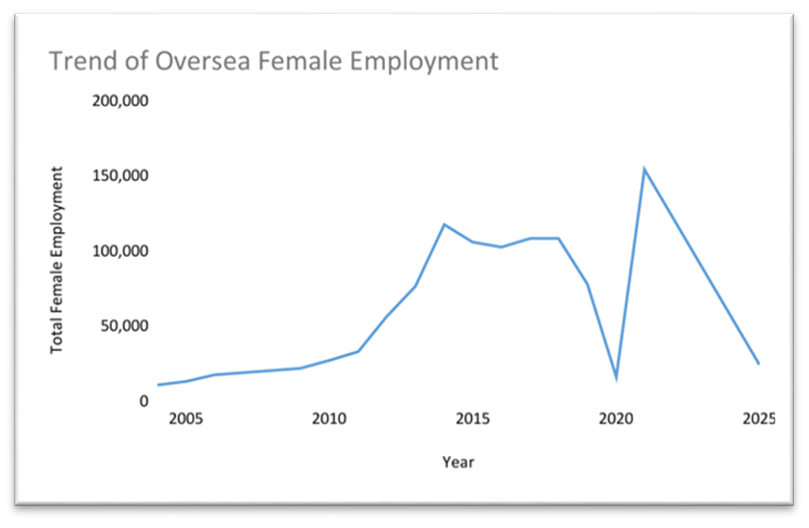
An analysis of BMET data shows that the migration of Bangladeshi women workers has followed a volatile path over the past decade. The upward surge began after the 2015 bilateral agreement between Bangladesh and the Kingdom of Saudi Arabia (KSA), which enabled the deployment of 200,000 women as domestic workers over two years (ILO, 2016). Reduced migration costs and government facilitation spurred a steep rise in female migration during that period.
However, this upward trend began to decline in the years leading up to 2020, before experiencing a brief spike during the COVID-19 pandemic. The temporary increase, driven by economic uncertainty in Bangladesh, which encouraged renewed attempts at overseas migration. By 2025, however, female migration had fallen back to levels comparable to the pre-2015 period. One likely explanation is the changing labour demand in major destination countries. Particularly Saudi Arabia, which absorbs a significant share of Bangladeshi female migrant workers. According to the Bureau of Manpower, Employment and Training (BMET), female migration stood at 76,108 workers in 2023 and remained similar in 2024 (76,108) before dropping sharply to 24,618 in 2025. This decline likely reflects tightening labour market demand in destination countries, alongside persistent concerns over working conditions in domestic work sectors. Both of which have discouraged the recruitment and migration of female workers.
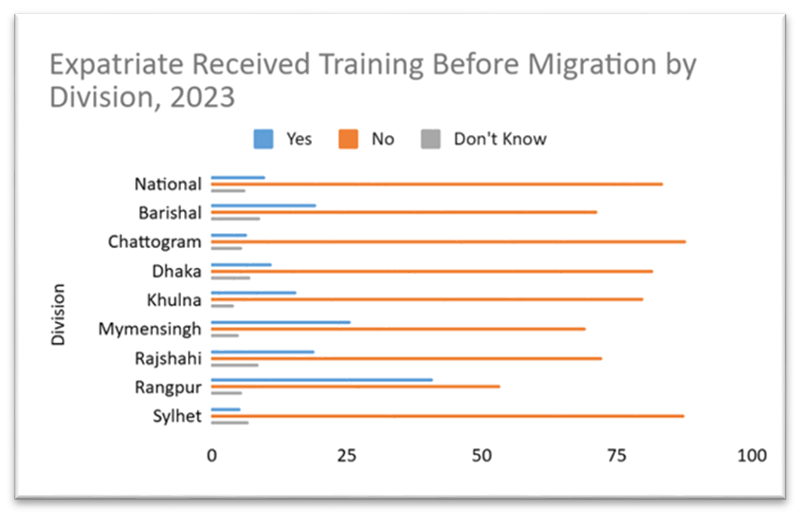
Effective reintegration begins with proper preparation before departure. Yet, the Population and Housing Census (2022) reveals that nationally, only about 10 percent of expatriates receive pre-departure training, leaving most unprepared for overseas work. Regional disparities are significant, Rangpur stands out as an outlier. Where roughly 40 percent of migrants are trained, while Sylhet records the lowest rate.
The limited access to structured skills training means that many women migrate into low-wage, low-protection sectors. Their lack of transferable skills often forces them to return sooner than expected and undermines their ability to re-enter the domestic workforce upon return. Strengthening pre-departure training is thus the first link in a more resilient migration-to-reintegration chain.
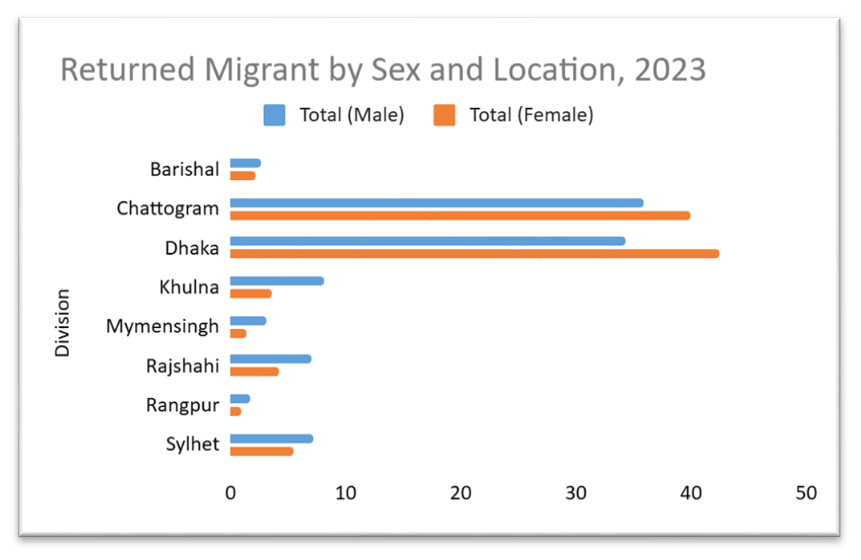
Census data show that roughly 39 percent of female expatriates from Chittagong return home each year, compared to 35 percent of male expatriates. In contrast, the return rates in Rangpur are only 0.86 percent for women and 1.74 percent for men, reflecting stark geographic variations.
These differences demonstrate that women are returning in greater numbers than men across most regions. This pattern imposes additional reintegration pressure on local institutions, particularly in urban and semi-urban districts where returning women often lack access to formal support mechanisms. As a result, a large segment of returnee women remains outside the productive economy despite possessing valuable overseas experience.
The Wage Earners’ Welfare Board (WEWB) under the Ministry of Expatriates’ Welfare and Overseas Employment (MoEWOE) leads the national reintegration agenda. According to the Government Gazette (September 2025), WEWB’s programs are structured around three pillars:
Social Reintegration: Community awareness initiatives designed to reduce stigma against women returnees and promote acceptance.
Economic Reintegration: Upskilling programs and certification processes that help returnees re-enter both local and international labour markets; entrepreneurship training for women seeking self-employment.
Psychological Reintegration: Access to health services and trauma counselling for returnees affected by abuse or mental distress abroad.
While these programs represent important progress, awareness and coverage remain limited. Many returnees are unaware of the services available to them. The coordination between government agencies such as the Bureau of Manpower, Employment and Training (BMET), the Ministry of Expatriates’ Welfare and Overseas Employment (MoEWOE), the Wage Earners’ Welfare Board (WEWB), and the Probashi Kallyan Bank remains weak. The existing referral system, intended to guide migrants toward appropriate services, suffers from inconsistent data collection and limited capacity at local levels.
To design more effective interventions, Bangladesh can draw on the ILO and IOM Reintegration Frameworks, which identify economic, social, and psychological reintegration as interlinked components.
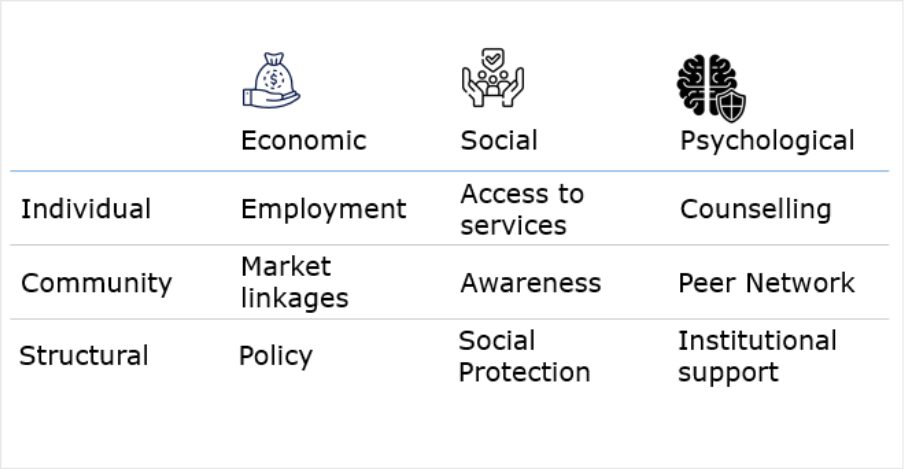
This focuses on employment and entrepreneurship. The Women must connect to local job networks and receive business development support, including access to credit and mentorship.
It ensures that returnees can access education, healthcare, justice, and social protection services. Social acceptance is key, as stigma often prevents women from participating in public and economic life.
This process addresses the mental health consequences of exploitation or social rejection. Trauma-informed counselling and community awareness programs are essential to promote well-being and dignity.
These three dimensions can be implemented at multiple levels:
Individual Level: Tailored support considering personal vulnerabilities and skills.
Community Level: Building local acceptance and inclusion through awareness campaigns.
Structural Level: Strengthening institutional capacity and coordination across ministries.
Such an integrated approach would ensure that reintegration is both holistic and gender responsive.
Despite these frameworks, the effectiveness of reintegration programs is hampered by data fragmentation and a weak referral mechanism. Currently, WEWB and BMET maintain separate datasets, while information from airport booths is collected manually and often incomplete. The ILO (2024) report, Managing Migrant Worker Information in Bangladesh, highlights that migration data are still disseminated as annual “snapshots,” with little disaggregation by region or gender.
This disjointed system results in overlapping responsibilities and missed opportunities for targeted support. Without accurate, real-time data on who the returnees are, what training they have received, and what services they access, it becomes nearly impossible to assess program impact or allocate resources effectively.
To make reintegration more inclusive and effective, Bangladesh should adopt a data-driven and gender-sensitive strategy that bridges institutional gaps and enhances coordination. The following measures are proposed:
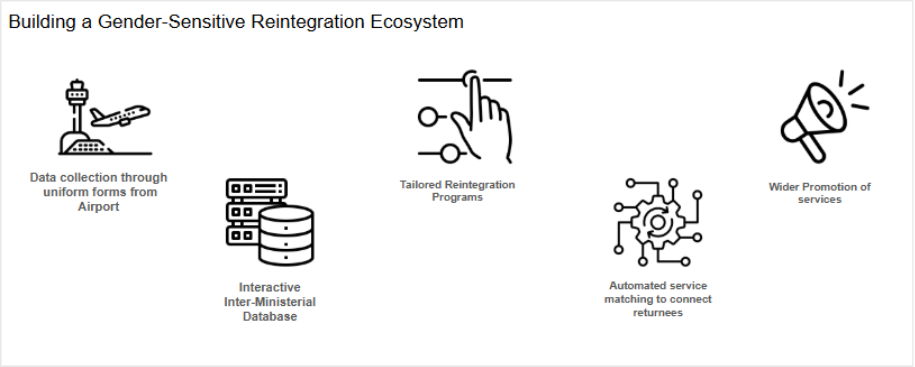
Unified Data Collection at Airports: Introduce standardized digital forms to capture essential information on returnees at the point of entry.
Interactive Inter-Ministerial Database: Develop a shared online platform linking WEWB, BMET, and DEMO offices to track returnee status, training participation, and program enrolment.
Tailored Reintegration Programs: Use data analytics to design customized interventions based on gender, district, and employment history.
Strengthened Referral System: Automate service matching to connect returnees quickly to relevant economic, social, or psychological programs.
Wider Promotion of Services: Conduct national awareness campaigns so that returnees understand and access available reintegration support.
Implementing these actions would enable policymakers to monitor reintegration progress, allocate resources efficiently, and provide evidence-based policy feedback. Over time, a strong data ecosystem can transform reintegration from a welfare function into a pillar of Bangladesh’s labour and social development strategy.
The increasing number of returnee women migrants represents both a challenge and an untapped opportunity for Bangladesh. By addressing structural barriers, through integrated data systems, gender-sensitive services, and institutional coordination, the country can convert return migration into a pathway for empowerment and growth.
Reintegration should not be viewed as the end of the migration cycle but as the beginning of a new phase of contribution. Where women returnees are equipped to become entrepreneurs, skilled workers, and agents of social change. With a stronger reintegration ecosystem, Bangladesh can truly move beyond remittance, transforming migration into a sustainable engine for inclusive national development.
This article was authored by Tasnia Isbat, Business Analyst at LightCastle Partners
For further clarifications, contact here: [email protected]
Our experts can help you solve your unique challenges
Stay up-to-date with our Thought Leadership and Insights