

GET IN TOUCH
- Please wait...

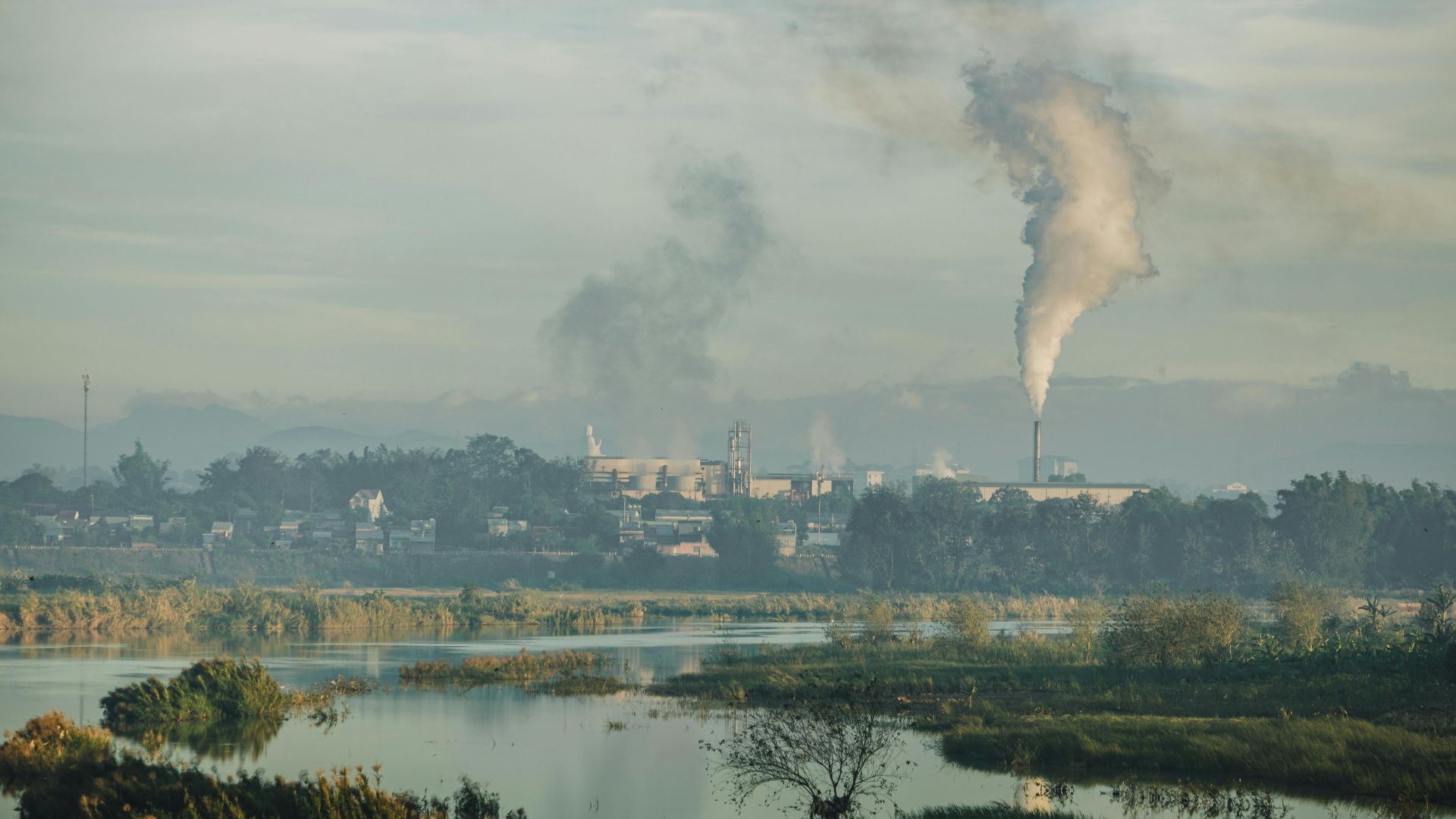
In January 2025, Dhaka recorded an Air Quality Index of 622 on its worst day, and not a single one of the month’s 31 days crossed into the “clean” category.i This was not an anomaly. Over the nine years from 2015 to 2024, Dhaka has recorded only 31 days of clean air in total.ii Tackling air pollution has become of paramount importance.
In the latest 2025 IQAir World Air Quality Report, Bangladesh ranked as the second most polluted country in the world and Dhaka as the second most polluted capital – trailing only New Delhi.iii What is often framed as a seasonal nuisance is, in reality, a slow-moving public health emergency with a measurable price tag attached to it.
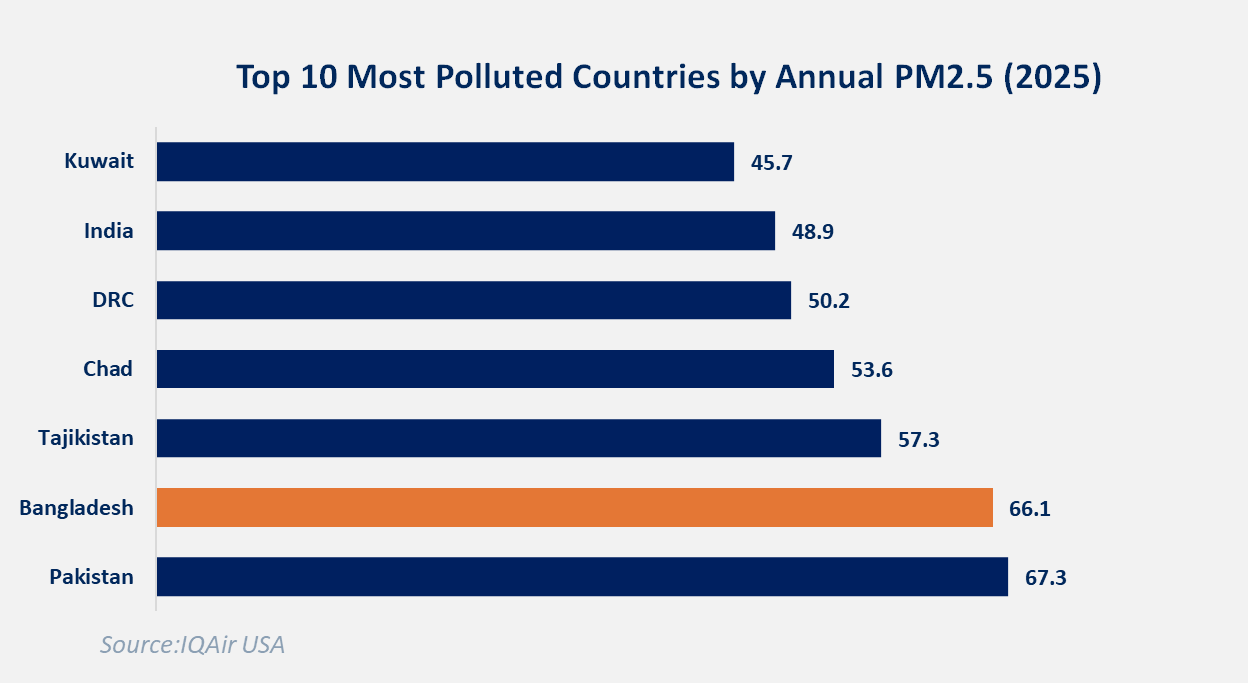
Bangladesh’s annual average Particulate Matter 2.5 (PM2.5) concentration stood at 66.1 µg/m³ in 2025, which is 13.2 times the World Health Organization’s (WHO) safe guideline of 5 µg/m³ and close to twice the national standard of 35 µg/m³. iv The crisis is nationwide, not just confined to the capital.
Industrial hubs such as Narayanganj averaged 109.7 µg/m³, while Gazipur, Chattogram, Rajshahi, and Khulna all sit well above both WHO and domestic thresholds.v Even Lalmonirhat, the country’s least polluted district, breathes air seven times dirtier than the WHO recommends.vi
Pollution levels swing sharply with the seasons, running four to five times higher in the dry months from November to March than during the monsoon.vii Regardless of these seasonal fluctuations, the annual baseline remains universally hazardous, leaving all 170 million citizens breathing air that fails safety standards.viii These pollution levels are not only an environmental concern but also a significant driver of public health and economic losses across the country.
The most visible toll is mortality. Fine particulate pollution is linked to an estimated 102,456 deaths in Bangladesh every year, driven by ischaemic heart disease, stroke, Chronic Obstructive Pulmonary Disease (COPD), and lower respiratory infections.ix When household air pollution is added in, the Lancet Countdown 2025 places the annual death toll at around 225,000, a 28 percent rise since 2010.x
Moreover, The Air Quality Life Index finds that polluted air shortens the average Bangladeshi’s life by almost 5.5 years, a burden heavier than that of tobacco and child malnutrition combine.xi
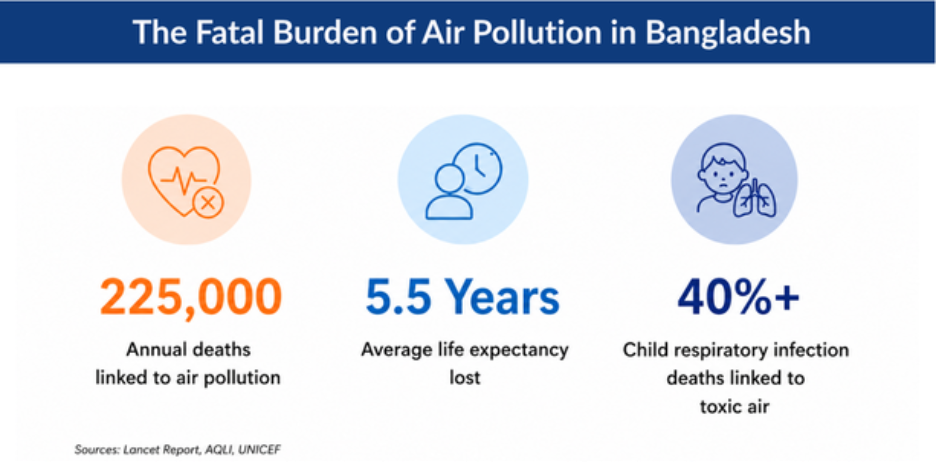
Children carry a disproportionate share of this burden. Over 19,000 children under five died from air pollution-related causes in 2021, and more than 40 per cent of child deaths from lower respiratory infections are attributable to toxic air.xii
Occupational exposure compounds the crisis for vulnerable working populations. For instance, rickshaw pullers in Dhaka show significantly reduced lung function compared to rural peersxiii, and the estimated 3.5 million ready-made garment workers, most of them women, endure airborne dust and chemical exposure that often forces early exits from the workforce.xiv
The World Bank has also documented a striking mental health link: a 1 percent increase in PM2.5 above WHO guidelines raises the probability of depression by roughly 20 percent.xv
These health outcomes translate directly into lost output. The World Bank’s 2023 Country Environmental Analysis estimated that air pollution alone costs Bangladesh the equivalent of 8.32 percent of GDP, or nearly USD 32 billion annually.xvi CREA’s more conservative estimate places the ambient-pollution bill at USD 11 billion per year, or roughly 4.4 to 4.8 percent of GDP. xvii
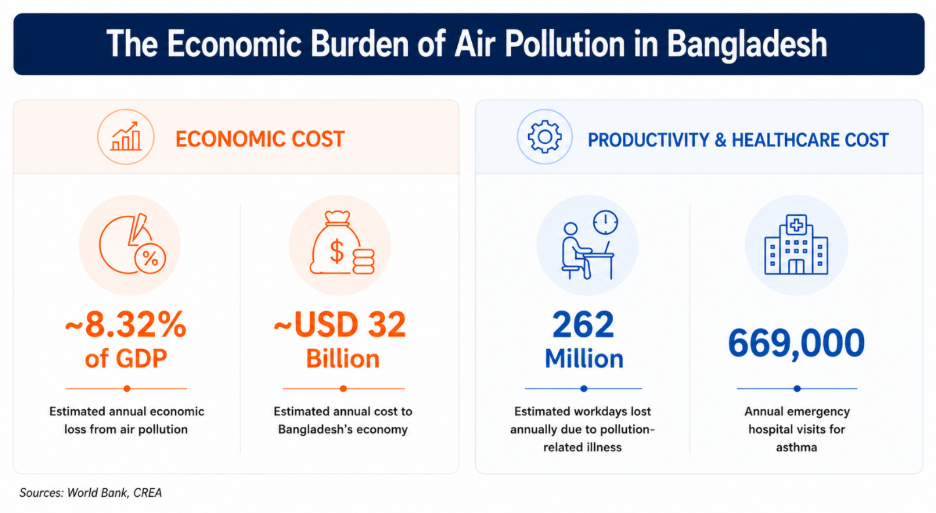
On productivity, the same CREA analysis estimates approximately 262 million workdays lost annually to pollution-related illness, alongside 669,000 emergency hospital visits for asthma each year.xviii The gap between the World Bank and CREA estimates reflects differences in valuation methodology rather than disagreement on the underlying health burden. Both figures, however, point in the same direction.
For an economy targeting upper-middle-income status by the early 2030s, these losses reduce labour productivity, compress household incomes, and constrain the fiscal space available for public investment.
Bangladesh’s toxic air is the product of a handful of well-identified sources. Brick kilns, of which the country operates roughly 8,000, account for 11 percent of national PM2.5 emissions.xix Construction dust and an ageing vehicle fleet running on Euro I and Euro II standards contribute another substantial share.xx
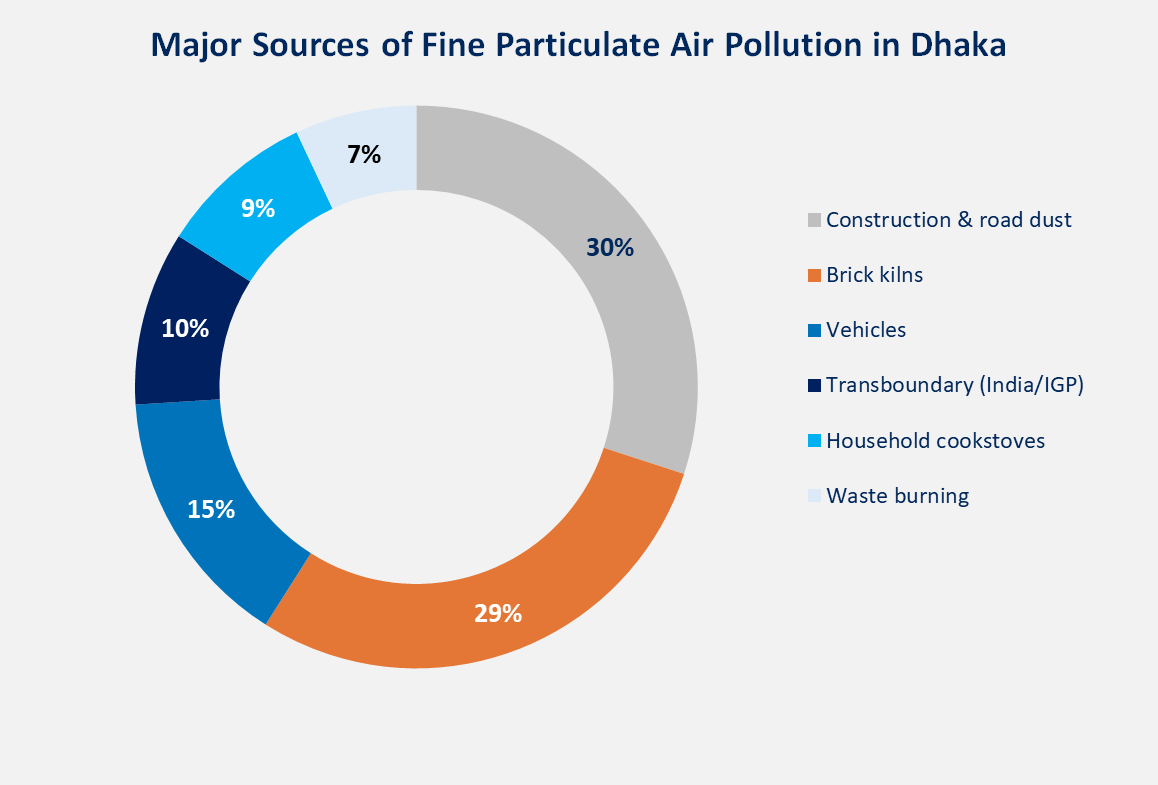
Roughly 30 percent of pollution in Bangladesh’s largest cities drifts in from across the border, carried by winter winds from India’s Indo-Gangetic Plain.xxi At home, nearly three-quarters of households still rely on solid biomass fuels for cooking, filling indoor spaces with smoke.xxii
Bangladesh has gradually expanded its policy response to air pollution, but implementation continues to lag regulatory ambition. The proposed Clean Air Act remains pending, while enforcement of the Brick Kiln Act 2013 has been inconsistent, with many operators still functioning without environmental clearance certificates. The National Air Quality Management Plan 2024–2030 offers a more structured framework, but its effectiveness will depend heavily on enforcement capacity and inter-agency coordination.
Experiences from neighbouring and peer economies offer useful operational lessons for translating policy ambition into measurable outcomes. For instance:
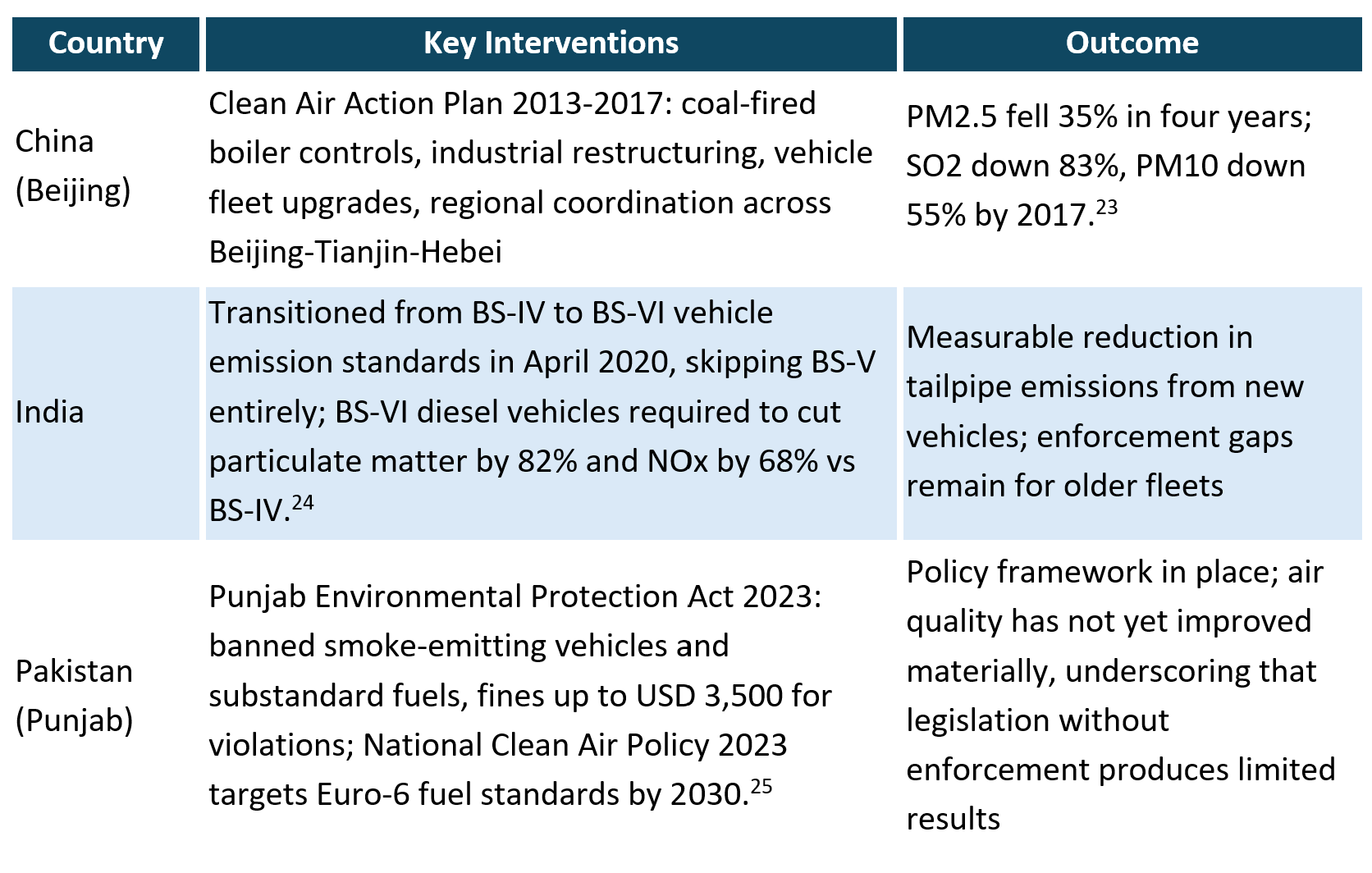
Despite the scale of the challenge, evidence from Bangladesh and abroad suggests that several air quality interventions are both technically feasible and economically viable. Recent research also indicates that cleaner production methods can generate direct commercial benefits alongside environmental gains.
A 2025 randomised controlled trial published in Science found that low-cost operational adjustments at zigzag brick kilns in Khulna reduced PM2.5 and CO2 emissions by 20 percent each, while saving kiln owners over USD 35,000 in fuel costs per kilnxxvi. The intervention ultimately generated a social benefit-to-cost ratio of 65 to 1.
Building on these findings, several priority interventions emerge for Bangladesh:
Bangladesh’s participation in the Indo-Gangetic Plains regional platform under BCAP is a starting point, but bilateral coordination with India requires further formalisation.
Overall, Bangladesh already possesses the foundations of a credible response through the National Air Quality Management Plan and the BCAP financing framework. The central challenge now lies less in policy formulation and more in implementation, monitoring, and institutional enforcement across major polluting sectors. Sustained improvements in air quality will increasingly shape Bangladesh’s future competitiveness, urban liveability, and public health resilience.
This article was authored by Safin Sadique, a Business Analyst at LightCastle Partners.
For further clarification, please contact: [email protected].
[1] [Prothom Alo, https://en.prothomalo.com/environment/pollution/k4pw4lj8td]
[2] [Dhaka Tribune, https://www.dhakatribune.com/bangladesh/bangladesh-environment/379368/data-dhaka-breathed-clean-air-on-only-31-days-in]
[4] [IQAir, https://www.iqair.com/world-air-quality-report]
[5] [AQLI, https://aqli.epic.uchicago.edu/files/Bangladesh%20FactSheet_2025.pdf]
[6] [AQLI, https://aqli.epic.uchicago.edu/files/Bangladesh%20FactSheet_2025.pdf]
[7] [Nature Scientific Reports, https://www.nature.com/articles/s41598-025-12815-9]
[8] [IQAir, https://www.iqair.com/world-air-quality-report]
[10] [The Daily Star, https://www.thedailystar.net/environment/news/bangladesh-saw-225-lakh-deaths-air-pollution-2022-lancet-report-4022306]
[11] [AQLI, https://aqli.epic.uchicago.edu/files/Bangladesh%20FactSheet_2025.pdf].
[12] [UNICEF, https://www.unicef.org/bangladesh/en/press-releases/disease-burden-air-pollution-children-continues-rise-bangladesh-according-latest]
[13] [JHEHP, https://oaji.net/articles/2020/4672-1600587042.pdf]
[14] [PMC, https://pmc.ncbi.nlm.nih.gov/articles/PMC6599266/].
[15] [World Bank, https://www.worldbank.org/en/news/press-release/2022/12/03/high-air-pollution-level-is-creating-physical-and-mental-health-hazards-in-bangladesh-world-bank].
[16] [World Bank, https://www.worldbank.org/en/news/press-release/2024/03/28/addressing-environmental-pollution-is-critical-for-bangladesh-s-growth-and-development]
[17] [CREA, https://energyandcleanair.org/publication/public-health-impacts-of-fine-particle-air-pollution-in-bangladesh/]
[18] [CREA, https://energyandcleanair.org/publication/public-health-impacts-of-fine-particle-air-pollution-in-bangladesh/].
[19] [J-PAL, https://www.povertyactionlab.org/evaluation/improving-brick-manufacturing-bangladesh-promote-clean-air-and-better-health].
[20] [Frontiers, https://www.frontiersin.org/journals/sustainable-cities/articles/10.3389/frsc.2021.681759/full]
[21] [World Bank, https://www.worldbank.org/en/region/sar/publication/striving-for-clean-air]
[22] [World Bank, https://blogs.worldbank.org/en/endpovertyinsouthasia/clearing-the-air–addressing-bangladesh-s-air-pollution-crisis]
[23] [CCAC, https://www.ccacoalition.org/news/beijings-air-quality-improvements-are-model-other-cities]
[24] [ScienceDirect, https://www.sciencedirect.com/science/article/abs/pii/S1361920922004291]
[25] [UNEP, https://www.unep.org/technical-highlight/pakistans-punjab-charts-roadmap-reducing-smog-and-vehicle-emissions]
[26] [Science, https://www.science.org/doi/10.1126/science.adr7394]
[27] [World Bank, https://www.worldbank.org/en/news/press-release/2025/06/18/world-bank-helps-bangladesh-improve-energy-security-air-quality].
[28] [World Bank, https://www.worldbank.org/en/region/sar/publication/striving-for-clean-air]
Our experts can help you solve your unique challenges
Stay up-to-date with our Thought Leadership and Insights