


GET IN TOUCH
- Please wait...

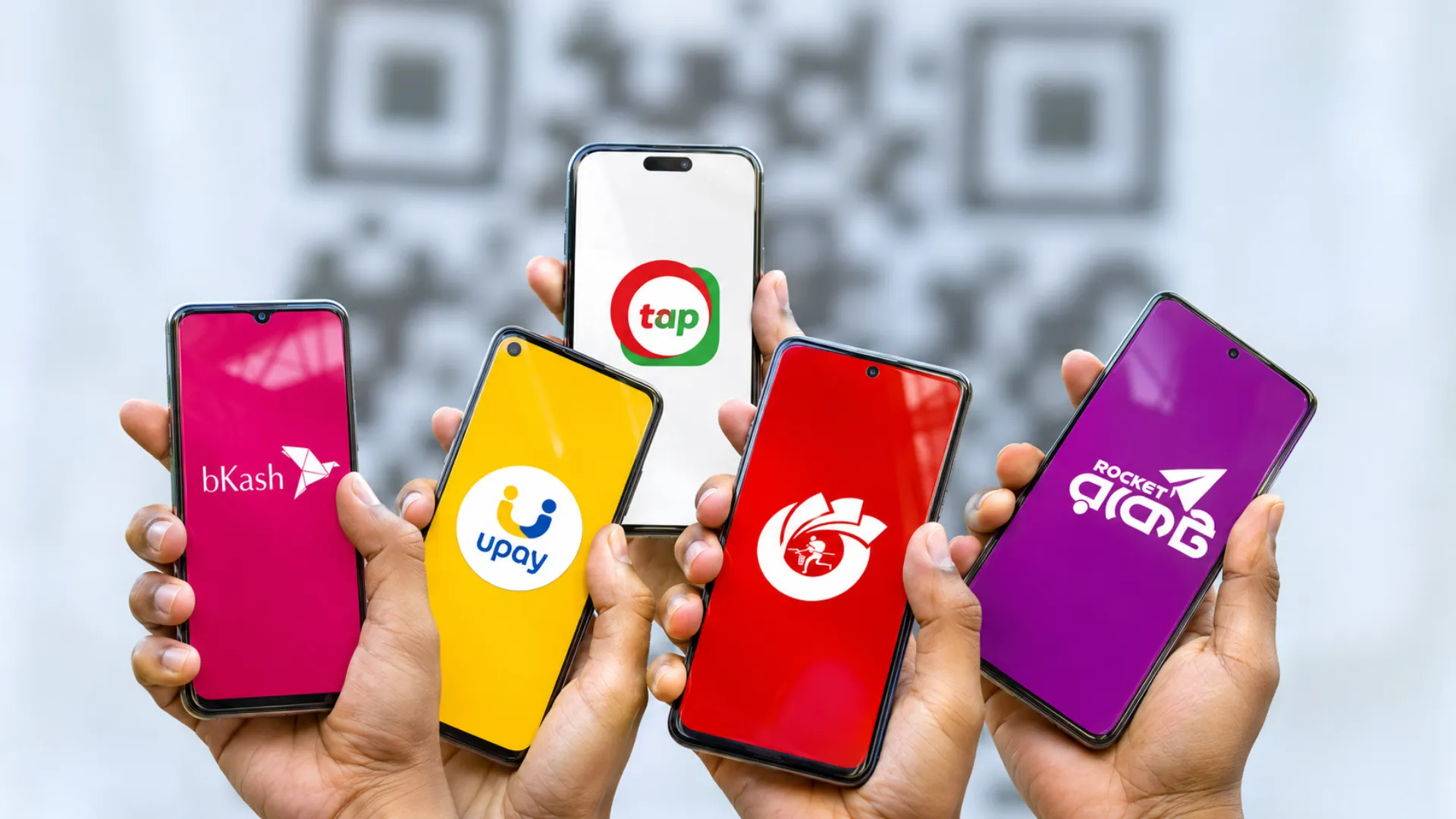
Over the last decade, mobile financial services (MFS) brought more Bangladeshis into formal finance than banks, especially the segments living in rural and lower-income communities who were underserved by banks or other financial institutions. USSD made services available on basic phones; agents helped customers open accounts and convert cash into digital balances and back again. People who had relied on cash gradually became accustomed to digital money and online transfers. By February 2025, Bangladesh had about 1.86 Mn MFS agents and 240.46 Mn registered accounts.1 It can be said that MFS providers in Bangladesh helped people build the habit of moving money digitally.
At the same time, MFS is not the most cost-friendly option for transfers or cash-outs compared with banking channels. As of today, cashing out through an MFS costs roughly BDT 12.50-18.50 per BDT 1,000, compared with typically nothing at one’s own bank’s ATM, or a flat BDT 15 per withdrawal (up to BDT 20,000) at another bank’s ATM (for the first five transactions a month).2 Similarly, bKash, the market leader, charges a flat BDT 5 per transfer for most users, whereas same-bank transfers are typically free. This means that people who rely on MFS because of their inaccessibility to banking channels often pay more than bank users do.
In theory, interoperability should have brought these costs down for MFS users. The market had have several banking apps and MFS providers, but money could not move from one wallet to another, and customers could not use another provider’s merchants or agents to pay or cash out balances. Each wallet was a closed system, so customers had to pay whatever cash out or transfer fee its wallet had set. If money could move freely, customers would have cashed in one wallet depending on their convenience, and then route money to the wallet that had the cheapest charge in terms of cash out or wallet transfer. This would inevitably bring the MFS charges into a market equilibrium, where providers had to charge same or almost the same to stay competitive.
However, interoperability did not fix this issue. Bangladesh launched its first interoperable platform, Binimoy, in 2022 to let customers transact across banks and MFS providers without opening an account with each. However, due to irregularities and breach of contract, Bangladesh Bank had to suspend the platform 3 years later.3
The next attempt at interoperability was Bangla QR: a single code that lets customers pay any participating merchant from a bank, MFS, or payment app. This meant that because people no longer needed a particular MFS to pay a merchant. They can scan the Bangla QR code to pay at shops or restaurants, even when their MFS account is different than the merchant’s MFS account or they use banking apps instead of MFS.
This changed MFS usage for a lot of customers. When merchants only accepted from a specific MFS providers, customers had to open accounts in them and keep them funded. Now, with Bangla QR, they could pay from anywhere- When a wallet balance was the only way to pay at the shop, people had to keep it funded. Now a bank app can pay the same merchant at no cost to the customer, so customers did not need to open an account in different mobile wallets or keep money in them. Customer enthusiasm was reflected in the volume of transactions: Daily Bangla QR payments rose from BDT 28 Cr in June 2026 to about BDT 143.54 Cr by late September, across roughly 39 Lakh merchant points.4
User enthusiasm is understandable. But why would the MFS providers want to sign up for Bangla QR when it had the possibility to affect their revenue?
There are two reasons. The first is a regulatory mandate. In April 2026, Bangladesh Bank directed banks, MFS providers, and other payment providers to replace their proprietary merchant QR codes with Bangla QR by June 30. Non-compliance could bring fines of up to BDT 30 Lakh, up to three years in prison, or both.5 Payment providers had to follow the Bangla QR, regardless of their concern about profitability.
But could Bangla QR really affect MFS profitability? To answer this question, a brief overview of the QR payment system is needed. QR payments typically involve two fees: MDR and IRF. MDR, or the merchant discount rate, is what a merchant pays its acquirer, the bank or MFS that signed it up. IRF, or the interchange reimbursement fee, is what the acquirer pays the issuer, the provider whose app the customer paid from. Before Bangla QR, an MFS merchant’s payment QR code only accepted payments from that same MFS provider, which means MFS providers received the MDR fee from the merchants and did not have to pay the IRF, because the acquirer and the issuer were the same provider.6 After the implementation of Bangla QR, the customer and the merchant can be on different providers, which means a merchant’s MFS providers will now have to pay the IRF fee to the customer’s MFS providers, which creates a split in their revenues.
After that, Bangladesh Bank then changed those fees. In July, it set a minimum MDR of 1%, meaning merchants had to pay at least 1% of every QR payment. From October 1, it removed that minimum and set IRF to zero.4 The merchant’s provider no longer has to pay anything to the customer’s provider, and it can now sign up merchants for free or for a small fee. To compensate for the cost, Bangladesh Bank pays the merchant’s provider BDT 1, and the customer’s provider gets BDT 2 on every BDT 1,000.4
For MFS providers, the effect is mixed. When a bank customer pays at an MFS provider’s merchant through Bangla QR, that MFS keeps whatever fee it charges the merchant and does not pay the IRF charge to the bank. When an MFS user pays at a bank’s merchant through Bangla QR, the MFS provider earns nothing except the compensation offered by the central bank. The main takeaway here is that since the issuer and acquirer are no longer the same entity, revenue from merchant payments have changed for MFS—whether that is positive after the central bank’s compensation or still negative needs to be seen.
In a regulated setting, Bangla QR may or may not negatively impact MFS’s revenue. But people are already finding ways around the rules. One example is the illegal way of cashing out wallet balances through Bangla QR. Cashing out BDT 30,000, which is the maximum one can cash out through an MFS, costs at least BDT 387.7 Through a merchant’s QR code, it costs little or nothing, so some have started bypassing agents and started cashing out through a merchant — paying the shopkeeper a small fee or nothing at all. Prothom Alo reported cases of tens of Lakhs of taka withdrawn this way within days, with untraceable fund trails.7
At the same time, MFS providers can do little to decrease the cash-out charges. The cash-out charge that MFS providers receive is usually shared among agents, distributors, mobile network operators, the government and the provider.2 In 2017, the Daily Star reported that bKash shared 77% of the revenue per transaction with its agents and 7% of its 1.85% transfer charge with mobile operators.8 Recent reports describe the same split. Providers also pay commissions on cash-in: for every BDT 1,000 deposited through an agent, they pay the agent, distributor and mobile operator at least BDT 6.40 between them.7 So cutting the cash-out charge means cutting the income of agents and distributors, or the revenue that pays for the cash network, and neither is easy for MFS providers to do.
The pressure is not limited to cash-out. Money can already move from banks to wallets cheaply: many banks allow customers to send money to MFS wallets free of charge, so a bank app customer sending money to someone’s MFS account does not pay an MFS-to-MFS peer transfer charge. With Bangla QR, customers can also pay merchants straight from a bank app, so they no longer need to top up a wallet first. This may lead to a future where fewer and fewer users keep money in MFS or actively use them in day-to-day life. Person-to-person QR transfer could push this further. Bangladesh Bank has instructed providers to prepare for its rollout from November 2026, after which customers can send money by scanning another person’s Bangla QR code from their bank app instead of using a wallet. As a result, fewer people may use MFS for payments and person-to-person transfers, although how many will depend on fees and reliability that are not yet known.4
Digital banks add a longer-term challenge. As of September 2026, five proposed digital banks had received initial approval or Letters of Intent, and these banks could compete with MFS and traditional banks through convenience, interoperable payments, and digital deposit and credit products.9
These developments put pressure on the MFS model. This raises the question: will MFS become obsolete?
Probably not in the near future. First, Bangla QR does not replace MFS or banking apps; it runs through them. It removes the exclusivity of MFS merchant networks, not MFS itself. A bKash customer still pays from the bKash app. MFS customers are also already heavy QR users: in April, they made about twice as many QR payments by value as bank customers did.6
Second, merchant cash-out is a regulatory concern, not proof that everyday users are abandoning MFS agents. Bangladesh Bank requires providers to cancel the QR facility of any merchant caught using it for cash-out, and officials are considering transaction limits on merchants, so the practice is unlikely to last. 5, 7 Person-to-person QR transfers, due from November, are a bigger open question. Reports on the launch do not say what they will cost, so their effect on MFS depends on fees and reliability that are not yet known. 4
Next, other markets show that interoperability can either weaken wallets or push them to reinvent themselves. In India, wallets lost ground to UPI: between September 2023 and September 2024, wallet transactions fell by about 17% in volume and 40% in value while UPI kept growing.10 Interoperability was not the only cause, and regulatory action against Paytm’s wallet may also have contributed, but the numbers show that people will move away from wallets when a bank-account-based option is as easy to use. Pakistan shows another route. Easypaisa, formerly Telenor Microfinance Bank, became the country’s first licensed digital retail bank in January 202511, and its revenue rose 18.53% to PKR 46.1 Bn in 2025.12 bKash seems to be taking a similar path with bKash Digital Bank, which could become a way for MFS to shift its revenue towards savings and lending from cash-out and payment charges in the future.9
Finally, many people still depend on cash for day-to-day transactions, so agents and cash-outs are likely to remain important. A Daily Star column cites 71.7% of all transactions being cash-based in December 2024.13 Digital banks can compete with MFS on convenience, payments, savings and credit, but under Bangladesh Bank’s guidelines they cannot operate their own branches, agents or ATMs and must rely on existing bank, MFS and ATM networks for cash.14 In a country where cash is so prominent in everyday life, the threat of digital banks overthrowing MFS seems slim.
MFS appears to be here to stay, at least for now. Some customers are likely to move to banking apps or digital banks, especially younger, educated users who are comfortable with technology and care about cost and convenience. Eventually, when Bangladesh becomes a cashless society, MFS providers will have to move on from the revenue generated through cash-in and cash-out, and focus more on what customers do with their money, such as digital savings and lending products. Such diversification of services is already in practice: City Bank’s digital nano loan, offered through the bKash app, has disbursed more than BDT 10,000 Cr since December 2021.15 Other MFS providers are likely to follow this route, through bank tie-ups like this one or a digital bank of their own, as bKash Digital Bank suggests.
The integration of interoperable payments and digital banking does not mean MFS is going away. It means its business model is going to change.
This article was written by Sabiba Hossain, Business Analyst at LightCastle Partners. For further clarifications, contact here: [email protected].
Our experts can help you solve your unique challenges
Stay up-to-date with our Thought Leadership and Insights