



GET IN TOUCH
- Please wait...

Bangladesh has relied on external finance for several decades, and the question this article examines is whether the current round of stabilization borrowing is strengthening the country’s capacity to finance its own recovery. External support has helped keep essential imports moving and has given the government time to repair public finances. Repayment commitments, however, continue to accumulate while revenue remains low, which means that each budget has to accommodate past borrowing alongside present needs. Where the resulting adjustment falls on investment and social protection, it can weaken the foundations on which future recovery depends and, in turn, add to the pressure to borrow again.
The risk in this sequence is that securing the next loan becomes progressively more important while the domestic capacity that would reduce reliance on such loans remains underfunded. Food security and social protection sit within this sequence because public spending supports farm productivity, household incomes and children’s development, each of which feeds into the economy’s future earning capacity. A financing strategy that repeatedly sacrifices these functions is therefore likely to become harder to sustain over time, as claims on future income grow at the same time as the capacity to generate that income is eroded.
In April 2026, the World Bank reported that poverty in Bangladesh had risen for three consecutive years, alongside persistent inflation, weak revenue, stressed banks and subdued private investment. [1] Under these conditions, a further financing package can provide immediate relief, although the underlying demand for support is likely to persist unless the conditions driving that demand also change. The lasting value of borrowing in this context depends largely on what the government is able to build during the time that the borrowing buys.
Climate change adds to this underlying problem by raising the cost of maintaining livelihoods and infrastructure. These additional costs fall on a budget that is already constrained by weak revenue, debt service and the terms on which external financial support arrives, which is why the climate and financing pressures are examined together in the sections that follow.
The FY2025 fiscal data indicate that this squeeze is already under way. Tax revenue fell to 6.9 percent of GDP, and interest absorbed about 29 percent of revenue and grants. Annual Development Programme (ADP) expenditure fell from 3.9 percent of GDP in FY2024 to 2.3 percent, and the IMF records that cuts to capital and social spending helped meet the primary-deficit target despite a substantial revenue shortfall. [2] Spending compression therefore delivered the immediate fiscal result, with investment and household support absorbing much of the adjustment.
Because interest adds to current expenditure and maturing principal has to be repaid or refinanced, persistent revenue weakness turns debt management into a recurring claim on future budgets. Foreign-currency borrowing adds exchange-rate exposure to this, since depreciation raises the taka cost of servicing a given foreign obligation. Domestic debt also accounts for more than half of public and publicly guaranteed debt, which links external financing pressures to a domestic financial system that is already under strain. [2] If foreign financing falls short, the government is left to choose among additional domestic borrowing, spending restraint and other forms of adjustment. Greater reliance on domestic banks can, in turn, crowd out private credit, making it harder for enterprises to finance the activity that sustains household earnings. [2]
The joint IMF–World Bank Debt Sustainability Analysis judges debt to be sustainable under its baseline and places the risk of external and overall debt distress at moderate. That baseline assumes stronger revenue and continued reform, and the assessment also warns of rising domestic debt-service pressures and limited capacity to absorb shocks. [2] Sustainability under this assessment therefore depends on economic and institutional gains that prolonged spending compression could undermine. If investment and household security weaken, recovery is likely to slow, which would make the next revenue target harder to reach and could renew the pressure for further cuts and borrowing. Figure 1 shows how unevenly the FY2025 budget was executed across spending categories.
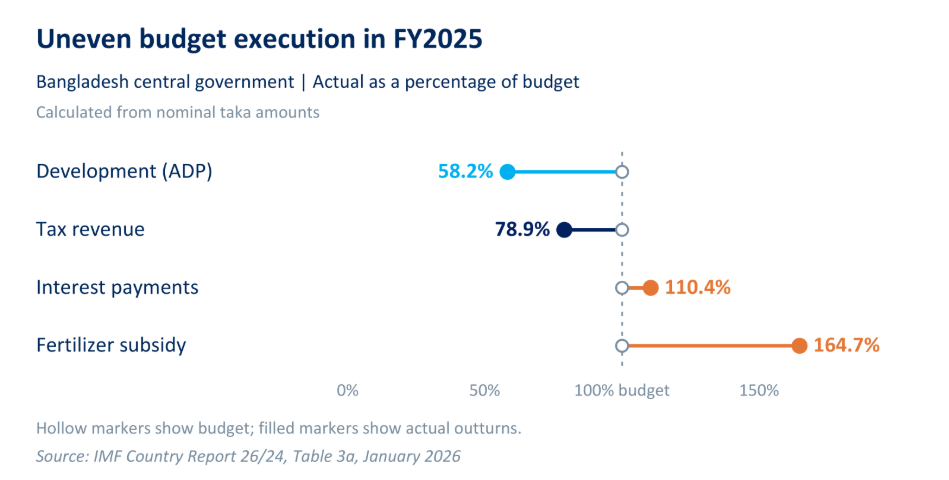
Figure 1. Uneven budget execution in FY2025. FY2025 ADP expenditure was 41.8% below budget, while fertilizer subsidies were 64.7% above budget. [2] Fertilizer import exposure is discussed in the climate section below.
For agricultural households, tighter public budgets can weaken the services and support that sustain production and earnings. Farmers rely on irrigation, affordable inputs and functioning transport links, and landless workers depend on the wages that cultivation generates. When assistance is delayed, low-income farming and landless households facing income gaps may borrow to buy food or sell productive assets, which can leave less income available for the following season. Limited fiscal room can therefore make it harder to prevent households from losing the assets on which their future incomes depend.
These livelihood risks may help explain why a strong national harvest forecast does not necessarily translate into secure food access for vulnerable households. FAO’s September brief forecast 2026/27 paddy output at about 5 percent above average, yet IPC’s June analysis projected that 18.1 million people across 36 districts and four special areas would face Crisis or worse acute food insecurity during September–December 2026, up from an estimated 15.3 million in May–August. [3, 4] The two estimates measure different things, as the FAO forecast describes national supply and the IPC analysis assesses food access in selected areas. Where earnings are low and prices are high, households may be unable to afford adequate diets even when aggregate production is strong.
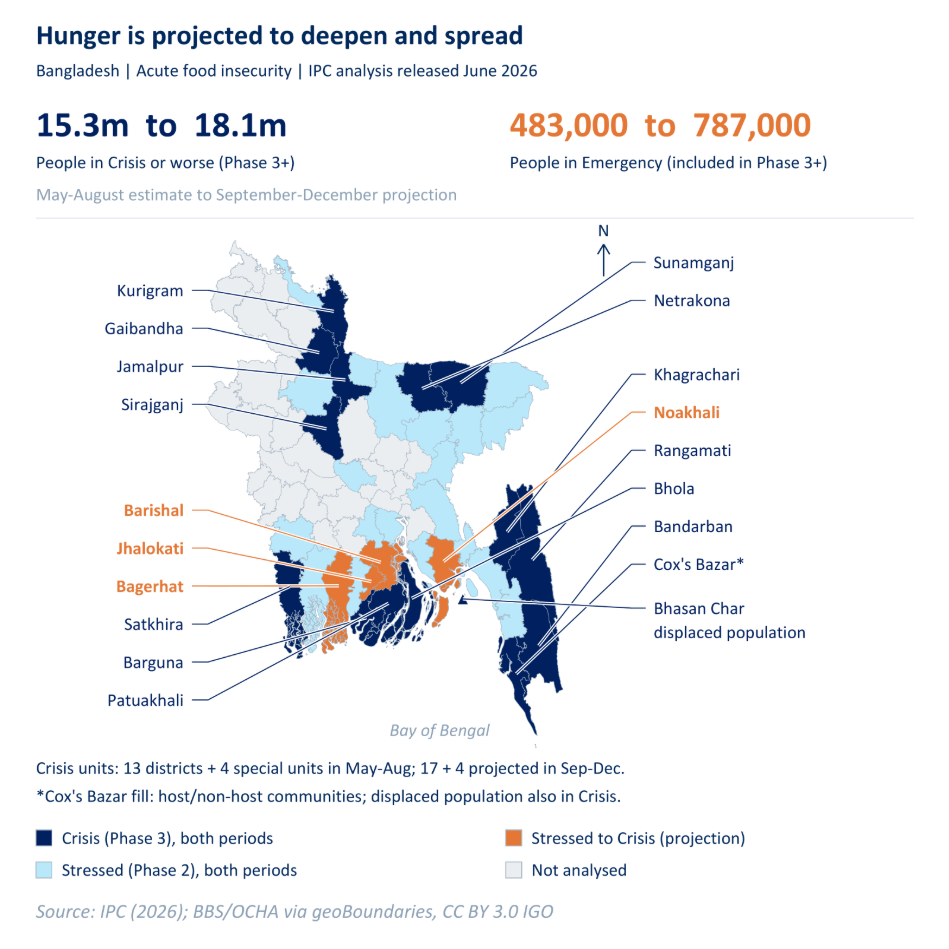
Figure 2. IPC area classifications and four districts projected to enter Crisis. Population totals count people in Phase 3+ and its Emergency subset, across the assessed districts and special population groups. [4]
Social protection has to absorb these pressures from an uneven starting point. The World Bank’s 2025 poverty assessment found that half of the poorest families received no social-protection benefit in 2022. [5] IPC has also projected nearly 3.7 million cases of acute malnutrition among children aged 6–59 months across 37 disaster-prone districts during 2026, identifying disease, inadequate feeding and poor water and sanitation among the drivers. [6] Because these drivers are multiple, cash support on its own would mainly address affordability, and reducing malnutrition would also depend on nutrition treatment and on water, sanitation and health services.
The consequences of these gaps can extend across decades, since childhood nutrition shapes learning and, later, adult earnings. [7] Repeatedly underfunding food access, health and education is therefore likely to reduce future productive capacity, and families carrying debt with fewer assets may remain dependent on assistance for longer. Over time, the state could face greater social needs with a weaker base for revenue collection. A budget saving achieved by allowing these losses to accumulate may, in this way, create obligations that outlast the loan programme itself.
Climate change adds further demands to this strained system. The fiscal question is whether protection can be funded before damage raises relief, repair and import bills, which would otherwise draw on the same constrained budget.
In Bangladesh, Boro rice is mainly irrigated and supplies about 55 percent of annual paddy output. [3] IRRI identifies water scarcity and pumping-cost constraints in northwestern Bangladesh as recurring problems for Boro cultivation. [8] Higher pumping costs raise farmers’ cash needs before harvest, and unreliable irrigation puts at risk their ability to recover those costs once the crop is sold. Water-saving irrigation, such as the alternate wetting and drying practice that IRRI promotes in the region, and timely assistance with pumping costs could reduce this exposure. [8]
Foreign-exchange dependence adds a further channel of pressure, as Bangladesh imports more than 85 percent of its fertilizer requirements. The World Bank’s June 2026 emergency package included US$300 million for fertilizer imports. [9] When imported fertilizer becomes more expensive in taka terms, maintaining subsidized farm prices raises the public cost of shielding farmers. Emergency finance of this kind supports immediate supplies, yet recurring import needs continue to require foreign exchange in subsequent seasons. Climate-related losses can then add relief and recovery costs to the same constrained budget. If borrowing repeatedly covers emergencies while protection remains weak, repayment obligations are likely to grow alongside the cost of the next shock.
Both the government and its lenders shape how this pressure is distributed. The government controls tax collection, tax exemptions, banking governance and spending choices, and lenders help set reform deadlines and the conditions under which funds are released. A cross-country study covering 1980–2015 links market-liberalizing structural conditions to programme interruptions, and those interruptions to higher sovereign borrowing costs. [10] For Bangladesh, this evidence points to a sequencing risk, in which a reform timetable that proves difficult to implement could put planned financing at risk.
Under current IMF rules, a missed quantitative performance criterion may require a Board waiver, and structural benchmarks and indicative targets feed into the overall review assessment. [11] Bangladesh’s programme already includes indicative floors for social and capital spending, alongside climate support through the Resilience and Sustainability Facility (RSF). The capital floor was nonetheless missed in June 2024 and the social floor in September, before both were met in December. The 2024 political upheaval disrupted implementation and contributed to a recalibration of the programme, with reviews modifying criteria and extending the arrangements; the waiver concerned exchange restrictions and followed corrective action. [12] This record suggests that the programme has some room for flexibility, which could be used to protect the timely delivery of essential spending more consistently.
Coverage and sequencing are likely to matter as much as the floors themselves. The social floor excludes agricultural subsidies, and aggregate capital targets cannot show whether irrigation works are ready before planting or whether recurrent maintenance is funded. [12] An IMF working paper also finds that energy reforms are commonly attached to prior actions, whereas social-assistance floors commonly remain indicative targets. [13] If energy-price adjustments raise pumping and living costs before compensation arrives, vulnerable households may in effect be left to finance the transition themselves, and the debt they take on to do so can carry the cost of reform into subsequent seasons.
The design of Bangladesh’s next agreement offers an opportunity to address this cumulative pressure. The IMF’s October 2026 update still described discussions as continuing after the government’s request for a new programme, which leaves the design open. [14, 15] The government could use that opening to connect borrowing with measurable improvements in revenue, productive capacity and household security, so that each round of support reduces the need for another.
One way to do this would be to define a costed set of essential services with payment deadlines and delivery measures attached. Irrigation maintenance, early transfers and nutrition services are strong candidates for priority, since the preceding sections suggest that delays in these areas are the most likely to create lasting losses. Funding for them could come from deferring lower-value expenditure, collecting more from taxpayers who currently benefit from exemptions, and securing affordable finance within debt and reserve limits. Because tax capacity tends to grow with the effectiveness of state institutions, staffing and collection systems would also need sustained investment. [16]
Protection should, as far as possible, reach households before price reforms raise their costs, with payment deadlines built into the reform timetable itself. Contingent financing could specify verified shock triggers, release conditions, limits and decision deadlines, together with agreed procedures for reconsidering fiscal targets when a shock occurs. The Fund’s 2026 review of programme design and conditionality supports contingency planning, and the negotiations would need to translate that principle into money that is available at the point when services need it. [17]
Over the coming decades, continued reliance on borrowing without stronger revenue and productive capacity would likely leave Bangladesh devoting a growing share of its fiscal effort to financing short-term stability as social needs accumulate. Based on the evidence reviewed, the costs of that path would be borne largely by households unable to rebuild their assets, by children whose development is affected by poor nutrition, and by public institutions with less capacity to protect the next generation. Reducing this dependence would therefore require using current finance to build the revenue, productive and institutional capacity that makes future borrowing less necessary.
The article was authored by Mir Mohammad Hamza, Business Consultant at LightCastle Partners. For further clarification, please contact [email protected].
[1] World Bank. 2026. Urgent Reforms Needed to Restore Macro Stability Sustain Growth and Create Jobs in Bangladesh. 8 April.
https://www.worldbank.org/en/news/press-release/2026/04/08/urgent-reforms-needed-to-restore-macro-stability-sustain-growth-and-create-jobs-in-bangladesh
[2] International Monetary Fund. 2026. Bangladesh 2025 Article IV Consultation. IMF Country Report No. 26/24, January. Staff report paras. 4, 14–19 and Tables 1, 3a and 3b; joint IMF–World Bank Debt Sustainability Analysis, paras. 2 and 14–20. Fiscal years run July–June; interest share calculated from rounded Table 3b ratios.
https://www.imf.org/-/media/files/publications/cr/2026/english/1bgdea2026001-source-pdf.pdf
[3] Food and Agriculture Organization. 2026. GIEWS Country Brief Bangladesh. Reference date 4 September. Paddy is unmilled rice. Accessed 29 October 2026.
https://www.fao.org/giews/countrybrief/country.jsp?code=BGD
[4] Integrated Food Security Phase Classification. 2026. Bangladesh Acute Food Insecurity Current Situation for May–August 2026 and Projection for September–December 2026. Released 30 June.
https://www.ipcinfo.org/ipc-country-analysis/details-map/en/c/1164690/?iso3=BGD
[5] World Bank. 2025. Job Creation Key to Equality and Faster Poverty Reduction in Bangladesh says World Bank. 25 November. Social-protection incidence uses 2022 household data.
https://www.worldbank.org/en/news/press-release/2025/11/25/job-creation-key-to-equality-and-faster-poverty-reduction-in-bangladesh-says-world-bank
[6] Integrated Food Security Phase Classification. 2026. Bangladesh Acute Malnutrition Situation for January–December 2026. Released 31 August. Food-insecurity and malnutrition estimates have different coverage and are not additive.
https://www.ipcinfo.org/ipc-country-analysis/details-map/en/c/1165433/?iso3=BGD
[7] World Bank. 2021. Early Years Programs in Bangladesh. 9 November. Nutrition, cognitive development and adult earnings.
https://www.worldbank.org/en/news/feature/2021/11/09/early-years-programs-sowing-the-seeds-for-a-brighter-future
[8] International Rice Research Institute. Undated. GHG Mitigation in Rice Bangladesh. Section on alternate wetting and drying in northwestern Bangladesh. Accessed 29 October 2026.
https://ghgmitigation.irri.org/focus-countries/bangladesh
[9] World Bank. 2026. Bangladesh World Bank Provides $1.1 Billion Emergency Support to Safeguard Food Security Livelihoods. 26 June. Package total as announced.
https://www.worldbank.org/en/news/press-release/2026/06/26/bangladesh-world-bank-provides-1-1-billion-emergency-support-to-safeguard-food-security-livelihoods
[10] Reinsberg, Bernhard, Thomas Stubbs and Alexander Kentikelenis. 2022. Compliance, defiance, and the dependency trap: International Monetary Fund program interruptions and their impact on capital markets. Regulation & Governance 16, 1022–1041. Published online in 2021.
https://doi.org/10.1111/rego.12422
[11] International Monetary Fund. IMF Conditionality. Sections on programme assessment and policy commitments. Accessed 31 October 2026.
https://www.imf.org/en/About/Factsheets/Sheets/2023/IMF-Conditionality
[12] International Monetary Fund. 2025. Bangladesh Third and Fourth Reviews under the ECF EFF and RSF Arrangements. Country Report 25/150, June. Staff report para. 14, programme tables, Technical Memorandum paras. 27–30, and Board decisions.
https://www.imf.org/-/media/files/publications/cr/2025/english/1bgdea2025001-print-pdf.pdf
[13] Hanedar, Emine and Zsuzsa Munkacsi. 2025. Designing Expenditure Policy Conditionality in IMF-Supported Programs. IMF Working Paper 25/22, sections I, III and IV.
https://www.imf.org/-/media/files/publications/wp/2025/english/wpiea2025022-print-pdf.pdf
[14] International Monetary Fund. 2026. Bangladesh Authorities’ Request for a New IMF-supported Program. Press Release 26/182, 3 June.
https://www.imf.org/en/news/articles/2026/06/03/pr26182-bangladesh-authorities-request-for-a-new-imf-supported-program
[15] International Monetary Fund. 2026. Press Briefing Transcript Asia Pacific Department Regional Economic Outlook Annual Meetings 2026. 15 October. Bangladesh programme discussions.
https://www.imf.org/en/news/articles/2026/10/15/tr101526-press-briefing-transcript-apd-reo-annual-meetings-2026
[16] Akanbi, Olusegun Ayodele. 2019. State Institutions and Tax Capacity An Empirical Investigation of Causality. IMF Working Paper 19/177, August.
https://www.imf.org/en/publications/wp/issues/2019/08/16/state-institutions-and-tax-capacity-an-empirical-investigation-of-causality-48555
[17] International Monetary Fund. 2026. Review of Program Design and Conditionality. Policy Papers 2026/031, published 24 September.
https://www.imf.org/en/publications/policy-papers/issues/2026/09/10/2026-review-of-program-design-and-conditionality-579561
Our experts can help you solve your unique challenges
Stay up-to-date with our Thought Leadership and Insights