




GET IN TOUCH
- Please wait...


The global labor market is reallocating, not collapsing. For Bangladesh, the question is no longer whether AI will arrive, but whether institutional capacity will move fast enough to spread the gains beyond a digitally fluent minority.
Between 2025 and 2030, employers expect 170 million new roles to emerge while 92 million disappear. Net jobs grow, but 22% of the current workforce will churn in five years.
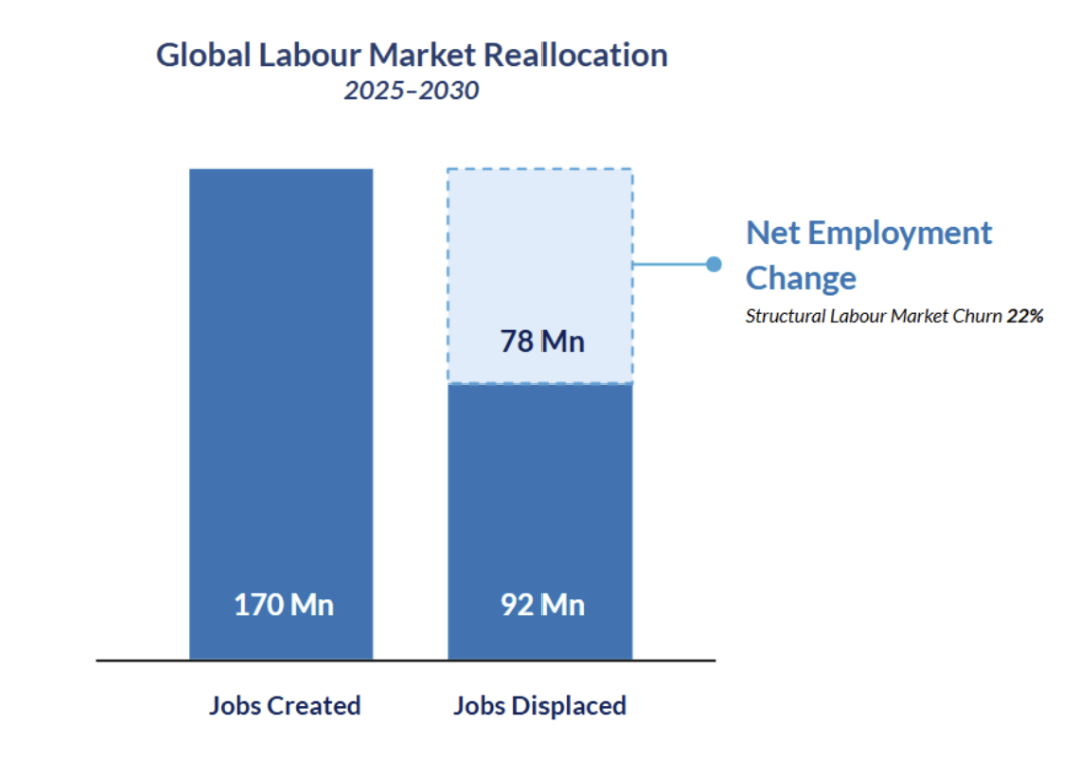
This is structural reallocation, not systemic decline. The pattern echoes past technological transitions. Electricity reshaped manufacturing only after factories redesigned production layouts around distributed power. Personal computing transformed firms only after workflows, reporting, and management practices were rebuilt around digital processes. Innovation creates the possibility and institutional adjustment converts that possibility into productivity.
AI sits in the late installation phase of its technological wave. Capability is racing ahead but absorption is lagging because incentives, skill pipelines, and governance frameworks evolve more slowly than the technology itself.
The decline curve clusters around routine cognitive work. Data entry clerks, administrative assistants, payroll clerks, and bank tellers are exposed because their tasks are structured, rules-based, and codifiable. As AI improves at document processing, pattern recognition, and transaction handling, the marginal value of human involvement in these tasks falls.
The growth curve clusters in two areas:
• Advanced digital and analytical roles: Big data specialists, AI engineers, fintech engineers, software developers, and information security analysts who design, manage, and secure digital infrastructure.
• Operational and sectoral roles: Logistics, infrastructure, renewable energy, environmental transition, and frontline service roles where physical execution, coordination, and contextual judgment remain critical.
Middle-tier routine jobs shrink, high-skill design and governance roles grow, and frontline operational jobs keep expanding. At the same time, the half-life of skills is shortening. Employers estimate 39% of core skills will change by 2030. Degrees alone are no longer sufficient. Continuous capability development becomes the baseline.
For advanced economies, this is a productivity transition. For Bangladesh, it is a competitiveness transition. The occupational mix will differ, but the underlying logic does not: routine cognitive tasks face higher automation exposure, and advantage shifts toward digital fluency, coordination capacity, and institutional readiness.
Digital adoption in Bangladesh is advancing but incomplete, and uneven infrastructure does not just slow adoption, it determines who benefits from it. Internet penetration sits at roughly 53% of the population, with rural connectivity and power reliability still constraining broad participation in digital productivity gains.
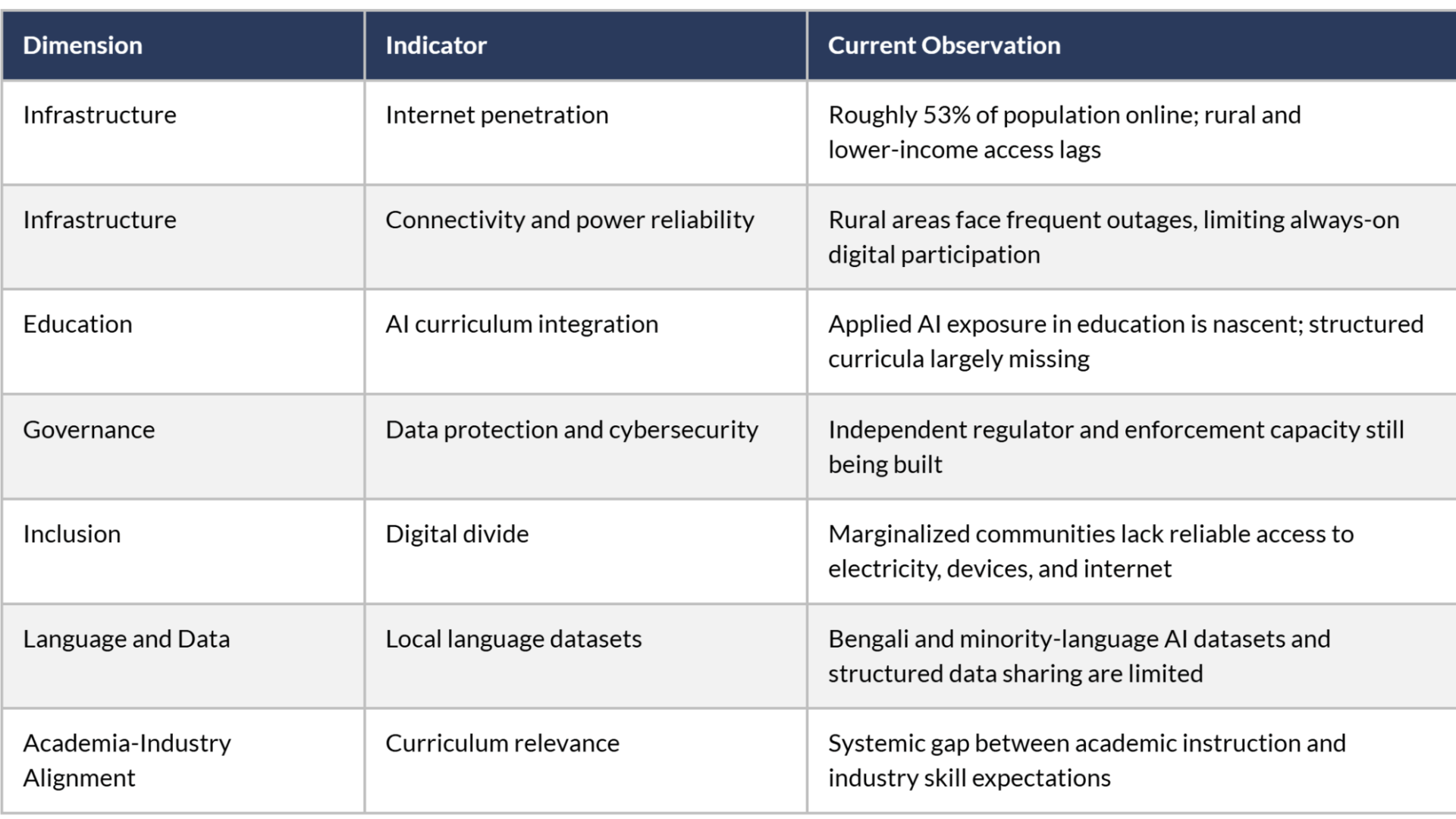
Beyond infrastructure, institutional readiness is still maturing. The national AI readiness assessment highlights weak independent oversight on data protection and cybersecurity. Scaled adoption in finance, healthcare, and public administration depends on regulatory clarity and institutional trust. Without credible safeguards, integration remains cautious and fragmented.
Education tells a parallel story, but with a faster lever in play. Applied AI integration in formal curricula is nascent, and industry-academia coordination is thin. In parallel, edtech platforms such as 10 Minute School and Shikho are already embedding AI-driven personalization, adaptive assessment, and tutoring tools that reach learners outside traditional classrooms. These platforms point to a delivery model that can scale faster than national curriculum reform, but they need policy support and integration with the formal credentialing system to convert reach into recognized capability.
This recasts Bangladesh’s strategic position, because comparative advantage has historically rested on labor scale and cost. AI shifts the basis of competition toward productivity intensity, coordination quality, and digital capability. The country faces both exposure and opportunity. Where the balance lands depends on the institutional response.
AI exposure in Bangladesh is not uniform. The map below assesses nine priority sectors across two dimensions: displacement risk (how exposed routine roles are to automation) and productivity upside (the potential value AI can unlock if institutional capacity scales).
| Sector | Displacement Risk | Productivity Upside | Strategic Implication |
|---|---|---|---|
| Banking and Finance | High | High | Highest near-term churn. Document processing, transaction handling, and routine credit ops are exposed. Upside requires redesigning credit, risk, and advisory workflows, not bolting AI onto existing ones. |
| BPO and IT Services | High | Medium | Routine outsourced tasks face direct substitution. Hedge is upskilling toward AI-enabled service delivery and higher-value engineering work. |
| Public Administration | High | High | Largest cost-efficiency lever in the system. Realization depends on governance reform, data infrastructure, and trust in digital service delivery. |
| RMG and Manufacturing | Medium | High | Routine line roles are durable for now. Real gains sit in supply chain optimization, predictive maintenance, and quality control. |
| Logistics | Medium | High | Routing, demand forecasting, and last-mile coordination are high-ROI use cases. Talent gap is the binding constraint. |
| Healthcare | Low | High | Clinical roles are protected. Gains are concentrated in diagnostic support, telehealth, and hospital operations. Regulatory clarity is the unlock. |
| Agriculture | Low | High | Crop intelligence, yield forecasting, and agri value chain coordination. Reaching smallholders at scale requires platform and connectivity investment. |
| Retail and E-commerce | Medium | Medium | Personalization, inventory optimization, customer service automation. Already underway among digital-first players. |
| Education | Low | High | Edtech platforms (10 Minute School, Shikho) already use AI for personalization and assessment. Policy support and integration with formal credentials is the next step. |
Assessment basis: Task composition (share of routine cognitive work), digitization maturity, share of GDP and employment, and observable AI use cases in comparable markets. Ratings are directional, not predictive.
Three patterns emerge:
• High-risk, high-upside sectors (banking, public administration) carry the biggest near-term workforce challenge but also the largest potential efficiency dividend. These will be won by enterprises and institutions that redesign workflows, not those that simply automate tasks.
• Low-risk, high-upside sectors (agriculture, healthcare, education) are where AI can deepen Bangladesh’s developmental gains without large-scale displacement. These need platforms, data infrastructure, and regulatory clarity more than retrenchment management.
• Medium-risk sectors (RMG, logistics, retail) need a balanced playbook: protect frontline scale, layer AI into operational decision-making, and upskill mid-tier supervisory roles.
If the labor market is undergoing structural reallocation, the central challenge is alignment: between skills and tasks, between technology and workflows, and between national ambition and institutional capacity. Without alignment, productivity gains concentrate inside a digitally fluent minority. With alignment, they diffuse.
1. For Individuals: Integrate, Do Not Just Specialize
Career durability will depend less on mastering one tool and more on combining four capabilities: analytical reasoning, communication, digital fluency, and domain expertise.
Example: An operations manager in manufacturing who can interpret a predictive maintenance dashboard and adjust production schedules accordingly creates more value than one confined to routine reporting. The advantage lies not in mastering a single tool, but in combining judgment, technical fluency, and contextual understanding in ways that complement automation.
2. For Enterprises: Redesign Workflows, Do Not Just Deploy Tools
Sustained advantage comes from operating model redesign, not isolated tool adoption. Automating routine tasks yields short-term efficiency gains. Sustained impact requires workflow reconfiguration, role redesign, and performance metrics that prioritize output and value creation.
Example: A bank that uses AI only to automate document verification cuts processing time marginally. A bank that redesigns its credit workflow by integrating AI-driven risk scoring, reallocating staff toward client advisory, and shortening approval cycles improves both asset quality and customer experience.
3. For Policymakers: Act Systemically, On Three Fronts At Once
Productivity gains diffuse across regions and income groups only when three systems advance together:
• Infrastructure. Reliable connectivity and power across rural and lower-income areas. Without this, digital adoption stays urban and elite, and AI’s productivity dividend concentrates.
• Applied Curriculum and Edtech Integration. Move beyond theoretical AI exposure. Embed analytical and digital competencies in mainstream education from secondary level upward. Use partnerships with edtech platforms to scale reach quickly, then formalize credentialing.
• Governance. Independent data protection and cybersecurity oversight. Without institutional trust, technology stays underutilized. Without skill alignment, opportunity stays uneven.
Technological transitions reward countries that align human capital, enterprise strategy, and regulatory capacity during the adjustment period. Bangladesh’s trajectory will depend less on the pace of AI advancement globally and more on the speed and coherence of its institutional realignment across education, industry, and governance.
The objective is not to slow disruption. It is to ensure that adaptation is deliberate, coordinated, and aligned with long-term competitiveness.
Without alignment, productivity gains concentrate. With alignment, they diffuse.
This article was authored by Israk Faruquee, a Business Analyst at LightCastle Partners. For further clarifications, contact us here: [email protected]
Our experts can help you solve your unique challenges
Stay up-to-date with our Thought Leadership and Insights