


GET IN TOUCH
- Please wait...

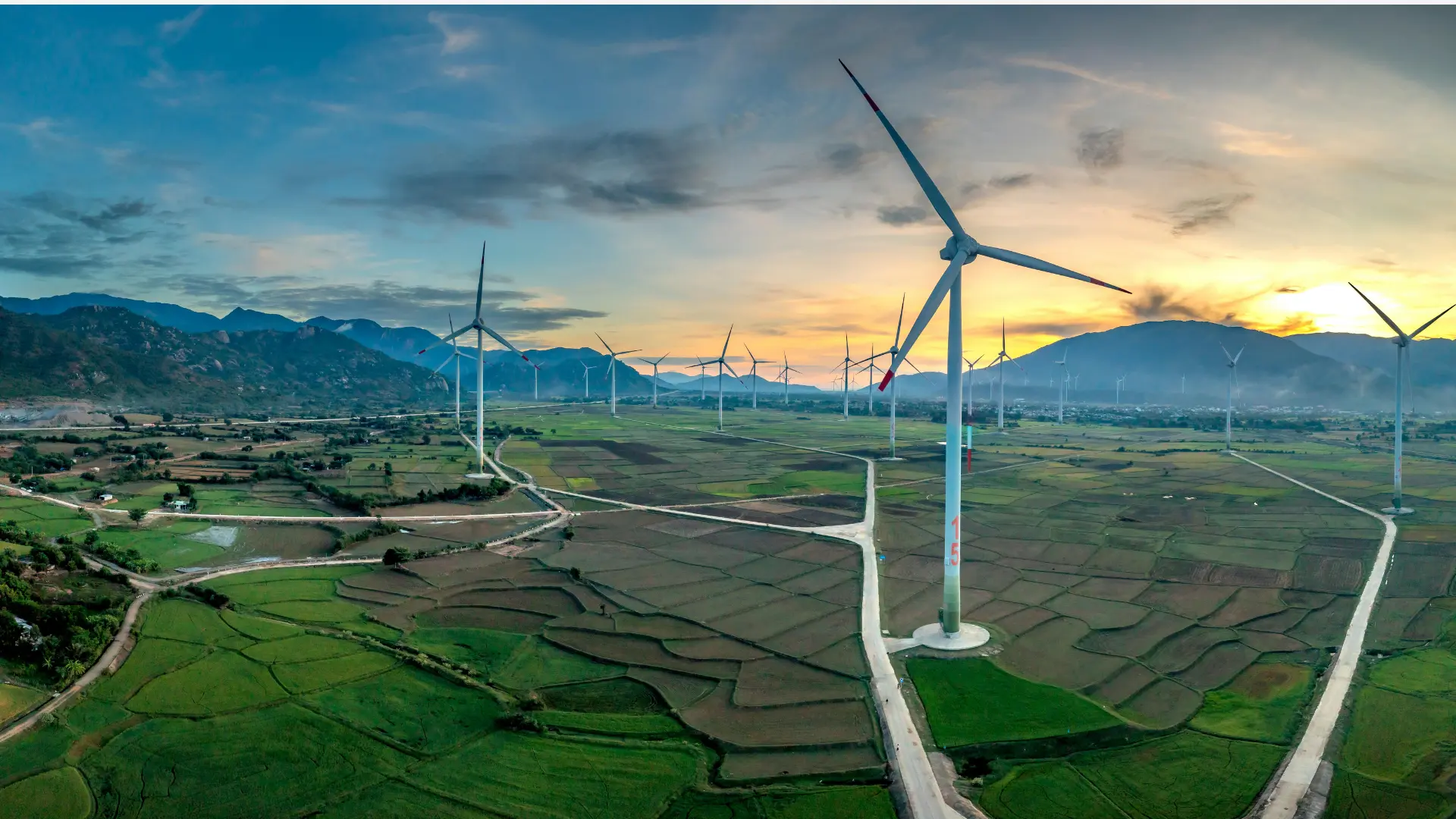
Renewable Energy in Bangladesh enters FY2026–27 at a critical stage. The sector remains strategically important for reducing fuel-import dependence, improving energy security, and supporting climate commitments. However, public investment continues to favor conventional generation, leaving a gap between policy ambition and budgetary prioritisation.
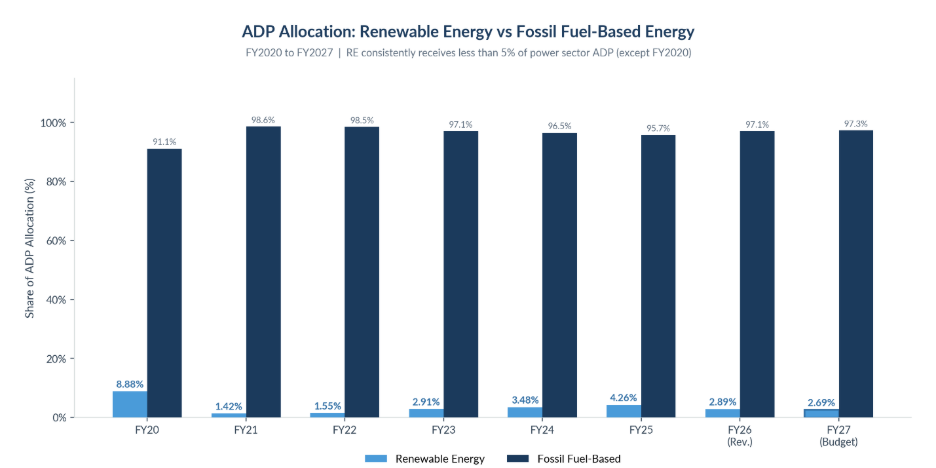
Source: Annual Development Programme – Bangladesh Planning Commission
Renewable energy’s share of generation-related Annual Development Programme (ADP) allocation rose to 4.26 percent in FY2025, then fell to 2.89 percent in the revised FY2026 budget and 2.69 percent in FY2027. Implementation remains constrained: FY2027 includes five related projects but no new solar project, while 11 proposals covering 640 MW of solar and a 25 MWh storage pilot received no allocation.i
This pattern in general frames the broader budgetary context. Although the budget offers stronger tax support, development spending has not yet shifted decisively toward renewables.
The budget offers stronger fiscal support for solar, although the benefits are targeted. Income from qualifying solar electricity generation and supply is tax-exempt until June 2035, eligible consumers receive a 5 percent rebate, and selected equipment receives import concessions.ii
Table 1: Selected Fiscal Measures Affecting The Renewable Energy Transition
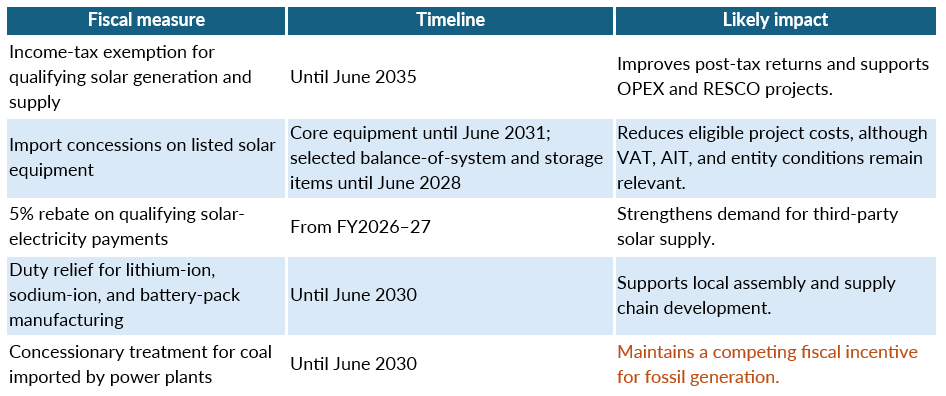
The concessions apply to VAT-compliant self-generators and RESCOs that finance and supply power under a power purchase agreement. Consequently, BSREA (Bangladesh Sustainable and Renewable Energy Association) has argued that the current incentive structure is concentrated around selected producers and RESCO (Renewable Energy Service Company)-model companies.iii
Table 2: Selected Changes in Total Tax Incidence on Solar Equipment
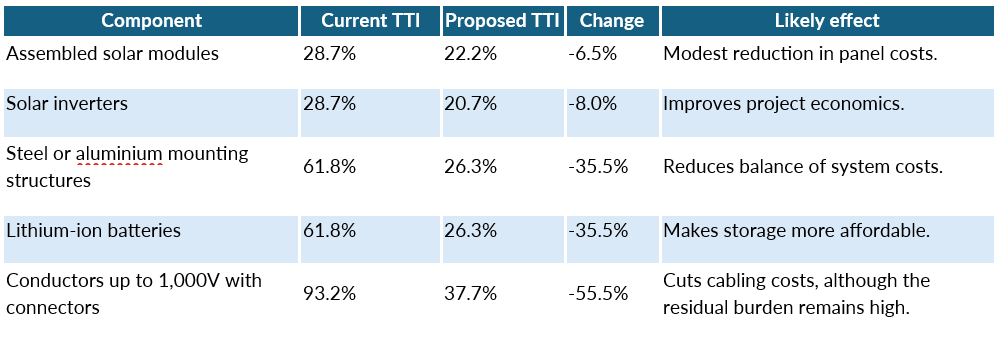
Overall, the largest reductions apply to mounting systems, batteries, and conductors in the new budget. The relevant estimates are shown above, but actual access is narrower because SRO (Statutory Regulatory Order) 159 applies entity-based conditions and retains 2 percent AIT (Advance Income Tax). Standalone EPC firms, importers, traders, and distributors do not automatically qualify, limiting how widely lower costs can flow through the market.
The FY2026–27 ADP allocates BDT 35,167.15 crore to Power and Energy. Distribution funding rose by 60 percent to BDT 9,319.23 crore, while transmission funding fell by 27.9 percent to BDT 5,825.48 crore.iv Stronger feeders, substations, three-phase connections, and bidirectional meters can help distribution networks absorb rooftop solar. The ADP includes six modernisation and three smart-metering projects, although several ongoing initiatives received no allocation.
These upgrades support the 3,000 MW National Rooftop Solar Programme launched in 2025 for public facilities. By February 2026, utilities had invited 224 tenders covering 1,282.91 MW, with progress reported in 18 districts.v The budget retains the policy direction but does not identify a separate allocation for the full target.
Power and gas subsidies have remained elevated and volatile, reflecting imported-fuel costs, exchange-rate pressure, and accumulated payment obligations. Power-sector subsidies rose from BDT 118 billion in FY2020–21 to BDT 620 billion in FY2024–25, while gas subsidies increased from BDT 35 billion to BDT 89 billion.
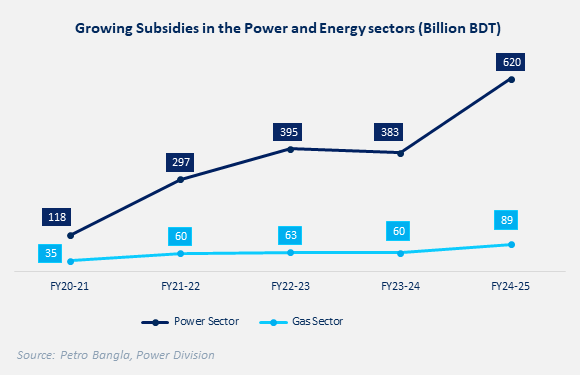
Geopolitical disruptions, from the Russia–Ukraine war to recent instability in the Middle East, have further increased Bangladesh’s exposure to oil and LNG price shocks. For FY2026–27, the government has allocated BDT 370 billion for electricity subsidies, while CPD estimates that LNG and petroleum oil could require an additional BDT 111.7 billion and BDT 102.58 billion, respectively
Reducing this exposure will require a gradual shift in the generation mix rather than abrupt contractual changes. Existing power-purchase agreements should not be cancelled unilaterally. A lower-risk approach is to let high-cost HFO (Heavy Fuel Oil) and quick-rental contracts expire, while replacing future capacity through competitive procurement and renewables. This would gradually reduce exposure to fuel-price and exchange-rate volatility.
The proposed concessions reduce the tax burden on several core inputs, particularly mounting structures, conductors, and lithium-ion batteries. However, important gaps remain across the wider renewable energy supply chain.
Photovoltaic generators, irrigation pump motors, transformers, towers, and electricity meters continue to face relatively high tax incidence, which may raise the cost of both project development and grid expansion. As a result, lower equipment costs at the generation stage may not translate fully into more affordable or scalable renewable energy deployment.
A complementary industrial policy could strengthen the impact of these fiscal measures by encouraging local production and assembly. Time-bound tax holidays, capital-machinery concessions, and predictable import treatment could attract investment in mounting structures, solar cables, battery packs, and control systems. Linking such support to local value addition, quality standards, workforce development, and technology transfer would help build domestic capability while reducing dependence on imported components.
The potential for renewable energy extends beyond electricity generation and is particularly relevant to agriculture, where diesel dependence remains substantial. Bangladesh has around 1.24 million diesel-powered irrigation pumps that consume approximately one million tonnes of diesel each year, while the FY2026–27 budget proposes only 98 additional solar pumps and 27 solar-powered dug wells.vi
Expanding solar irrigation through service-based models could reduce farmers’ exposure to fuel-price volatility, lower petroleum-import demand, and improve access for users who cannot finance complete systems independently.
The budget also supports a gradual shift toward electric mobility by lowering taxes on selected EVs and reducing the tax burden on charging equipment from 39.75 percent to zero. These measures can strengthen the market for electric transport, although their wider energy-security and environmental benefits will depend on the availability of charging infrastructure and the pace at which renewable energy expands within the national power mix.
Rooftop solar will similarly require a financing and regulatory framework that provides predictable returns. Under the 2025 net-metering framework, surplus electricity is settled at the applicable bulk tariff, while tariffs under OPEX arrangements are negotiated between consumers and investors.vii A transparent and stable surplus-buyback methodology could improve revenue certainty and make third-party rooftop investments more attractive, particularly for commercial and institutional users.
The long-term performance of distributed renewable systems will also depend on installation quality, maintenance, and technical support. A 2026 CPD-Samakal survey found that 47 percent of the household systems covered by the survey were no longer functioning, largely because of weak maintenance arrangements and limited after-sales support.viii This finding highlights the need for stronger certification, installer accountability, monitoring, and service standards alongside fiscal incentives.
Taken together, the FY2026–27 budget lowers several financial barriers affecting solar power, energy storage, and electric mobility. The extent to which these measures translate into sustained deployment will depend on broader access to the concessions, timely grid investment, reliable equipment and services, and consistent implementation across the renewable energy value chain.
This article was authored by Safin Sadique, a Business Analyst in the Development & Management Consulting department at LightCastle Partners. For further clarification, contact [email protected].
[1] Centre for Policy Dialogue Power and Energy Study, Proposed National Budget for FY2026–27: What Is There on the Power and Energy Sector?
[2] National Board of Revenue, Government of Bangladesh, S.R.O. No. 211-Ain/Aykor-2/2026, “Providing Tax Exemption for Electricity Generated from Renewable Solar Energy Sources,” and S.R.O. No. 159-Ain/2026/14/Customs, “Solar Energy Production Related SRO,”
[3] Bangladesh Solar and Renewable Energy Association (BSREA), BSREA Reviews National Budget 2026–27, Calls for Inclusive Renewable Energy Policies
[4] Centre for Policy Dialogue (CPD), An Analysis of the National Budget for FY2026–27
[5] Centre for Policy Dialogue Power and Energy Study, “Comprehensive and Accurate Planning Is the Pathway to 3000 MW Rooftop Solar”
[6] Infrastructure Development Company Limited, “Solar Irrigation Program, CPD Brief
[7] Sustainable and Renewable Energy Development Authority, Net Metering Guideline 2025. [1] “Survey Finds 47% of Home Solar Systems Failing Across Bangladesh,” The Daily Star
Our experts can help you solve your unique challenges
Stay up-to-date with our Thought Leadership and Insights