



GET IN TOUCH
- Please wait...

On 17th November 2026, B-Briddhi hosted the fifth and final edition of its Peer-to-Peer (P2P) Exchange Event. This closing session looked back on seven years of the programme through the people who shared the journey. In this session, the portfolio founders and Train-the-Trainer graduates talked about how B-Briddhi shaped their businesses, what did not work as well, and what the ecosystem still needs to bring impact investing into the mainstream in Bangladesh.
The session opened with remarks from Bijon Islam, CEO of LightCastle Partners, and was moderated by Parisa Omar, Consultant at LightCastle Partners. Five key speakers shared their experiences, namely Arefin Zaman from MedEasy, Mashrur Shurid from Aunkur, Rifad Hossain from Shomvob, Sakib Siddique from TurnQi and Yasir Arafat from Apon Bazaar.
MedEasy: Turning Impact into a Team Habit
Arefin Zaman, Co-Founder and CEO of MedEasy, described B-Briddhi’s impact on two levels. The first was measurement. Like many early-stage founders, the MedEasy team believed it was creating social value but had no way to put numbers on it. Through the programme, the company built a dashboard that tracks its impact metrics every month and every quarter, so the team can monitor its progress.
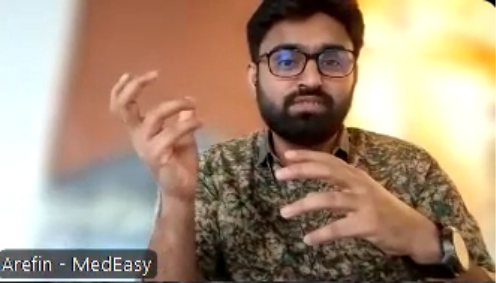
Arefin Zaman, Co-Founder and CEO of MedEasy
The second shift, which Arefin considered more important, was cultural. Over roughly two and a half years with B-Briddhi, through the SIINC programme and several trainings before it, he brought many of his colleagues into the work. Team conversations shifted from revenue and growth to affordability, access to consultations, and how long patients wait to see a doctor. When MedEasy considers a new city or a new vertical, it weighs these social metrics alongside the commercial ones.
Arefin thinks incentives were the key reason the change stuck. Fundraising is a constant pressure for Bangladeshi startups, so impact work usually comes after commercial operations. Because SIINC was an Impact-Linked Finance transaction, the impact work became part of the fundraising process. That motivated everyone, from management to the engineers building the dashboard. His suggestion for future programmes was to go beyond funding and training. Programmes should also connect enterprises with other Impact-Linked Finance programmes and global impact investors and help them meet those programmes’ different eligibility requirements.
Aunkur: A Programme That Grew With the Company
Mashrur Shurid, Co-Founder and CEO of Aunkur (formerly iPAGE), traced a journey that began in 2020, just after the pandemic hit. Aunkur applied to B-Briddhi twice without success and got in on its third attempt. The programme gave Aunkur its first global institutional backing, from the Swiss Agency for Development and Cooperation and Roots of Impact, with support from LightCastle Partners and Truvalu.
Aunkur learned to articulate, measure, manage and document its impact well enough to present it to JICA, Expo City Dubai and the British Asian Trust. That path ended in a VC round with Accelerating Asia last year. Mashrur also stressed that the support grew in stages. Under the Voucher Scheme, Truvalu trained the team on the IMP framework, and that work became a cloud-based impact dashboard that Aunkur now relies on when approaching impact investors worldwide. He described this as the move from a Theory of Change to change on the ground. Aunkur then went through the IRMF programme and the ILF Readiness Bootcamp, and its Bootcamp certificate is now used in due diligence with impact investors. As recently as last month, the same approach to impact storytelling helped Aunkur win a pitch in front of a Gulf-based audience.
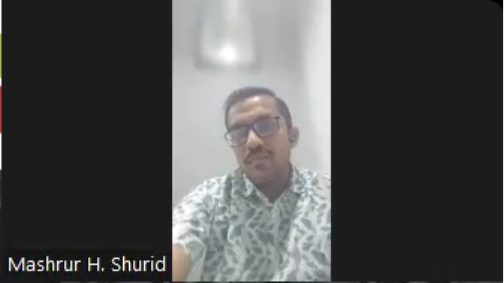
Mashrur Shurid, Co-Founder and CEO of Aunkur
Mashrur believes that grants have changed the perception of impact in the wider ecosystem. Before B-Briddhi, grants in Bangladesh were usually paid in one or two tranches, with little link to the results they were meant to unlock. Impact-Linked Finance was a new idea. Aunkur took the logic on board: when JICA asked how it could help, Aunkur proposed a set of milestones, with funding released in parts as each was met. It later used the same structure with Expo City Dubai and CIF.
“This was a cornerstone for the ecosystem to treat grants as a tool for supporting founders to achieve milestones and activate the funding so that they can grow.” – Mashrur Shurid
He noted that B-Briddhi’s influence went beyond its own portfolio. It changed how at least some founders now negotiate with other funders. Results-based thinking has become something they bring to the table themselves rather than a condition that donors impose on them.
Shomvob: From Fully Commercial to Impact-Driven
Rifad Hossain, Founder and CEO of Shomvob, joined the B-Briddhi programme around two and a half years ago. He described the biggest change as a shift in mindset, from running a fully commercial business to running an impact-driven one. During roughly a year and a half of close engagement, the team learned how to design impact KPIs, track them and double down on them. Those same KPIs ended up driving business results such as revenue, user numbers, and profitability. The second gain was team capacity. Regular monthly and quarterly calls with the Roots of Impact team helped to train employees to think about impact whenever they work towards a result.
Shomvob got into the programme on its first attempt. Rifad credited part of that to a Gates Foundation grant received shortly before, which had already accelerated the team’s learning. Most Bangladeshi startups, he said, would need hand-holding with writing concept notes, applying, measuring metrics and delivering results. Very early-stage startups might need even closer guidance. He also echoed Arefin’s point on incentives. Without some direct or indirect benefit, such as funding or credits for tools like AI platforms, founders tend to log in, pass the time and never come back.
The Service Provider’s View: TurnQi Advisors
Sakib Siddique, CEO of TurnQi Advisors (now rebranded as OZMO Consult), brought the view of a Train-the-Trainer graduate. TurnQi joined B-Briddhi in 2022–23 with the goal of helping clients become investment-ready and measure their actual impact. On investment readiness, the training brought more structured policies and procedures into TurnQi’s existing services. It also pushed the team to look at the whole investment journey: understanding a company’s fundraising needs and business model, then governance, due diligence and investor communication. One enterprise TurnQi supported has secured around 500,000 in blended impact funding to date. On impact measurement, the training changed the questions TurnQi asks. Counting registered beneficiaries, the team realised, is not enough without knowing whether their income and revenue opportunities actually improved. The broader lesson was that no single approach works for every business.
One of the key difficulties that Sakib thinks everyone faced was the limited time founders had for assignments. A financial model and pitch deck do not make an enterprise investment-ready, and fixing financial records, governance or strategy can take months. Building a theory of change and choosing indicators was the easy part. Many enterprises had no historical data, no benchmarks and no dedicated staff to keep measuring.
If TurnQi were to start again, it would do three things differently. It would assess each enterprise more thoroughly before starting an assignment. It would keep deliverables practical, such as a simple model the founder can update or a handful of indicators that are actually tracked. And it would build follow-up in from the start, because a polished pitch deck does not guarantee investment and a polished impact report does not guarantee impact.
He said the biggest change at TurnQi was psychological. At least six of his team members have been through B-Briddhi’s Train-the-Trainer programme or the Theory of Change card game. Since then, they think about the impact on the client’s side even on projects that have nothing to do with investment readiness or impact measurement. For the future, he argued that programmes should go beyond preparing enterprises for investment and reporting and help them actually use these tools to grow, raise funds and make better decisions.
Apon Bazaar: Turning Matching Funds into Leverage
Yasir Arafat, Co-Founder of Apon Bazaar and a member of B-Briddhi’s first SIINC cohort, said that B-Briddhi’s tools helped founders balance business outcomes against impact outcomes.
“In 2020 or the beginning of 2021, we used to track more than 10 impact metrics. B-Briddhi was the first initiative for us to filter it down to three, and the amazing thing was there was no trade-off for my impact goals.” – Yasir Arafat, Co-Founder, Apon Bazaar
Five years later, Apon’s investors still track those same three metrics. This shows that a small, well-chosen set of indicators can work for both impact reporting and investor conversations. Arafat also addressed the programme’s matching-fund requirement, which many founders found frustrating because matching capital is hard to raise in Bangladesh. Apon treated it as leverage instead. It went to investors who were not impact-first and showed them that foreign funding was already committed and only needed to be matched. Last month, Apon closed an impact investment of roughly USD 0.4–0.5 Mn, mostly from a single country. It is now using the same approach to raise USD 1.2 Mn in matching capital, which will be the focus of its 2027 pitch. For purpose-driven enterprises, he said, impact is a strong tool if they know how to sell it.
What Could Have Been Done Differently
Alongside the successes, speakers were open about where the programme fell short and what a future programme should do differently:
Closing Reflections from Roots of Impact
The Roots of Impact team closed the session with some insights and impact numbers. Jordan Wolken, Senior Associate at Roots of Impact, highlighted a shift in founders’ mindset, as they now measure impact to improve it rather than just to prove it. Adrija Das, Manager at Roots of Impact, then shared the programme’s impact. Over seven years, B-Briddhi worked with more than 200 enterprises and funded 16 companies. It has reached 191,000 low-income and underserved customers and raised USD 35.4 Mn beyond programme funding, with USD 40 Mn in additional impact funding set to continue in the ecosystem.
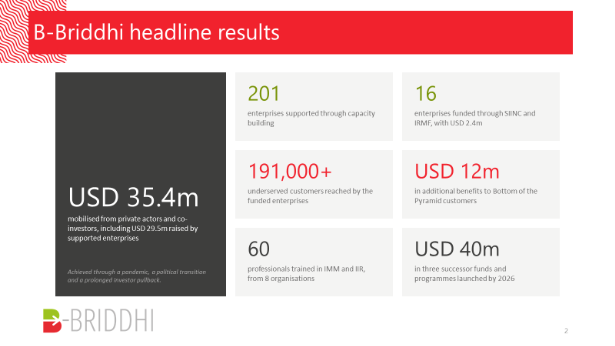
Seven Years of Impact of B-Briddhi
The programme’s key lessons, adapting to local crises, staying accountable and building strong local partnerships, offer a useful guide for what comes next. B-Briddhi has shown that impact-linked finance can work in Bangladesh, and the way forward is to keep this community connected and build on that foundation. With the right support from investors and ecosystem partners, the momentum built over these seven years can grow into a lasting shift in how impact is valued in Bangladesh.
About the Biniyog Briddhi Programme:
B-Briddhi is a gender-inclusive programme supporting a thriving impact ecosystem in #Bangladesh where impact enterprises can grow and scale. This programme is supported by #Switzerland and implemented by Roots of Impact and LightCastle Partners.
#BBriddhi #ImpactInvesting #ImpactEnterprises #ImpactLinkedFinance #IMM #Bangladesh #SwissInBd
Our experts can help you solve your unique challenges