


GET IN TOUCH
- Please wait...


Bangladesh sits at the frontline of climate-driven humanitarian risks. Cyclones, floods, monsoon surges, and displacement events recur with growing frequency. As a result, the households most exposed to these shocks are often the least equipped to withstand them. When crisis strikes, the speed and equity of humanitarian response depend on how quickly funding reaches organisations that already understand the terrain, the communities, and the practical realities of delivery.
This is the operating logic of locally led humanitarian action. It is exactly the model that Start Network utilizes to advance in Bangladesh. Through its network of member NGOs, Start Network channels emergency funding to organisations positioned to respond quickly, responsibly, and at community scale. The mechanism that makes this possible, and that keeps it credible to donors and communities alike, is a rigorous, tiered due diligence process. It assesses member NGOs by their organisational capacity, governance strength, and readiness to deploy funds under pressure.
For the 2025-26 assessment cycle, Start Network commissioned LightCastle Partners to conduct the tiered due diligence assessment of 22 member NGOs across Bangladesh. The assignment aimed to inform Start Network’s capacity-building initiatives. At the same time, it sought to enable member NGOs to secure timely emergency funding.
Due diligence in the humanitarian sector must be simultaneously rigorous, efficient, and grounded in the operational realities of grassroots organisations. The 2025-26 assessment cycle set out to meet these three requirements through a co-developed, digitally enabled, and locally contextualised approach.
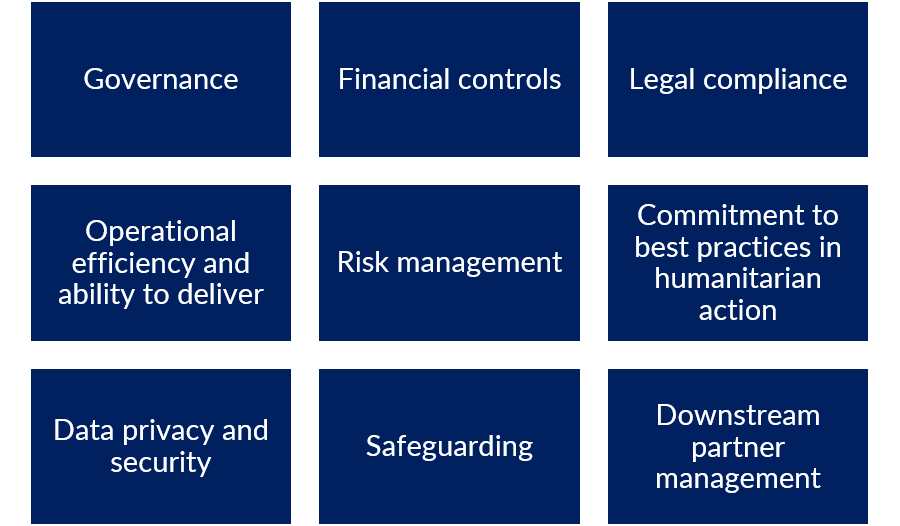
LightCastle worked with Start Network’s global and Bangladesh teams to review and enhance the existing due diligence framework. In doing so, the team incorporated evolving compliance standards and the operational realities of NGO practice in Bangladesh. The refined framework covered nine assessment streams. Together, these streams cover the full spectrum of organisational capacity. They determine whether an NGO can absorb, deploy, and account for humanitarian funding.
The framework was operationalised through a four-pillar methodology:
Each of the 22 NGOs participated through a combination of digital evidence submission and direct engagement with their leadership teams. The digital questionnaire structured the initial documentary review. As a result, NGOs could submit evidence across the nine streams through an online platform while reducing the review workload for assessors. A pool of assessors completed pre-assessment training, used templated documents, and participated in calibration sessions. This ensured consistent scoring criteria across the full pool.
To validate the initial assessments, assessors conducted in-depth meetings primarily through video conferencing, with in-person visits where required. This approach allowed them to validate submitted evidence, identify gaps in documentation, and understand the operational context behind each NGO’s practice. Moreover, it significantly reduced travel and logistical burden across a geographically dispersed pool of member organisations. During the assessment, NGOs across the cohort showed high engagement with the process. They treated the exercise as a reputational benchmark as much as a funding gate. Finally, the assessment team applied a multi-layered review and scored each organisation against evidence benchmarks in every stream. This process culminated in draft tier awards, structured feedback loops with Start Network and the NGOs themselves, and final sign-off.
Beyond individual tier awards, the assessment cycle generated sector-level intelligence. It highlighted where Bangladeshi humanitarian NGOs are structurally strong and where common challenges concentrate. Governance, legal compliance, safeguarding, and risk management consistently showed the strongest compliance patterns. This reflects close alignment with existing regulatory and reporting frameworks that most NGOs already operate under.
Operational efficiency and data privacy and security emerged as areas where structural realities most commonly translate into opportunities for improvement. NGOs with microfinance operations naturally carry higher liabilities relative to their assets because of the operating model of MFIs. Therefore, a standard financial health assessment may not always fully contextualise this reality. On cybersecurity, most member NGOs primarily operate with paper-based data. Meanwhile, NGOs that have cybersecurity capacity often outsource it to external firms, while a designated internal staff member serves as the liaison. This reflects the transitionary phase the NGOs are currently in regarding cybersecurity adoption. It also highlights the need to strengthen internal organisational capacities in this area.
The 2025-26 assessment cycle produced an evidence base that extends well beyond individual tier classifications. For Start Network, it provides a clearer view of where member NGOs stand relative to the framework. It also identifies which streams present recurring challenges across the pool and where capacity-building initiatives can strengthen the ecosystem. For the NGOs themselves, participation offered a structured reputational benchmark. In addition, it provided a clearer picture of what stronger organisational readiness requires.
Locally led humanitarian action is only as effective as the systems that channel funding to the organisations best positioned to deliver it. As Bangladesh continues to face increasing climate-driven emergencies, the credibility, efficiency, and contextual grounding of due diligence frameworks will shape how quickly resources reach communities in need. Therefore, continued investment in evidence-based assessment methodology, iterative framework refinement, and targeted capacity-building of local NGOs will strengthen the foundation on which humanitarian response in Bangladesh stands.
Our experts can help you solve your unique challenges