



GET IN TOUCH
- Please wait...


As Bangladesh transitions from LDC to developing status, it is reshaping its social protection landscape. The country is moving from fragmented, relief-based programs toward a comprehensive, lifecycle-oriented system. The National Social Security Strategy (NSSS) 2015 and its Second Phase Action Plan (2021–2026) guide this transition. However, public budgets alone cannot sustain modern safety nets.
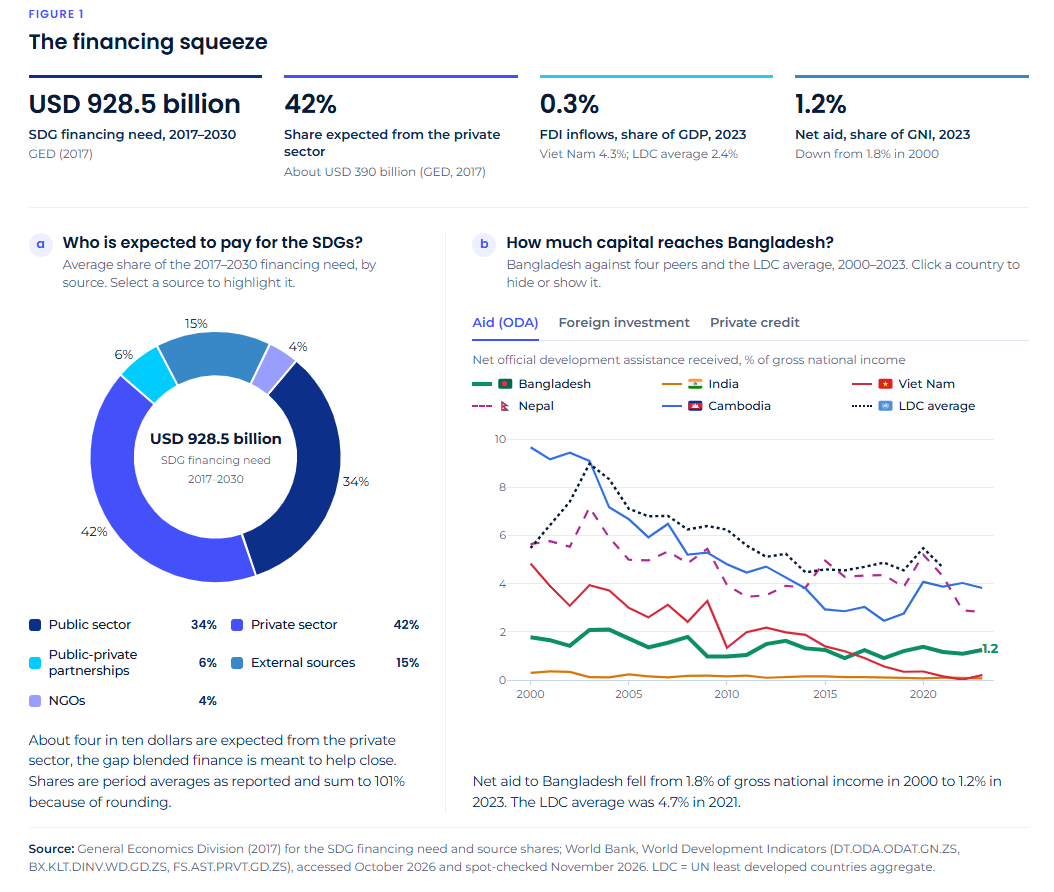
Delivering on the country’s Sustainable Development Goals (SDGs) between 2017 and 2030 will require nearly a trillion dollars. To meet this target, national planning leans heavily on commercial capital. National plans expect the private sector to supply 42% (roughly USD 390 billion) of the USD 928.5 billion total requirement. Meanwhile, the public budget aims to cover only about 34% (General Economics Division [GED], 2017).
Yet a stark financing gap remains, as external capital flows are modest. Net foreign direct investment (FDI) stood at just 0.3% of GDP in 2023, compared with 4.3% in Viet Nam (World Bank, 2026).
Blended finance offers a practical way to address this funding gap. It deploys a modest allocation of public or philanthropic capital to absorb unmarketable risk. This encourages commercial institutions to invest their own resources. In theory, concessional funding acts as a targeted buffer. It steps in only to absorb downside risk where market uncertainty deters private lenders.
Bangladesh has so far made modest use of it. Convergence’s market data record 26 blended finance transactions in Bangladesh in 2016–24, worth about USD 1.4 billion in total. In comparison, India recorded 85 transactions (USD 11.8 billion) and Viet Nam recorded 42 (USD 8.3 billion) (United Nations Development Programme [UNDP] & Convergence, 2026).
The main challenge is that evidence on how much subsidy these investments need to reduce risk remains limited. Concessionality refers to how “soft” public finance must be compared with a loan at market rates (UN-ESCWA, n.d.). The OECD calls sizing the minimum level of concessionality “one of the key unresolved challenges in blended finance” (Organisation for Economic Co-operation and Development [OECD], 2025).
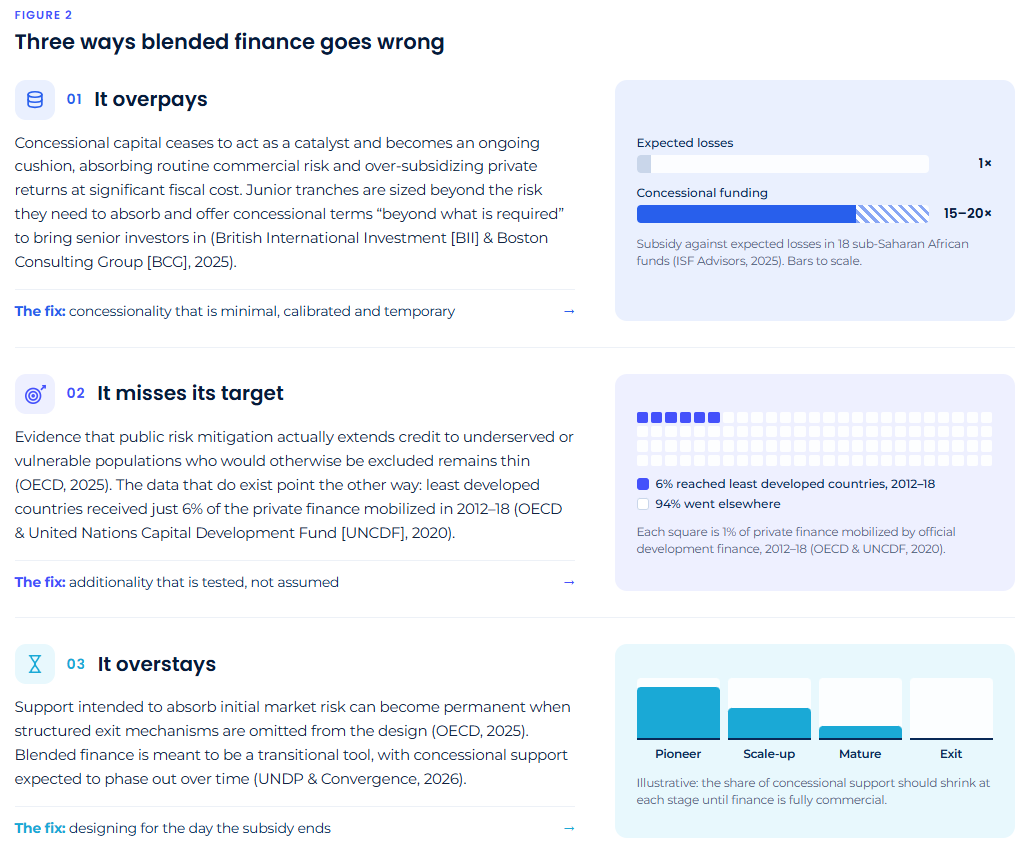
Where researchers have examined empirical risk structures, the gap between public subsidy and actual downside risk is notable. One example covers 18 investment funds in sub-Saharan Africa with significant exposure to agricultural small and medium-sized enterprises (agri-SMEs). These funds used below-market funding to reassure private investors. However, this funding was 15 to 20 times larger than the credit losses it aimed to cover (ISF Advisors, 2025; OECD, 2025).
As Bangladesh prepares for LDC graduation amid tightening fiscal space and hardening borrowing terms, over-subsidizing private risk is an inefficiency it cannot afford. When public capital absorbs far more risk than necessary, blended finance tends to fail in three distinct ways:
The OECD Development Assistance Committee (DAC) defines blended finance as “the strategic use of development finance for the mobilisation of additional finance towards sustainable development” (OECD, 2025). The DAC adopted the definition in 2017 and reaffirmed it in its 2025 Guidance. It rests on one test: did public or philanthropic money bring in commercial finance that would not otherwise have flowed?
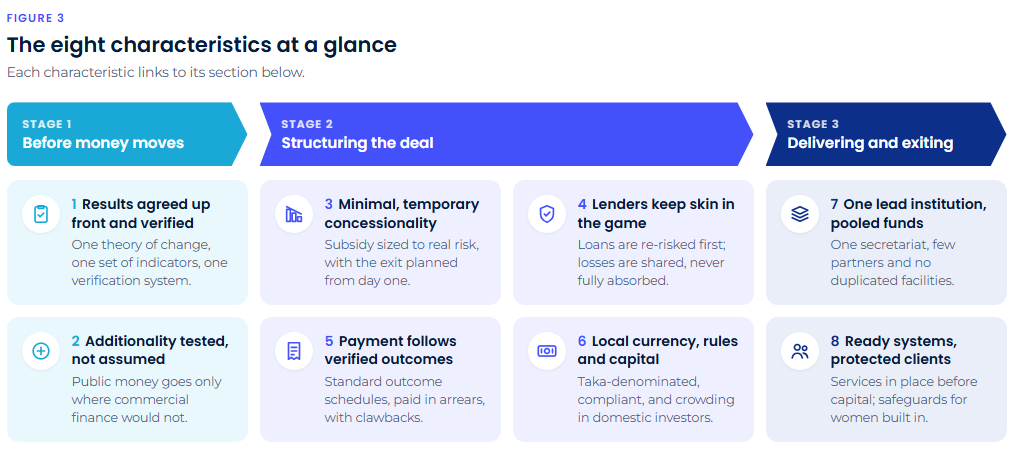
That test has a practical consequence. A grant, a social transfer or a technical assistance project is not blended finance just because it sits next to a loan. Only the components that mobilize additional commercial finance qualify as blended finance. Their assessment should consider both what they mobilize and the outcomes they secure. The characteristics below follow that logic.
Successful programs agree on a theory of change with key stakeholders. It names the specific market failure or risk the intervention addresses (UNDP & Convergence, 2026). From the very start, this should include a common set of key performance indicators. It should also include a common framework for data collection, monitoring and evaluation (OECD, 2025, Subprinciples 1.B and 5.A).
UNDP and Convergence recommend convening DFIs, donors and private investors to agree “clear results frameworks” whenever public concessional money is involved. Indicators should capture financial performance, such as mobilization and portfolio performance, alongside development impact (UNDP & Convergence, 2026).
Most importantly, programs define what success looks like before any money moves. They then track flows, commercial performance and development results through a single verification system. This ensures that no one receives payment on an unverified claim.
Practice is moving in this direction. By the end of 2024, the Credit Guarantee Corporation of Cambodia (CGCC) had approved guarantees on USD 256.58 million of loans to about 3,139 businesses.
The CGCC worked with UNDP on an impact measurement and management framework that draws on the SDG Impact Standards. The framework measures institutional outcomes against impact goals. It also makes the use of public resources accountable across the institution rather than product by product (UNDP & Convergence, 2026).
On the investor side, BII has used a standard scorecard to assess its 20 blended finance funds. It also assessed the 27 proposals from a recent call. BII now requires every blended fund proposal that reaches its Investment Committee to include a scorecard assessment (BII & BCG, 2025).
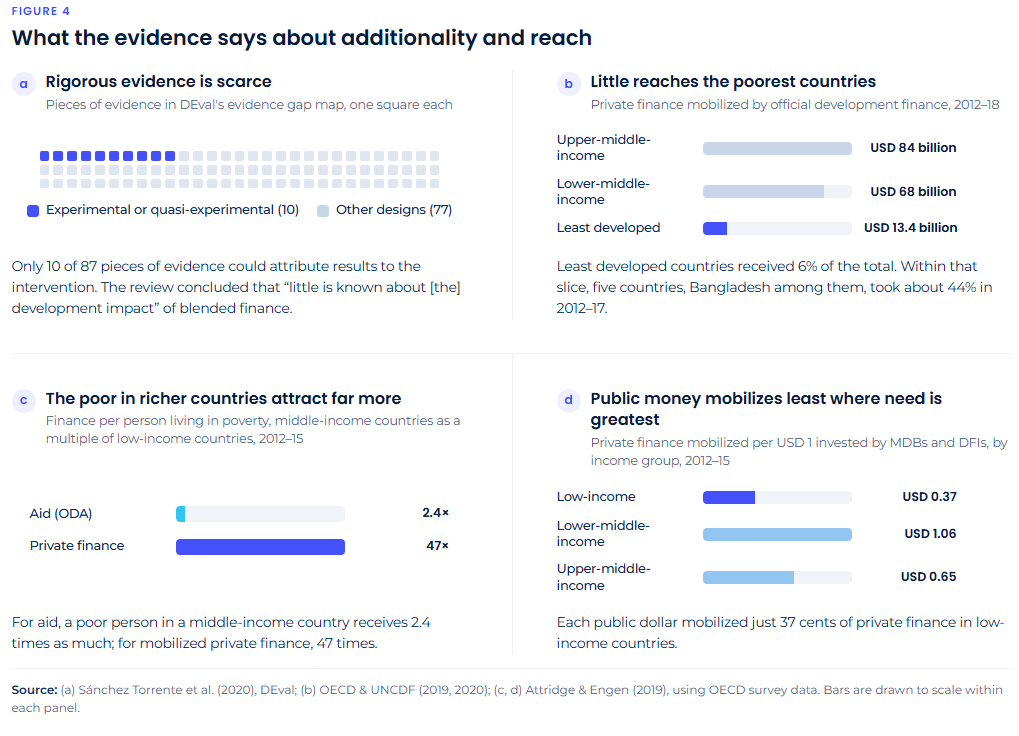
A shared framework matters because the evidence base is thin. An evidence review by the German Institute for Development Evaluation (DEval) found just 87 pieces of evidence on blended finance that met its inclusion criteria. These came from 33 publications. Only 10 used experimental or quasi-experimental designs (Sánchez Torrente et al., 2020; Figure 4a). Few evaluations assess long-term sustainability and impact (OECD, 2025).
In Myanmar, a cash plus nutrition program still showed gains in food security and diet quality during an economic crisis. These gains persisted one to two years after it ended, but researchers only identified them because they went back to look (Maffioli et al., 2023).
Funders should therefore dedicate appropriate resources to monitoring and evaluation (OECD, 2025, Subprinciple 5.C). Good programs also ring-fence part of that budget for independent verification after exit.
Public money should flow only where commercial finance would not otherwise go. If a commercial bank or microfinance institution can already serve a segment on market terms, a subsidy does not add finance. It replaces private money that would have arrived anyway and hands the lender a windfall at public expense.
The difference between crowding in and displacing private finance is a shared principle across development finance, not only an OECD one (OECD, 2025, Subprinciple 2.A).
The International Finance Corporation (IFC) co-chairs the DFI Working Group on Blended Concessional Finance. The group’s principles require concessional support to make a contribution “beyond what is available” in the market. It “should not crowd out the private sector” and should minimize “the risk of market distortion or crowding out private finance” (IFC, n.d.).
UNDP and Convergence ask governments to avoid the “subsidy of investments that would occur anyway”. They also recommend building the capacity to run simple counterfactual checks of whether a project could proceed on commercial terms (UNDP & Convergence, 2026).
BII and BCG put the same test to fund designers. Concessional money must achieve impact objectives “that purely commercial capital could not”. Funds should first demonstrate their use of diversification, concentration limits and other risk management tools. Otherwise, they may rely on concessional capital to absorb risk that their own design could have mitigated (BII & BCG, 2025).
Good programs test for this from the very start. Typical checks include a lender statement that no existing product serves the segment at the proposed ticket size. Examples include micro-loans of USD 500–2,000 or “missing middle” SME loans of USD 10,000–50,000. The checks also cover tenor (loan term) and collateral.
Further checks include a market pricing test before releasing any reserve and an open call on equal terms. This ensures that support does not entrench one dominant provider (M. Rahman et al., 2019; UNDP & Convergence, 2026).
Where the design allows, a staggered phase-in creates a comparison group. It shows whether clients gained accounts, jobs or credit they would not otherwise have had. Programs re-test and disclose these assumptions at every stage.
Targeting matters as much as testing. Globally, blended finance has gone mostly to markets where commercial finance is easiest to raise (Figures 4b and 4c). A person living in poverty in a middle-income country attracted 47 times as much mobilized private finance as one in a low-income country. The gap for aid was only 2.4 times (Attridge & Engen, 2019).
In fairness, studies of credit guarantees generally find that they do raise firms’ access to credit. However, the evidence on wider economic effects is mixed (Schich et al., 2017). The lesson is not that risk-sharing fails. Rather, programs must demonstrate its additionality instead of assuming it.
Effective blended finance deploys only the minimum subsidy necessary to catalyze commercial capital. The concessionality level measures how soft finance is compared with a loan at market rates (UN-ESCWA, n.d.). In the words of the development finance institutions’ own principles, this level should be “not greater than necessary” (IFC, n.d.).
UNDP and Convergence put it more bluntly. Programs should use concessional capital only to the extent needed “to address identified market failures and make transactions viable, and no more” (UNDP & Convergence, 2026).
BII and BCG supply a practical benchmark. Fund designers should limit concessionality to “what is necessary to unlock capital from a representative senior investor, not to accommodate the most risk-averse or negotiation-driven stakeholder” (BII & BCG, 2025).
When subsidies do not match actual risk, public money buys little. Estimates of private capital leveraged per dollar of blended concessional resources range from USD 0.8 to USD 4 (Mutambatsere & Schellekens, 2020). In low-income countries, each USD 1 that multilateral development banks (MDBs) and DFIs invested mobilized only USD 0.37 of private finance (Attridge & Engen, 2019; Figure 4d).
Sizing the concessionality level accurately requires objective risk diagnostics. Aceli Africa, for example, evaluated lenders’ historical portfolio data to quantify true profitability gaps in agri-SME lending. It established a targeted first-loss cover of 2–9% (International Growth Centre [IGC], n.d.; OECD, 2025).
Where markets allow, tenders, auctions and open calls can also reveal the minimum subsidy a deal needs (UNDP & Convergence, 2026).
High-performing structures also plan the exit from day one and write it into the contract. BII and BCG describe two ways to do this.
In the first, investors commit junior capital upfront. However, the capital unlocks only in fixed proportions, such as 3:1, as the fund raises senior capital. The fund then cancels any unused junior commitment.
In the second, the fund redeems part of the concessional tranche once it hits agreed milestones. These might include a minimum credit rating for the senior tranche (BII & BCG, 2025).
UNDP and Convergence ask implementing partners to set out how concessionality will decline as risks fall or markets mature. They also recommend reviewing periodically whether concessional terms are still appropriate (UNDP & Convergence, 2026).
The OECD recommends phasing out concessional first-loss tranches as investors grow comfortable with the risk. Programs can then redeploy released funds to technical assistance. The OECD also recommends following a “cascade” in which non-concessional finance gradually replaces concessional finance until private finance stands alone (OECD, 2025).
The DFI principles point the same way: each operation should contribute “towards commercial viability” (IFC, n.d.).
Programs should allocate risks between development and commercial finance in a targeted, balanced and sustainable manner (OECD, 2025, Subprinciple 4.B).
High-performing blended finance mechanisms sequence public intervention by first restructuring transaction terms (“re-risking”) before deploying public de-risking capital. They reserve public funds for risks that private lenders cannot absorb.
Re-risking forms a direct part of loan design. India’s microfinance regulation, for instance, requires lenders to adopt a board-approved policy for assessing household income. It also requires lenders to cap a household’s total loan repayments at 50% of its monthly income (Reserve Bank of India, 2022). Lenders therefore size loans on verified cash flow rather than aspiration.
This reflects evidence that borrowing behavior is harder to shift than saving habits (Kaiser & Menkhoff, 2017).
Risk-sharing should then leave lenders with a real stake in every loan. The United States Agency for International Development (USAID), for example, guaranteed up to 50% of net losses on principal through its Development Credit Authority. Partner lenders carried the rest (USAID, n.d.). Similarly, Aceli Africa’s 2–9% first-loss cover leaves most of any loss with the lender.
The same holds at fund scale. In the USD 1.1 billion SDG Loan Fund, FMO, the Dutch development bank, anchors the structure with a USD 111 million first-loss junior investment. Meanwhile, institutional investors provide 90% of commitments as senior shares. They bear any losses beyond that layer (BII & BCG, 2025).
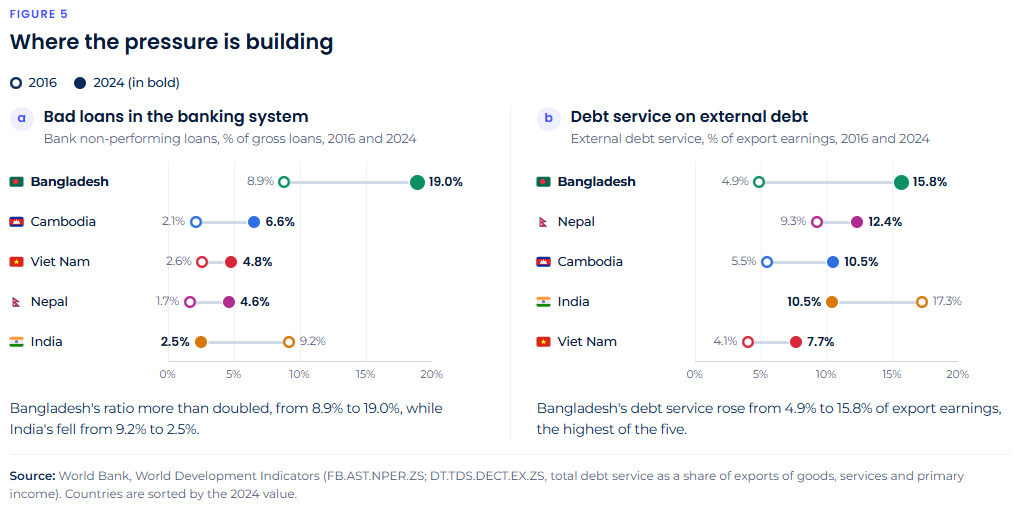
This matters in Bangladesh, where bank non-performing loans rose from 8.9% of gross loans in 2016 to 19.0% in 2024 (World Bank, 2026; Figure 5a). Fully insulating lenders from credit default creates moral hazard and weakens underwriting.
Structuring concessional support around verified outcomes shifts execution risk to operational partners while strengthening fiscal accountability.
In Bangladesh, the Biniyog Briddhi (B-Briddhi) program demonstrates this mechanism through its Social Impact Incentives (SIINC). The Swiss Agency for Development and Cooperation (SDC) funds the program. Roots of Impact and LightCastle Partners co-implement it.
The program provides USD 50,000–250,000 over three years to impact enterprises that raise more than USD 200,000 in repayable capital. It disburses the funds in phases upon verification of social outcomes (Biniyog Briddhi, n.d.-b).
These enterprise-scale thresholds do not translate directly to micro-lending. Therefore, smaller-ticket programs benefit from standardized outcome schedules that keep administrative costs down.
Bespoke impact bonds carry substantial legal and structuring costs relative to small deal sizes (Gustafsson-Wright et al., 2017). This is why many programs favor standard outcome payment schedules over complex contracts.
The same lesson holds for fund design. BII and BCG find that “long structuring timelines, high transaction costs and bespoke negotiations” have limited the replicability of blended finance funds. They treat a capital stack with more than three tranches as a possible sign of unnecessary complexity (BII & BCG, 2025).
UNDP and Convergence recommend standardized term sheets, risk allocation frameworks and legal templates for the same reason (UNDP & Convergence, 2026).
Premium mechanisms tend to work best when programs pay them in arrears and benchmark them against each partner’s historical baseline. Programs should also cap premiums per beneficiary and calibrate them to the documented cost of serving the segment. Clawback clauses should protect against data misrepresentation.
In Bangladesh, most end borrowers earn in local currency (Bangladeshi taka, BDT). Capital structures should therefore use taka to avoid foreign exchange mismatches. This includes reserves, loan principal and outcome premiums (OECD, 2025, Subprinciple 3.B).
Channeling foreign donor or development finance institution (DFI) funds through local escrow accounts does not by itself remove currency risk. Bangladesh has no formal domestic hedging facility and few guarantee instruments (M. Rahman et al., 2019). Consequently, facilities need local-currency matching or hedging through providers such as The Currency Exchange Fund (TCX).
The gap is global. A 2021 MOBILIST study found that MDBs and DFIs made less than 5% of the commitments it covered in local currencies (MOBILIST, 2021, cited in OECD, 2025).
Currency pressure also weighs on the country as a whole. External debt service rose from 4.9% of export earnings in 2016 to 15.8% in 2024 (World Bank, 2026; Figure 5b).
Designs must also respect domestic regulation, such as the Microcredit Regulatory Authority (MRA) interest rate cap on lending by microfinance institutions (MFIs). As facilities mature, they can crowd in domestic institutional capital.
For example, life insurers hold an estimated USD 4 billion in assets in short-term bank deposits because corporate bond markets remain underdeveloped (M. Rahman et al., 2019).
This would reduce a regional dependence on foreign money. Development agencies provide roughly half of all concessional commitments to blended finance in South and Southeast Asia. Meanwhile, domestic private investors take little part. UNDP and Convergence (2026) describe this as “a structural reliance on external sources”.
Local pension funds, insurers and banks usually need partial guarantees, subordinated debt or long-term investment mandates before they will take part. However, once in, they invest in local currency, “reducing exposure to FX risk and the associated hedging costs” (UNDP & Convergence, 2026).
Bangladesh lacks an operationalized cross-ministerial blended finance framework or designated national lead agency (M. Rahman et al., 2019). Facility designs must therefore establish robust, self-contained governance structures.
Institutional fragmentation carries real operational risks. In Ghana, separate ministries oversaw the Livelihood Empowerment Against Poverty (LEAP) program and the related Japan Social Development Fund (JSDF-LEAP) program. This created conflicting chains of command, data-sharing bottlenecks and inter-agency friction (Amofa et al., 2023).
High-performing programs mitigate these risks by establishing a unified lead secretariat. It operates under a binding mandate and standardized data-sharing protocols. Programs also keep the partner architecture lean. Every participating entity contributes distinct value that justifies the added coordination (OECD, 2025, Subprinciple 4.A).
For governments, UNDP and Convergence recommend standing or program-specific bodies, such as blended finance steering committees. These bodies should have standard procedures for setting agendas, allocating decision-making authority and resolving disputes (UNDP & Convergence, 2026).
Inside a fund, BII and BCG point to shared advisory committees and proportional veto rights. These help keep different classes of investor pulling in the same direction (BII & BCG, 2025).
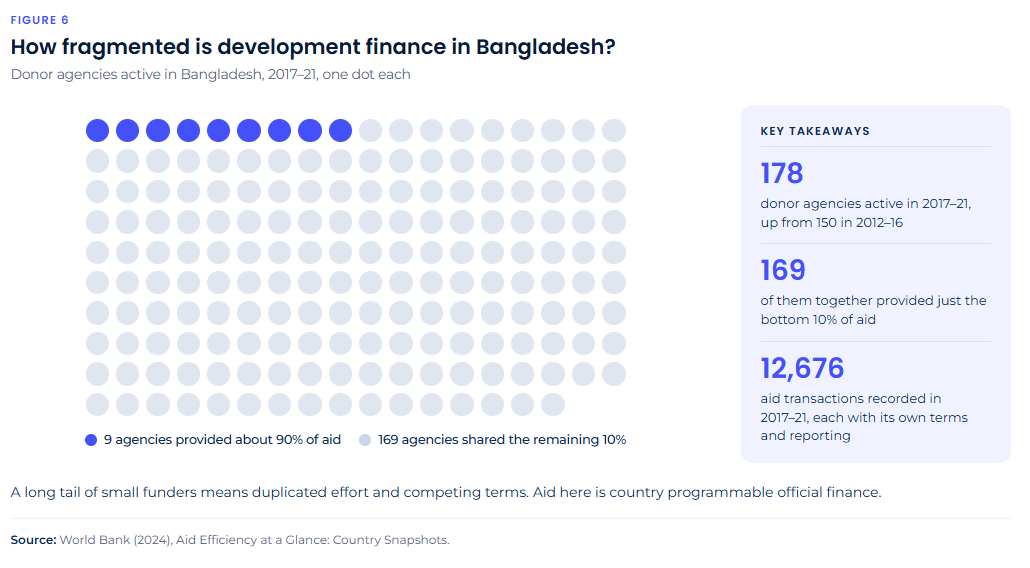
Good governance also means pooling. Bangladesh’s development finance landscape is crowded. In 2017–21, 178 donor agencies were active, and 169 of them together provided the bottom 10% of aid (World Bank, 2024; Figure 6).
When several funders back separate facilities for the same segment, they duplicate efforts. Lenders face competing terms, and no single facility reaches scale.
Across the region, UNDP and Convergence find “fragmented and reactive sourcing of concessional capital through informal networks or ad hoc engagement”. They recommend mapping concessional capital to compare providers and align them with national priorities (UNDP & Convergence, 2026).
Pooling concessional funds in one facility, under one lead institution, enables the allocation of resources where they are most needed. It gives every lender the same terms. It also makes it possible to diversify across lenders, regions and client segments.
The OECD likewise recommends “pooling concessional funds across donor agencies to enhance equal treatment” (OECD, 2025).
Nepal offers a nearby model. Its Agricultural Credit Guarantee Scheme sits as a single, ring-fenced scheme inside the national Deposit and Credit Guarantee Fund (DCGF), which manages it.
The scheme combines first-loss capital from the UN Capital Development Fund (UNCDF) with seed funding from the Joint SDG Fund. It also receives contributions from participating municipalities and the DCGF itself (UNDP & Convergence, 2026).
Financial interventions achieve impact only when they operate within functional delivery systems and include the right complementary services.
In northwest Bangladesh, a randomized study examined transfers to poor households. Cash combined with intensive nutrition behavior change communication cut child stunting by 7.8 percentage points. In contrast, cash on its own had no measurable effect on child growth (Ahmed et al., 2025).
In Ghana, the JSDF-LEAP evaluation found that inadequate market research before implementation seriously constrained beneficiaries’ incomes and business growth (Amofa et al., 2023).
Capital release should therefore follow supply-side readiness checks and market mapping.
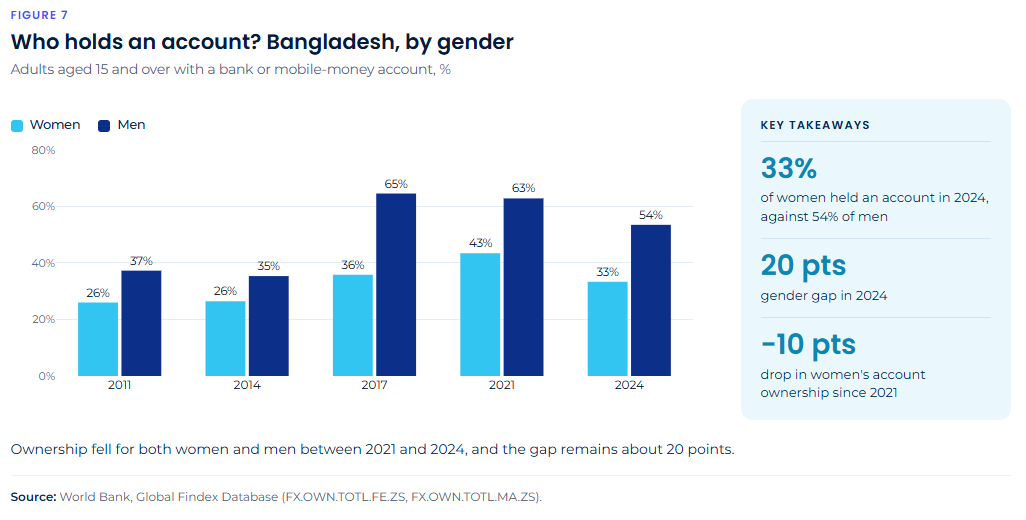
Programs must also protect their clients, especially women, whose access to finance in Bangladesh remains limited and has recently slipped. In 2024, 33% of women held a bank or mobile-money account, against 54% of men. The share of women fell from 43% in 2021 (World Bank, 2026; Figure 7).
Expanding economic opportunities for women with limited household bargaining power can trigger backlash at home (Heath, 2012). In India, for instance, paying women’s public-works wages into bank accounts in their own names strengthened their financial control. It also raised their labor supply and shifted gender norms (Field et al., 2021).
Design processes should give these clients a voice. UNDP and Convergence recommend stakeholder mapping that represents the intended recipients of finance, including community-level groups. This should extend beyond the institutions executing a deal (UNDP & Convergence, 2026).
Similarly, BII and BCG’s assessment framework asks of every impact thesis “who experiences the effect, and how underserved are they in relation to the outcome?” (BII & BCG, 2025).
Programs can build these lessons in by issuing accounts or digital wallets in women’s own names. They can also engage households before lending begins and agree in advance on the safety indicators that would pause lending in an area.
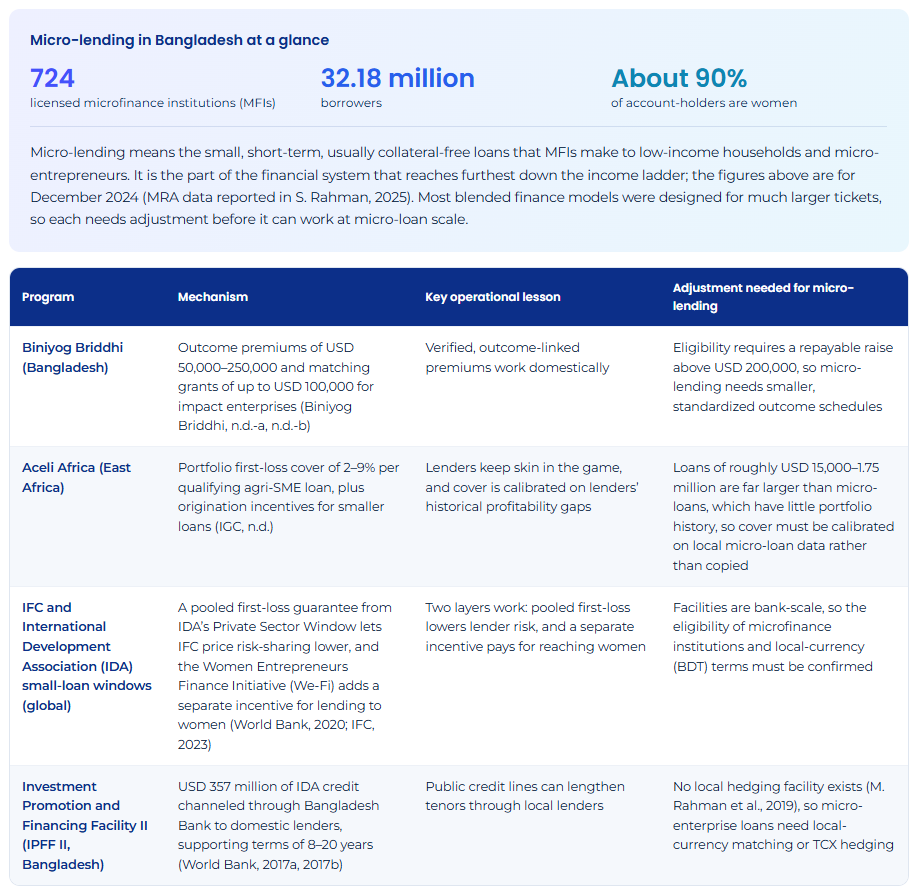
The eight characteristics are easier to judge in practice than in principle. The four programs below each put several of them to work, from outcome-linked payments and pooled first-loss cover to long-tenor credit lines.
For Bangladesh, the practical test is whether a model can reach low-income households. Most of the finance that does so flows through microfinance institutions. The table therefore asks the same question of each program: what would it take to make it work for micro-lending?
The common thread is that successful blended finance has an endpoint. Each characteristic tests whether public money is still necessary: additionality at entry, minimal concessionally during delivery, and a commercial exit test at the end.
UNDP and Convergence ask governments to check the same thing over time. They recommend periodic evaluations of whether concessionality is declining and private participation is increasing (UNDP & Convergence, 2026).
Concessional borrowing is already tightening. Bangladesh now borrows from the World Bank as a “blend” country. Under the current International Development Association (IDA) cycle, at least 10% of its borrowing has to be on market-based terms (Kabir, 2025).
LDC graduation, now deferred to November 2029 (Abdullah, 2026), will bring further changes. Moreover, public budgets alone will not close the SDG financing gap.
The programs that matter will be those that prove commercial lenders will lend on comparable terms without support. Where commercial lenders will not, programs should recycle the funds into technical assistance and publish what they learned.
The question for funders is not how much finance they can blend. It is how little concessional money it takes, and how soon they can step back.
This article was authored by Irti Haq, Business Consultant at LightCastle Partners. For further clarifications, contact us here: [email protected].
Our experts can help you solve your unique challenges
Stay up-to-date with our Thought Leadership and Insights