


GET IN TOUCH
- Please wait...

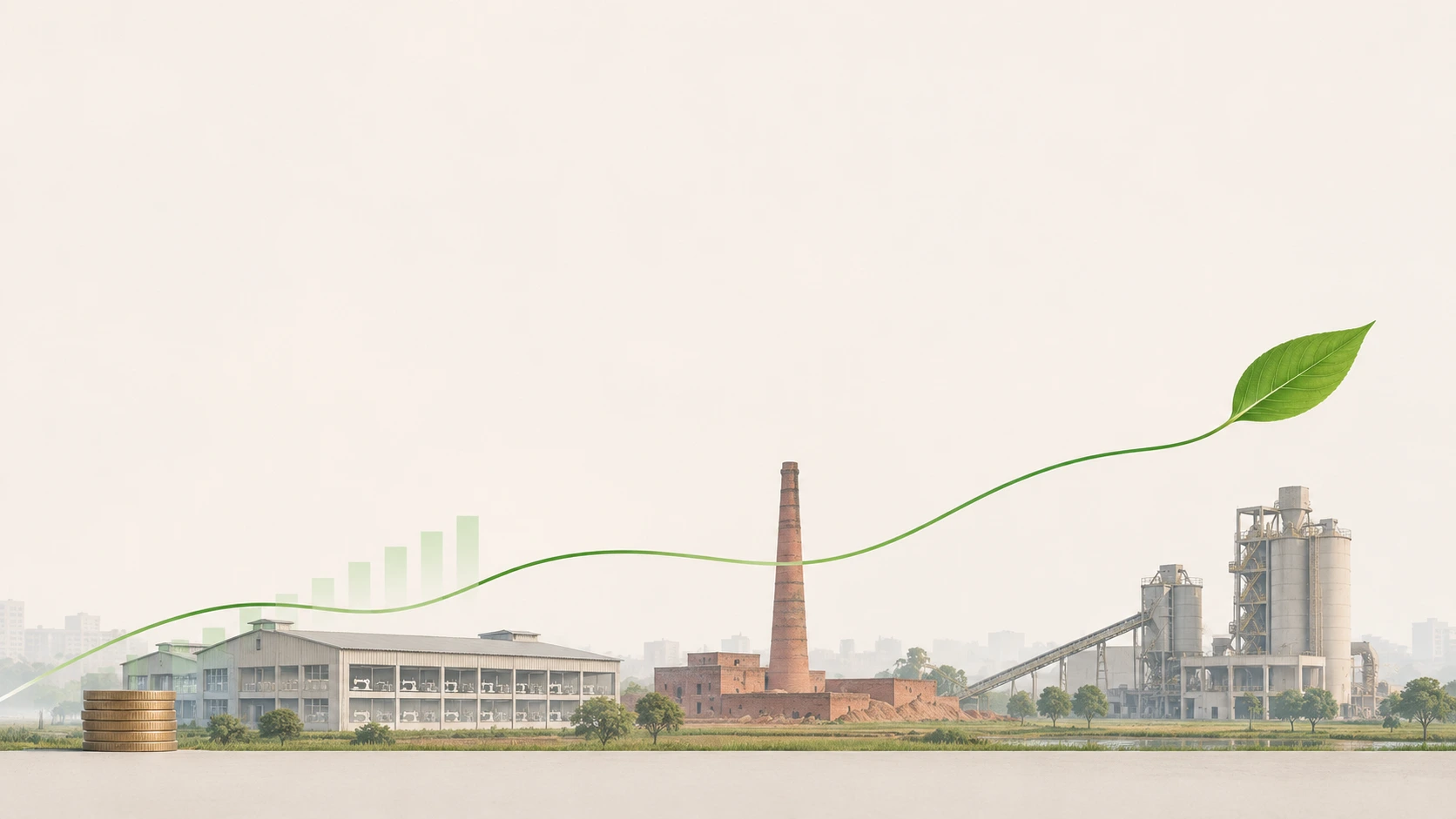
In 2025, Bangladesh’s banks and finance companies disbursed BDT 303.7 billion under green financing and BDT 4,480 billion under sustainable financing.¹ At first glance, the country’s financial sector has never been greener. However, if we take a look at where the money went, the picture changes. For instance, in the last quarter of 2025, renewable energy received BDT 3.53 billion, less than half a percent of all sustainable finance. Meanwhile, environmentally friendly brick production, a sector responsible for more than half of Dhaka’s air pollution, received under BDT 100 million.
Bangladesh Bank was among the first central banks to make green lending mandatory. To this end, it set up concessional refinance lines, binding disbursement targets, and a rating that rewards banks for meeting them.²˒³ After more than a decade, however, the system is still struggling to direct financing towards the sectors that need it the most. In practice, the money is not reaching the industries that emit the most. Meanwhile, banks continue to finance those same industries, at many times the scale, through ordinary loans.
Bangladesh’s Nationally Determined Contribution (NDC) 2.0, as updated in 2021, shows emissions concentrated in a small set of sectors. Moreover, it shows how fast those sectors could grow without intervention.
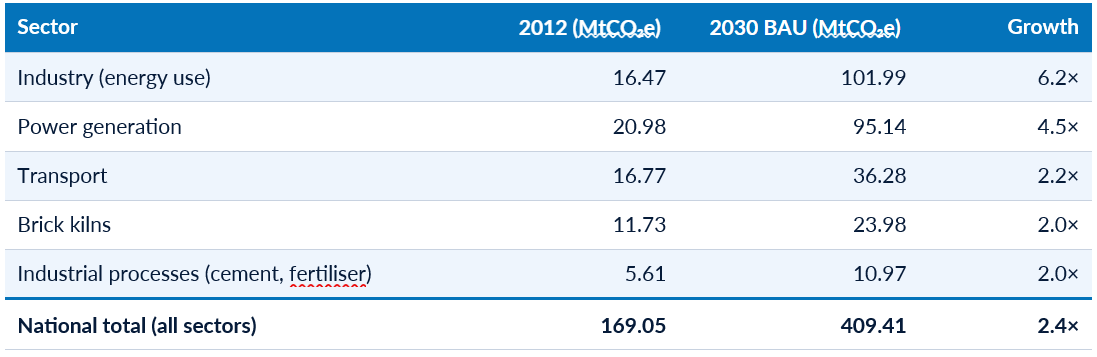
Table 1: Greenhouse gas emissions by sector, base year and business-as-usual (BAU) projection. Source: Ministry of Environment, Forest and Climate Change.⁴
Industrial energy use, which under IPCC accounting covers fuel burned in manufacturing, could become the country’s single largest source by 2030, at 24.9 percent of the total. Furthermore, when we add brick kilns and cement-led industrial processes, the industrial economy accounts for roughly a third of projected emissions. In particular, three sectors stand out.
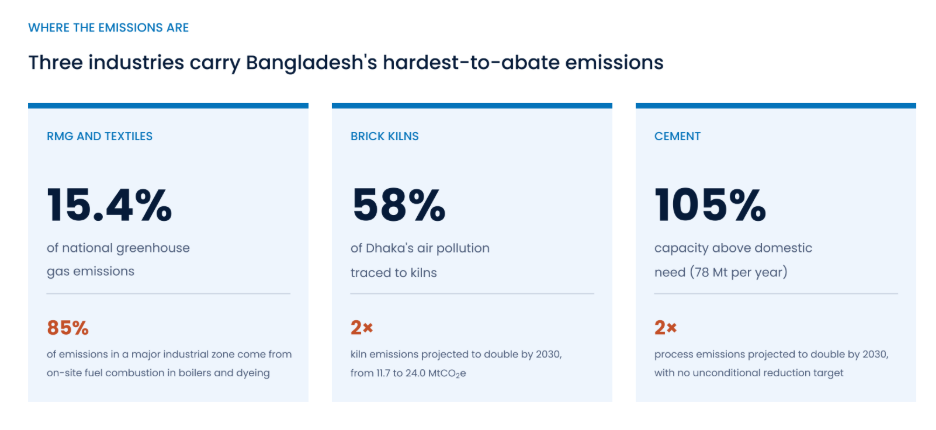
Figure 1: Headline indicators for Bangladesh’s three highest-emitting industries. Sources: UNB,⁵ Biswas et al.,⁶ Hossain,⁷ Ministry of Environment, Forest and Climate Change,⁸ Chakma.⁹
Garments and textiles are Bangladesh’s export engine, earning over 84 percent of export income.¹⁰ However, they also have the hardest kind of emissions to shift. A bottom-up inventory of Gazipur, a major industrial zone of the country, found that most of its emissions come from fuel burned on site in boilers, dyeing and finishing. On current trends, it projects them to rise more than fourfold by 2030.¹¹ Consequently, this matters for lenders. Rooftop solar, the most common green upgrade, cannot reach the heat-intensive washing and dyeing stages because they run on gas.¹² Therefore, decarbonising them means replacing boilers and process equipment. In other words, that is capital-intensive, long-payback investment, not a green building certificate.
Brick kilns are as much a public-health problem as a carbon one. For instance, thousands of registered kilns, and many more unregistered ones, burn coal and firewood at scale.¹³ Consequently, the kilns ringing Dhaka account for most of the capital’s air pollution.¹⁴ Kiln emissions could double by 2030,¹⁵ but brick is also the cheapest sector to start with. For example, a randomised trial of zigzag kilns found that better operating practices alone, with no new capital, cut emissions substantially.¹⁶ Therefore, kiln upgrades represent transition finance at its most bankable: small loans with conditions attached rather than large new plants.
Cement’s problem is scale. The industry has built far more capacity than the country uses.¹⁷ Moreover, most of its emissions come from burning fuel and drawing power, on top of the process emissions built into cement-making.¹⁸ Yet the NDC makes no unconditional commitment to cut industrial process emissions.¹⁹ As a result, there is little regulatory pressure on producers, or on their lenders, to change how the capacity runs.
To see how this plays out inside individual balance sheets, we compiled green and sustainable finance disclosures from the 2020–2024 annual reports of 11 commercial banks: three state-owned commercial banks and eight private commercial banks, Islamic and conventional. First, the findings concern the data itself. For example, some banks report only the final quarter’s disbursement. Meanwhile, others report cumulative “up to date” totals; others only outstanding balances. Consequently, only six of the 11 banks published clean annual green and sustainable disbursement figures for 2024.
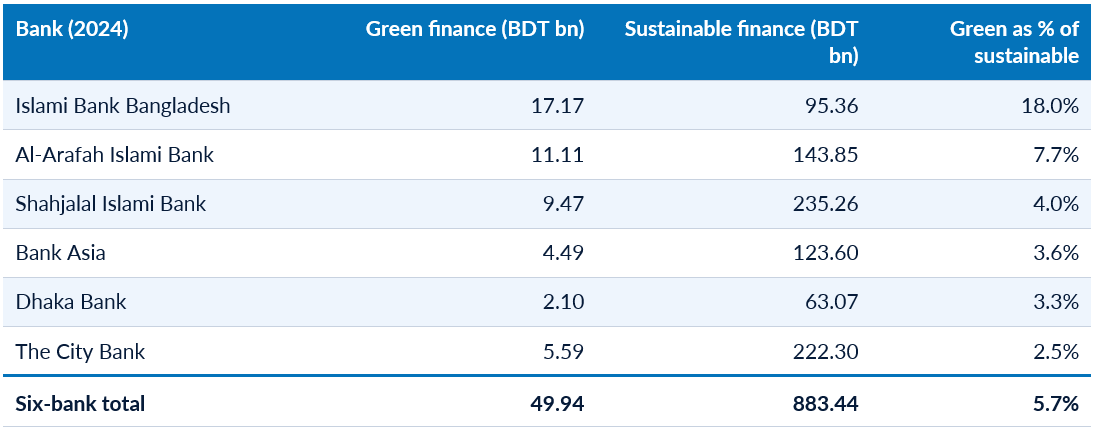
Table 2: Green versus sustainable finance disbursement, 2024.
Across these six banks, for every BDT 100 they disbursed as “sustainable” finance, they classified less than BDT 6 as green. Similarly, the trend points the same way. For the five banks with comparable 2023 and 2024 figures, sustainable disbursement rose by about 151 percent in a single year, while green disbursement rose by 2.7 percent. Even without the most volatile reporter, sustainable finance grew 86 percent against 24 percent for green.
The bank-level disclosures in Figure 2 show the same pattern from several angles:
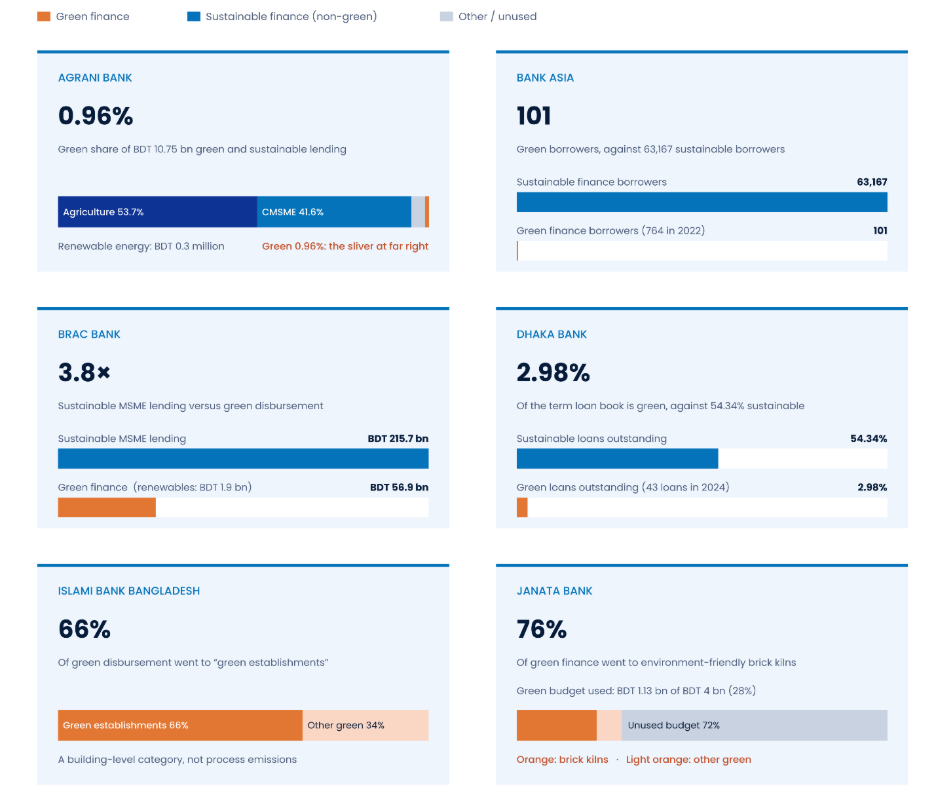
Figure 2: Green finance at six commercial banks, 2024. Each bank discloses different measures, so each panel shows the comparison its data allows.
Where banks break down their sustainable lending, agriculture and small-business loans dominate, and green finance is a thin remainder.
Similarly, where banks report borrower counts or loan-book shares, green finance reaches a few dozen to a few hundred clients, against tens of thousands of sustainable borrowers.
Meanwhile, where banks break down the green lending itself, the money goes mainly to building-level and efficiency categories, while renewable energy gets low single-digit shares.
Janata Bank, however, is the one exception. It directs most of its green finance to cleaner brick production. However, it disbursed barely a quarter of its own green budget.
Furthermore, the national data confirm the pattern. Bangladesh Bank’s quarterly reviews show that “other sustainable linked finance,” a broad residual category, made up 54.7 percent of all sustainable finance in late 2023, with CMSME (20.3 percent) and agriculture (10.6 percent) next. In contrast, green finance accounted for 8.2 percent.²⁰ By late 2025, the residual category had shrunk to about 35 percent and MSME lending had grown to about 33 percent. However, green finance was still about 8 percent of the total, and its internal mix remained skewed.²¹
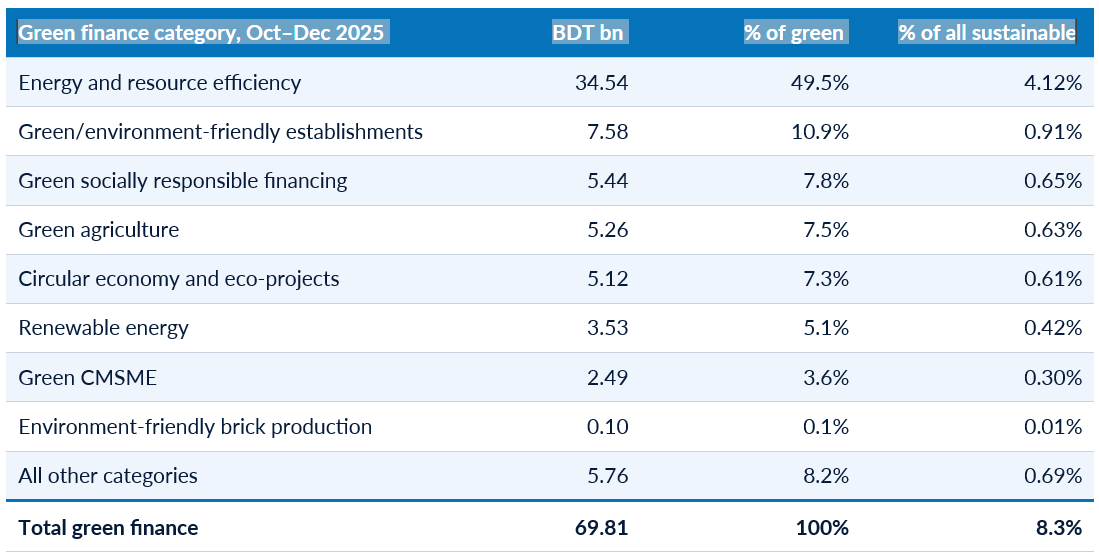
Table 3: Green finance disbursement by category, October–December 2025. Total sustainable finance in the quarter was BDT 837.5 billion. Source: Bangladesh Bank.²²
Energy and resource efficiency dominates the green book, and some of that does reach factories. For example, Bangladesh now has 268 LEED-certified RMG factories, the highest in the world.²³ However, building certification and efficiency retrofits are the easy, bankable end of decarbonisation. In contrast, the hard end is gas-fired process heat, kiln conversion, and clinker substitution. Yet it barely registers in the data. For instance, brick production received about BDT 1.40 of every BDT 1,000 in green finance during the quarter.
In fact, comparing Tables 1 and 3 makes the gap plain. The sectors projected to drive Bangladesh’s emissions growth are industrial energy, brick, and cement. However, the money is flowing mainly to small agricultural and CMSME borrowers, to green-certified buildings, and to a residual “other” category. The reasons are structural.
Bangladesh Bank’s targets require green finance of at least 5 percent of term loan disbursement and sustainable finance of 20 percent of total disbursement. From 2025, the targets are 5 percent and 40 percent of net loans outstanding.²⁴ However, Bangladesh Bank rates banks on whether they hit these volumes, not on the emissions their lending avoids. Consequently, the result shows up as a year-end rush. For example, green and sustainable disbursement jumped 160 percent in the October–December 2023 quarter, and bankers openly attributed the surge to “the drive to secure favourable ratings.”²⁵ Indeed, banks are meeting the targets: in 2024, 34 banks cleared the green finance threshold.²⁶ However, banks will meet a target that counts taka with whichever taka are easiest to relabel.
Sustainable CMSME and sustainable agriculture are legitimate development priorities. However, much of this lending looks like the SME and farm credit banks were already extending. When a bank can meet a 20 or 40 percent sustainable finance target largely through its existing SME and farm portfolios, it has little reason to take on a 10-year kiln conversion loan. For example, at Bank Asia, green borrowers fell from 764 to 101 in two years while its sustainable borrower base stayed above 60,000. In other words, that is what the incentive looks like inside one institution.
Green industrial projects are long-tenor, technically complex, and slow to pay back. Meanwhile, banks prefer quicker returns, and refinance procedures are paperwork-heavy.²⁷ For example, the Green Transformation Fund, the main window for export-oriented manufacturers, illustrates this. Specifically, its taka component had disbursed only about 37 percent of its BDT 50 billion allocation by June 2025, and its euro component 36 percent. Moreover, borrowers must put up 30 percent equity, which many factories cannot.²⁸ In a banking sector where 26 percent of RMG loans and 25 percent of textile loans were already non-performing in 2024,²⁹ lenders are not inclined to take on new transition risk.
The compliance signature in the data: sustainable finance surging while green finance stays flat, quarter-end spikes timed to ratings, green borrower counts falling, and reporting formats that change year to year. Together, these are the marks of a portfolio that banks manage to meet a target rather than to change emissions.
Even if banks targeted green finance perfectly, it would still be a small book running alongside a much larger one. Moreover, the same banks that report green disbursements are the main conventional lenders to the sectors that most need to decarbonise.
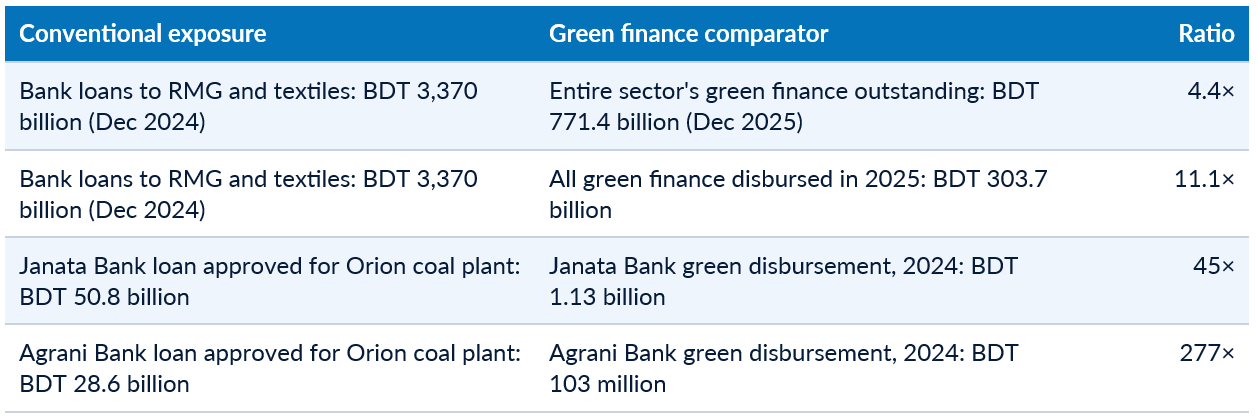
Table 4: Conventional exposure versus green finance. Dates differ where noted; the comparisons indicate orders of magnitude. Sources: Bonik Barta,³⁰ Bangladesh Bank,³¹ and Hasan.³²
Bangladeshi banks held BDT 3,370 billion in loans to RMG and textiles at the end of 2024.³³ In fact, that is more than four times the banking sector’s entire green finance stock a year later. Of course, not all of that lending is emission-intensive. However, banks do not screen any of it for emissions either. As long as banks do not price working capital and term loans for gas-fired boilers and dyeing lines for carbon, these loans keep current processes running with no incentive to change.
By comparison, the power sector is a clearer case. In 2022, Bangladesh Bank lifted the 25 percent single-borrower exposure cap for coal-fired power projects for five years.³⁴ Under that relaxation, three state-owned banks, Agrani, Janata, and Rupali, approved BDT 105.8 billion for a single coal plant. Specifically, Janata’s approval equalled 219 percent of its paid-up capital and Rupali’s 569 percent.³⁵ Ultimately, the banks did not disburse the loans after the sponsor moved the project to solar. Nevertheless, the approvals show the risk appetite: banks reluctant to lend a few hundred million taka for kiln upgrades were ready to commit multiples of their capital to coal. In effect, the same regulator that pushes green targets made room for that lending through its own exposure rules.
The arithmetic is unforgiving. A green portfolio worth a few percent of the loan book cannot offset the emissions financed by the rest of the book. Moreover, the green share does not come from the sectors where emissions are concentrated. Furthermore, political capture adds to the problem. For instance, concessional Green Transformation Fund loans went to borrowers linked to a single conglomerate, and those loans are now in default.³⁶ Under these conditions, green finance becomes a parallel reporting exercise rather than a counterweight to conventional lending.
The fix is not more green financing. Instead, it is a different way of counting it. Bangladesh Bank’s rating framework could shift weight from disbursement volume to portfolio emissions intensity. Consequently, banks would need to measure and disclose financed emissions for their largest industrial exposures, starting with textiles, brick, cement, and power. Moreover, the green taxonomy needs a dedicated transition category for process-heat conversion, kiln upgrades, and clinker substitution. As a result, a catch-all “other” category would no longer dilute this lending. Additionally, conventional loans to high-emission borrowers could carry transition covenants. For instance, the kiln trial suggests these need not be expensive: zero-capex operating changes that cut 171 tonnes of CO₂ per kiln a year at a 65-to-1 benefit-cost ratio³⁷ are the kind of condition a lender can attach to an ordinary working capital line.
Bangladesh built one of the developing world’s earliest green finance frameworks. However, its next test is whether the framework can follow the carbon, not just the money. With LDC graduation approaching and buyers already scoring suppliers on emissions, banks that learn to read their loan books in tonnes as well as taka will be best placed to finance the transition, and to avoid being left holding the stranded assets.
This article was authored by Labib Al Tasfi, Business Analyst at LightCastle Partners. For further clarification, please contact [email protected].
Our experts can help you solve your unique challenges
Stay up-to-date with our Thought Leadership and Insights