


GET IN TOUCH
- Please wait...

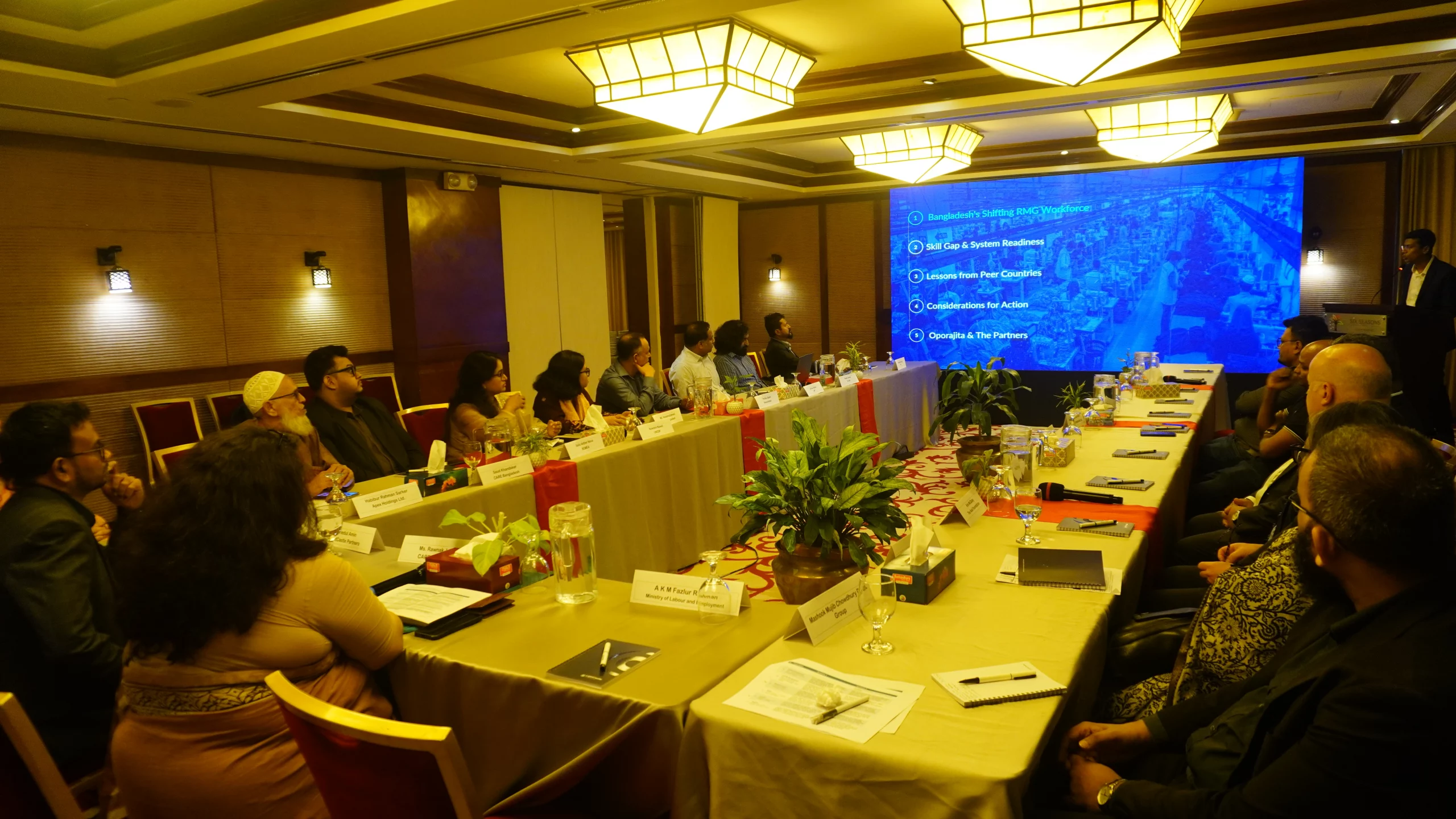
On June 24, 2026, LightCastle Partners convened its fourth closed-door roundtable in partnership with Center for Communication Action Bangladesh (C-CAB), titled “Shaping the Future Workforce: Advancing Workforce Development in Bangladesh’s RMG Sector”. The session was organized as part of Bunon 2030 under Phase 2 of the Oporajita – Collective Impact on Future of Work: Just Transition for Women in the RMG Ecosystem initiative. This collective effort is supported by the H&M Foundation, co-funded by Sweden and COS, with The Asia Foundation serving as the backbone organization.
The roundtable brought together representatives from development organizations, the private sector, industry associations, and the RMG sector, as well as RMG sector experts. Participants included representatives from The Asia Foundation, UNCDF, CARE Bangladesh, CAIF, C-CAB, BGMEA, DBL Group, Meghna Knit Composite Ltd., Tusuka Ltd., Apex Holdings Ltd., Ayat Education, and Neo Grid.
The roundtable commenced with a presentation by Shoumik Shahriar, Senior Business Consultant & Project Manager from LightCastle Partners, who outlined the structural changes reshaping Bangladesh’s RMG workforce. The presentation highlighted that the sector directly employs approximately 3.8 million workers, with women accounting for more than 55% of the workforce, yet only 9% of supervisory and managerial positions. It also noted that more than 60% of workers lack the skills required for current and future roles. The presentation further examined how automation, digitalization, and emerging sustainability requirements are changing factory-level skill needs.
Following the presentation, the discussion was moderated by Zahedul Amin, Managing Director and Co-Founder of LightCastle Partners, and co-moderated by Rawnak Jahan, Director, Women and Youth Programme of CARE Bangladesh. Mr. Zahedul Amin guided the conversation around how successful workforce development interventions could move from being project-specific to becoming part of a permanent, sector-wide system. He raised questions on Recognition of Prior Learning, the relevance and portability of certification, workforce and gender-linked financing mechanisms, the care economy challenges faced by Tier 2 and Tier 3 factories, and the sustainability of development interventions beyond their funding periods.
Ms. Rawnak steered the discussion on women workers’ career progression, the importance of combining technical and soft skills, and the social and institutional barriers that prevent women from advancing into supervisory and leadership positions.
Following this framing, the floor was opened to stakeholders, beginning with Mashook Mujib Chowdhury, Senior Manager, Sustainability, DBL Group, who highlighted the need to prepare workers for emerging sustainability and reporting requirements. He also discussed DBL Group’s sustainability-linked loan, which offers financial incentives for achieving social targets such as increasing female representation in supervisory roles. However, he noted that longer working hours, social expectations, and limited understanding of supervisory compensation continue to affect women’s progression into leadership positions.
Building on the need for adaptable workers, Muhammad Mainul Islam, Director of Operations at Meghna Knit Composite Ltd., emphasized the importance of multi-skilling to maintain productivity as factories shift between products. He explained that the company uses On-the-Job Training to help operators manage multiple machines and processes. “Soft skills are what change the whole game,” he said, stressing that technical training must be combined with leadership, responsibility, and ownership. He also noted that family responsibilities and relocation continue to limit the retention of women in supervisory roles.
Turning to women’s aspirations and retention, Laila Karim, Director of Ayat Education, highlighted the social and economic barriers that prevent many women garment workers from viewing factory employment as a long-term profession. She noted that “limited literacy and immediate household pressures often restrict women’s ability to envision progression into supervisory, technical or design-related roles”. She called for training programs to expose workers to a wider range of factory careers and identify suitable candidates for targeted progression.
Ms. Karim also emphasized the importance of the care economy, arguing that dependable childcare and health services should be treated as workforce-retention and sectoral compliance issues rather than optional welfare measures. She further called for a live worker database and greater digital literacy, noting that many women workers still lack access to smartphones.
From an industry-association perspective, Saila Akther Nova, section in-charge of the Skill Development Programme at BGMEA, discussed the importance of recognizing the competencies of experienced workers through standardized certification. Although Recognition of Prior Learning is being implemented through BGMEA’s center, it has not yet been regularized across the sector.
Shifting the discussion towards financing, Nowshin Nawal, National Green Financing Analyst at UNCDF, highlighted the barriers faced by smaller enterprises and marginalized groups in accessing funding. She explained that banks and financial institutions often struggle to serve smaller borrowers because of profitability concerns and the high administrative cost of due diligence. She suggested that bulk approval mechanisms and streamlined certification could make it easier for smaller factories to access finance for workforce capacity building and sustainability-related investments.
“We need to move towards market development systems,” she said, highlighting the potential of guarantees, equity-based financing, bond markets, and low-cost development partner support.
Addressing the sustainability of development interventions, Jamal Uddin, an independent RMG expert, highlighted the gap between development programmes and factory realities, noting that interventions often fail when they lack industry input. He also stressed that certifications must reflect the distinct skill requirements of knit, woven, and sweater factories. “Factories will always test the required skills; they will not hire based on certificates alone,” he said.
Building on the discussion of skills and employability, Hasan James, Senior Program Officer at C-CAB, highlighted the behavioral and social barriers that limit women’s progression. He noted that only 8% of surveyed women workers had smartphones, while 40% lacked confidence in their ability to take on leadership or technology-related roles, and 71% believed men were better leaders.
Turning to workers lived realities, Habibur Rahman Sarker, President of Apex Holdings Ltd., emphasized that financial hardship, limited career aspirations, and unaffordable childcare frequently force women to leave employment after childbirth.
Highlighting ongoing interventions, Mohammad Hassanuzzaman of CARE Bangladesh explained that Oporajita combines technical training with leadership development, stress management, and gender-based violence prevention. “One-shot training is not enough; market connectivity makes it sustainable,” he said.
Extending the discussion to women who have already left the sector, Dhiman Halder, Manager at Intellecap, CAIF, noted that 2.7 million women are at risk of job loss and that many fall out of formal support systems after leaving factory employment. He highlighted the childcare gap between the end of maternity leave and the age at which many daycare facilities accept children. He also outlined efforts to introduce the recognition of Prior Learning and create transition pathways into sectors such as plastics, leather, and recycling.
Offering an industry example, Md. Shahid Ullah Patwary, General Manager of Tusuka Group, shared the company’s progress in developing women leaders. Of 500 women trained, 60 were selected for progression, with 30 already promoted to supervisory roles and another 30 preparing for leadership positions. He also noted that Tusuka is supporting four former helpers and operators to pursue bachelor’s degrees at the Asian University for Women, demonstrating how factories can invest in longer-term education and career pathways.
Reflecting on these examples, Ainee Islam, Program Director of The Asia Foundation, emphasized that Oporajita’s interventions are grounded in a broader assessment of the sector and place women workers at the center. She noted that the program addresses not only technical skills but also childcare, social stigma, changing perceptions, and alternative livelihoods, with the aim of developing practical models that factories and policymakers can adapt and scale.
As the session concluded, co-moderator Rawnak Jahan synthesized the discussion by highlighting the need to combine hard and soft skills, align training with actual industry demand, and strengthen women’s career aspirations with support from families, communities, and factory management.
“Even as a mother, she is a person with a dream,” Ms. Rawnak said, underscoring the need to place women’s aspirations at the center of Bangladesh’s transition towards a resilient, inclusive, and future-ready RMG workforce.
Our experts can help you solve your unique challenges