


GET IN TOUCH
- Please wait...

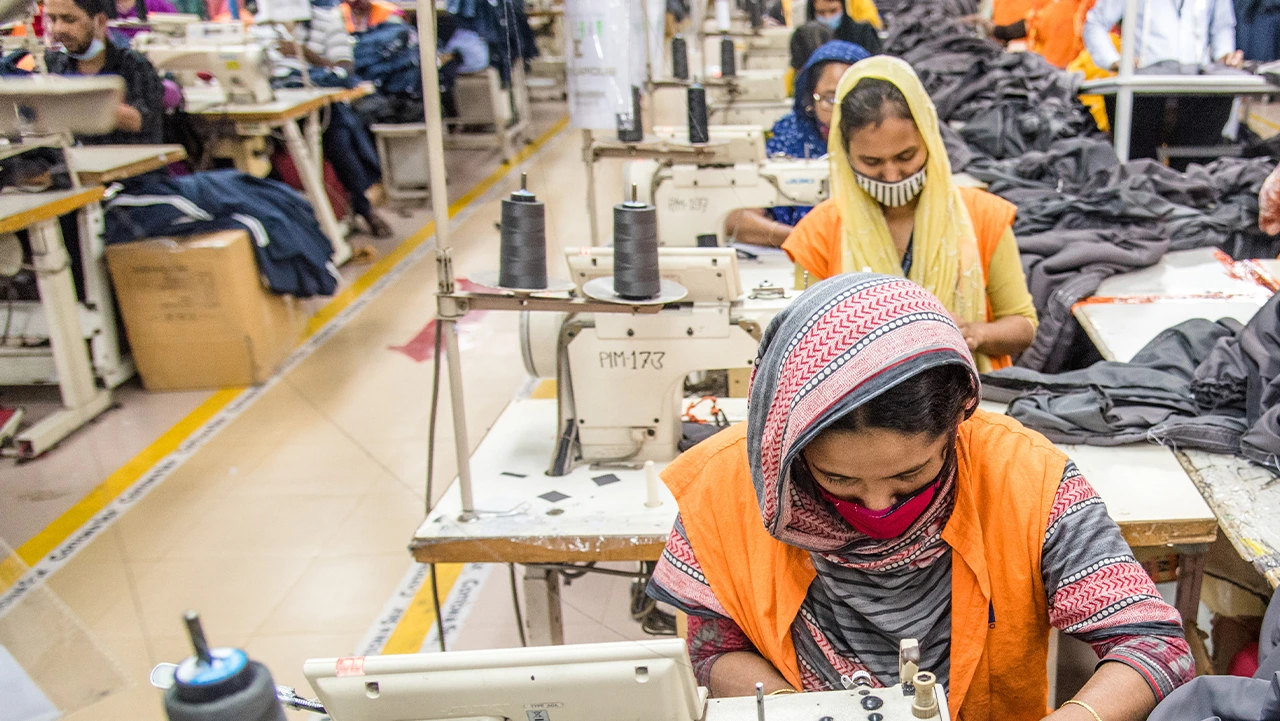
Bangladesh’s RMG sector has been built on the strength and resilience of its workforce, and investing in their skills now can unlock the industry’s next phase of growth.
With 3.8 million workers directly employed and women comprising more than 55% of the workforce, the RMG sector generates 84% of the country’s export earnings. [1,2] Yet more than 60% of workers lack the skills required for current and future roles, and the forces converging on the sector, automation, digitalization, buyer sustainability mandates, and the approaching end of preferential trade access, are arriving simultaneously, not sequentially.
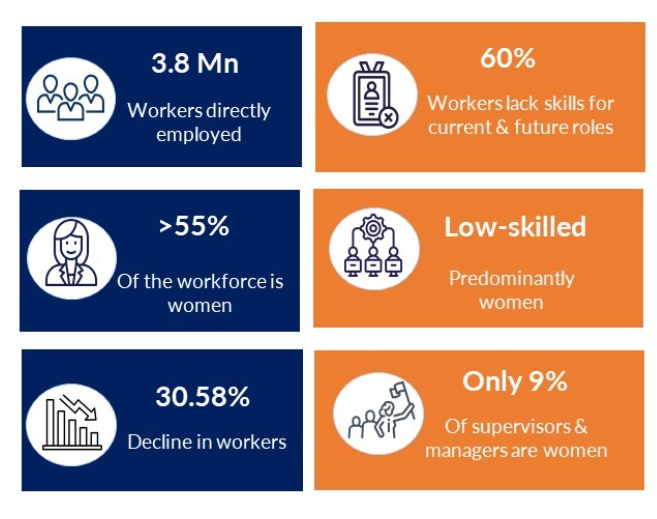
Figure: Bangladesh’s RMG Workforce Landscape
To deliberate on pathways forward, LightCastle Partners convened its fourth closed-door roundtable, titled Shaping the Future Workforce: Advancing Workforce Development in Bangladesh’s RMG Sector, on June 24, 2026, in partnership with C-CAB, as part of the Bunon 2030 initiative under Phase 2 of the Oporajita — Just Transition for Women in the RMG Ecosystem initiative. Supported by the H&M Foundation, co-funded by Sweden and COS, with The Asia Foundation as the backbone organization, the session brought together industry leaders, development organizations, financial institutions, and worker representatives to translate roundtable deliberations into a coordinated workforce-transition agenda.
The keynote presentation by LightCastle Partners set the scale of the challenge plainly. Women’s participation in the workforce has been declining steadily, alongside an overall contraction in worker numbers. Women also remain concentrated among helpers and entry-level operators, the roles most exposed to industrial transformation, while their representation in supervisory and managerial positions remains limited. This reflects a promotion pipeline that has remained effectively closed for decades
Buyer net-zero commitments, H&M’s 56% emissions reduction target by 2030 and Inditex’s 50% reduction, are pushing carbon reporting, waste tracking, and energy monitoring into factory operations as skill requirements, not hardware upgrades. [3,4] The EU’s Carbon Border Adjustment Mechanism, expected to extend to textiles from 2028, will penalize suppliers who cannot measure embedded carbon. With Bangladesh’s LDC graduation expected around 2029, the loss of preferential trade access alone could cut RMG exports by 11.8% and GDP by 1.53%.[5] The cost of inaction is macroeconomic, not merely sectoral.
Building a future-ready RMG sector requires a workforce equipped to adapt, progress, and contribute across evolving production roles.
Factory-level adaptability hinges on a workforce that can move across machines and processes, a capability the sector has not yet systematically built.
Muhammad Mainul Islam, Director of Operations at Meghna Knit Composite Ltd., described the operational gap: with approximately 50% of operators confined to a single machine, product transitions generate significant idle time and efficiency losses. His factory addresses this through structured On-the-Job Training, maintaining an 8.5 to 9.5% excess operator pool to absorb transitions without disruption. He stated, that soft skills are equally critical: “Soft skills are what change the whole game, without a sense of responsibility and ownership, technical expertise alone won’t make a big impact.”
Other participants further highlighted the practical conditions that shape whether adaptability can be achieved. Mashook Mujib Chowdhury, Senior Manager, Sustainability at DBL Group, noted that Science Based Targets initiative (SBTi) compliance demands workers capable of understanding sustainability metrics at production level, a requirement with no counterpart in existing training. Laila Karim, Director of Ayat Education, was more direct about the pipeline itself: “When we see who comes for vocational training, they can barely write their names, how will they dream of being a supervisor if they are just surviving for immediate family needs?”
The retention of women in supervisory pathways emerged as the roundtable’s sharpest fault line. Even with targeted on-the-job and soft-skills training, a 2021 BRAC University research, A Study on the Declining Number of Female Workers in the Bangladesh RMG Industry, found that caregiving and family responsibilities remained the main reasons women left the workforce. Childcare was cited by 26.67% of former women RMG workers and pregnancy by 17.89%, followed by age-related concerns and difficulties balancing work and family responsibilities.
Figure: Reasons for exit cited by former women RMG workers (2021), Source: GIZ & BRAC
Research conducted for Oporajita Phase 2 by C-CAB found that only 8% of women workers have smartphones, 40% lack confidence in their ability to take on leadership roles, and 71% believe men are better leaders. “Change must be behavioral at the core; unless confidence grows within the worker, technical training alone will not work,” mentioned Hasan James, Senior Program Officer at C-CAB. His team addresses this through multi-channel communication like puppet shows, street theater, and free cinema screenings, engaging families as active partners in the process.
Bridging technical training with sustained behavioral support is where programme design becomes decisive. Mohammad Hassanuzzaman of CARE Bangladesh described Oporajita’s response: training covering leadership, stress management, and gender-based violence prevention, reinforced by a Training of Trainers model to sustain impact beyond the project cycle. Ainee Islam, Program Director at The Asia Foundation, reinforced the point: the enabling environment, accessible childcare, perception change, and alternative livelihood pathways, is not supplementary to the skills agenda; it is foundational to it.
A persistent gap remains between formal training and factory-level hiring practices. Jamal Uddin, RMG expert at LightCastle Partners, explained that skill requirements vary considerably across knit, woven, and sweater factories, limiting the value of standardized certificates during recruitment. “Factories will always test the required skills; they will not hire based on certificates alone,” he said. Echoing this concern, Saila Akther Nova, Section In-charge of BGMEA’s Skill Development Programme, highlighted ongoing efforts to strengthen RPL across the sector. She stated, “RPL is already being implemented at BGMEA’s center and that closer coordination with the NSDA could help institutionalize the approach and align related initiatives under a unified framework.”
The roundtable discussion also made clear that future-oriented competencies are not a policy horizon; they are already demanded by buyers.
Figure: From Training to Transition, the capability layers
Among these capability layers, green and sustainability skills have become especially urgent as environmental performance increasingly influences sourcing decisions and market access. Buyers are no longer treating these competencies as optional; they are incorporating them into supplier’s assessments and compliance requirements. Industry experience with SBTi compliance is instructive here: carbon accounting, waste tracking, and energy monitoring are absent from national curricula even as buyer scorecards and EU regulatory requirements make them prerequisites for market access. Embedding these skills into RT-ISC and BTEB standards, co-financed by the brands whose mandates create the demand, is a gap the sector cannot afford to leave open.
Moving from successful pilots to a permanent, sector-wide system will require an institutional structure that does not yet exist. In her closing synthesis, co-moderator Rawnak Jahan, Director of the Women and Youth Programme at CARE Bangladesh, emphasized the need for a dedicated coordination mechanism bringing together government organizations, development partners, and worker representatives. Crucially, this coordination mechanism must have the authority to convene stakeholders, align priorities, and drive implementation rather than function solely in an advisory capacity.
Financing must also extend beyond machinery to support the workforce operating it, particularly in Tier 2 and Tier 3 factories. Nowshin Nawal, National Green Financing Analyst at UNCDF, highlighted the need to diversify the instruments available: “We need to move towards market development systems, equity-based, bond-based tools, and low-cost development partner support, rather than relying solely on central bank refinancing, which is susceptible to inflation and regulatory friction.” She further identified bulk approval mechanisms and non-funded guarantees as potential pathways for expanding access to structured workforce-development financing among smaller factories
The transition pathway involves mapping occupations by automation risk, building operator-to-supervisor progression routes for women, converting factory-floor experience into portable credentials through a national RPL drive, embedding green and digital skills into national curricula, and extending access to financing for lower-tier factories through matched or buyer co-financing.
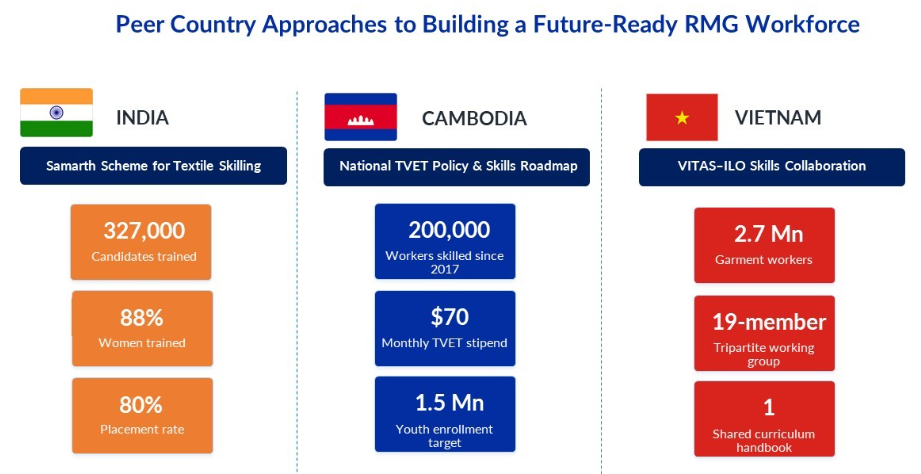
Figure: Peer country outlook on future RMG workforce
As illustrated in the infographic, peer-country experience shows that effective workforce development combines demand-driven training, long-term planning, and strong industry-government collaboration. India demonstrates the potential of targeted textile-skilling programs at scale, Cambodia highlights the value of a garment-led, long-horizon skills roadmap, and Vietnam shows how tripartite collaboration can produce industry-responsive curricula. Together, these approaches provide a practical reference for developing a sector-specific workforce roadmap for Bangladesh. [7,8,9]
The roundtable revealed that Bangladesh’s RMG sector already possesses many of the building blocks required for workforce transition, but not yet the coordinated system needed to bring them together. The programme evidence, financing models, and institutional capabilities exist; the next step is to align them under a shared roadmap with clear ownership and accountability.
“Even as a mother, she is a person with a dream,” Rawnak Jahan said in her closing remarks, capturing the human significance of the agenda. Preparing Bangladesh’s RMG workforce for the future is therefore not only a competitiveness imperative. It is also about ensuring that the women who built the sector have the skills, opportunities, and support to lead its next chapter.
This article was authored by Faiza Tahiya, a Business Analyst at LightCastle Partners. For further clarifications, contact here: [email protected]
Our experts can help you solve your unique challenges
Stay up-to-date with our Thought Leadership and Insights