



GET IN TOUCH
- Please wait...

As preferential tariff structures phase out in 2026, competing solely on low production costs will become insufficient for Bangladesh. Sustainable market positioning will increasingly depend on Bangladesh’s capacity to document domestic material reclamation and circular manufacturing processes.
For the past decades, Bangladesh has driven one of the most successful manufacturing ventures in the developing world on a clear proposition: stitch garments cost-effectively and at volume, leveraging preferential trade access. This industrialization paradigm is now approaching a critical transition. In November 2029, Bangladesh graduates from Least Developed Country status, a milestone of genuine national progress that simultaneously introduces significant trade adjustments in the country’s modern history.
The economic metrics are demanding. Ready-Made Garment sector accounts for roughly 84 percent of export earnings and contributed 7.9 percent of GDP in 2024, generating an estimated $38.48 billion in revenue. A substantial portion of this competitiveness relies on duty-free, quota-free access, most notably the European Union’s Everything But Arms scheme. Graduation significantly alters these foundational trade terms.
Conventional responses have successfully focused on securing transition periods (2026-29) and new free-trade agreements. While necessary, these approaches may not address the core structural vulnerabilities. The defining factor for whether Bangladesh sustains its position as the world’s long standing second-largest (now third) apparel exporter lies in its capacity to manufacture its own raw materials. The most abundant available resource: fabric waste, is currently underutilized. Circularity, previously viewed primarily as an environmental initiative, has emerged as a central pillar for maintaining industrial competitiveness in the post-2026 landscape.
It is crucial to outline the specific impacts of graduation, as the sector faces multiple simultaneous adjustments.
Tariff Escalation
The EU has granted a three-year grace period, extending EBA benefits to 2029. Following this, the Centre for Policy Dialogue¹ estimates the loss of duty-free access adds an average tariff of 6.7 percent across global markets. Given tariff peaks in apparel, the effective tariff in the EU—which absorbs over half of Bangladesh’s garment exports at approximately $19.4 billion—is projected to rise to roughly 12 percent, while in Canada it may climb to 16 to 18 percent. Because global apparel demand is highly price-elastic, a double-digit tariff increase requires significant strategic realignment to prevent the re-routing of orders to rivals.
Rules of Origin Requirements
The EU’s GSP+ scheme is frequently cited as a transition pathway, restoring preferential access conditional on ratifying conventions regarding labor, human rights, and the environment. However, the primary hurdle is structural. GSP+ mandates “double transformation” rules of origin, requiring fabric to be manufactured domestically rather than just cut and sewn.
Bangladesh’s current model heavily relies on single transformation through imported woven fabric and virgin yarn from China and India. Relying on imported virgin material post-2026 risks failing the origin test, and the UN’s readiness assessment² warns this requirement alone threatens a 16 percent drop in total exports. Furthermore, RAPID³ research indicates Bangladesh’s clothing exports exceed both the 7.4 percent product-diversification threshold and the proposed 6 percent EU safeguard ceiling, potentially excluding the sector from standard GSP+ apparel benefits and leaving roughly 12 percent Most-Favoured-Nation tariffs as the probable outcome.
Compliance and Sustainability Regulations
Beyond tariffs, the EU’s Ecodesign for Sustainable Products Regulation (ESPR), active since July 2024, designates textiles as a priority, mandating durability and recyclability, and prohibiting the destruction of unsold clothing. Along with the Corporate Sustainability Due Diligence Directive (CSDDD) and the forthcoming Digital Product Passport, these regulations establish verifiable sustainability as a non-tariff market entry condition. A factory unable to document recycled content and trace its supply chain risks exclusion from the EU regardless of price point. Sourcing criteria have decisively shifted to prioritize carbon intensity, traceability, and circularity over pure price arbitrage.
Read together, the three challenges highlight a single condition. The trade buffers that historically offset Bangladesh’s structural weaknesses, import reliance and a narrow product range—are phasing out at the exact moment global rules are rewarding integrated, circular production.
The challenges ahead cannot be resolved solely through labor cost advantages, as competitor nations have diversified their value propositions over the past several years.
| Metric | Bangladesh | Vietnam | Turkey | India |
| Average lead time | 60–90 days | 45–60 days | 20–30 days | 60–90 days |
| Product mix | Low (basic cotton) | High (MMF, technical) | High (fast fashion) | Medium (integrated) |
| Rules-of-origin risk | High (import-reliant) | Low (EVFTA) | None (Customs Union) | Low (vertical) |
| EU access post-2029 | ~12% (likely MFN) | 0% (EVFTA) | 0% (Customs Union) | TBD (FTA pending) |
(Synthesised from CPD, Pressenza, Fibre2Fashion, SANEM and Flame University analyses, 2026)⁴
Lead time remains a critical differentiator. Turkey fulfills orders in 20 to 30 days with zero duty within the EU Customs Union, positioning itself as a sustainable denim hub. Turkish mills, such as Maritas, utilize 100 percent recycled technology and hold dense clusters of GOTS, OEKO-TEX, and GRS certifications that align seamlessly with ESPR requirements. Vietnam offers 45 to 60-day lead times, benefits from zero-duty EVFTA access, maintains vertically integrated spinning and weaving facilities, and is drafting Extended Producer Responsibility decrees that formalize circularity requirements. India achieves complete vertical integration from cotton production to fabric weaving, easily satisfying double-stage origin rules.
Bangladesh currently averages 60 to 90 days, significantly impacted by the time required to import fabric from China. This import dependence creates both the lead-time penalty and the rules-of-origin challenge, meaning localized material sourcing serves as a dual-purpose intervention.
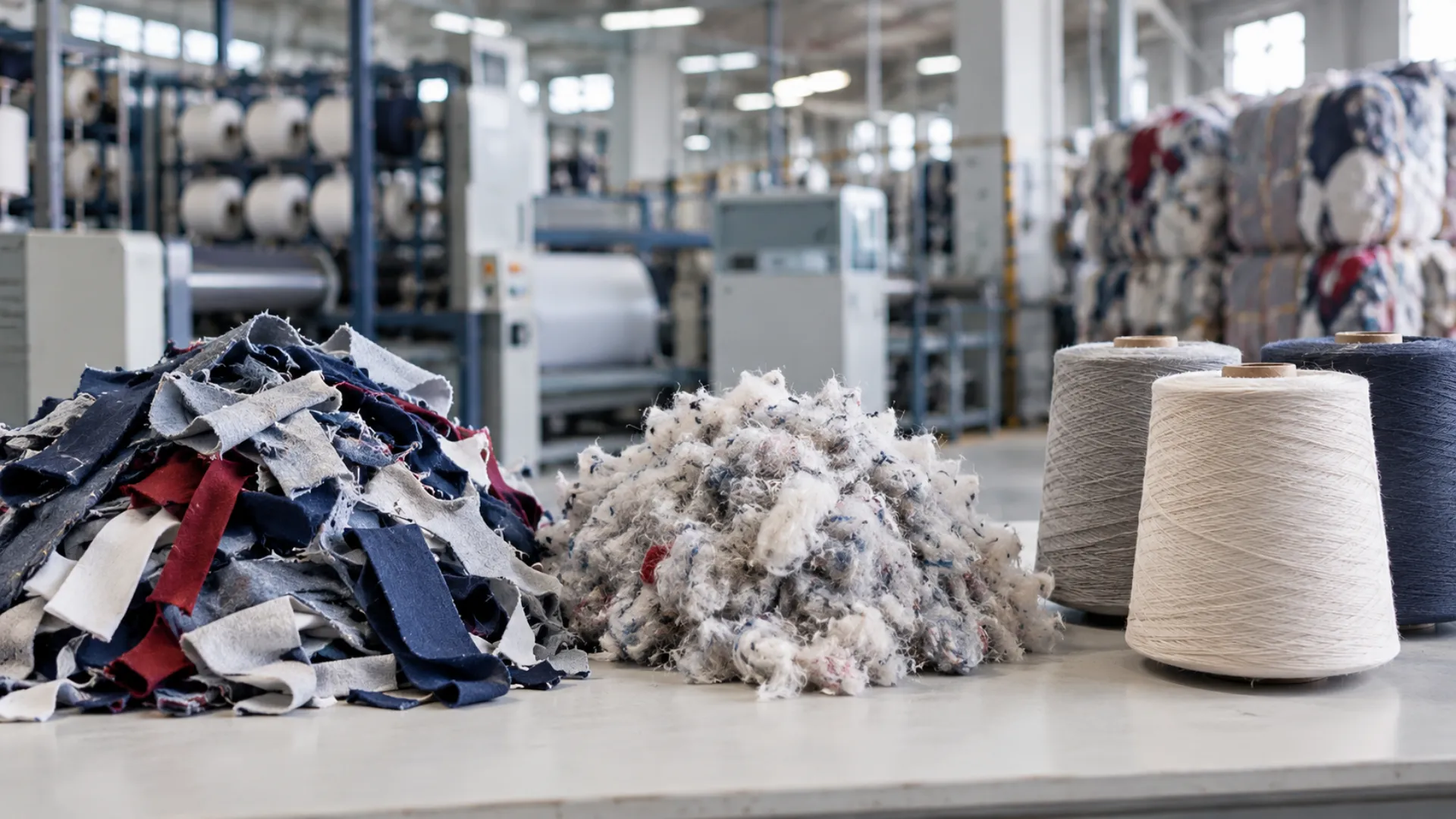
Fragmentation within the textile value chain incurs significant operational costs. Bangladesh’s manufacturing process loses roughly 30 percent of its material throughout the production lifecycle, generating between 577,000 and 700,000 tonnes of pre-consumer jhut annually. Currently, less than 5 to 7 percent of this material is recycled domestically. More than half of the highest-grade waste, primarily pure cotton, is exported informally at low costs to countries like India and Pakistan. There, it is processed into recycled yarn and sold back to Bangladesh at a premium—creating an ecosystem that hemorrhages raw material while expending foreign reserves to repurchase it in finished form.
Currently, Bangladesh exports a significant portion of its pre-consumer waste, essentially offshoring the raw materials required to meet future compliance standards. By reclaiming this material stream for domestic apparel-grade yarn production, the sector can transform a potential trade barrier into a defensible competitive advantage. Systematically recycling cotton waste domestically could add an estimated $4 to $8 billion in annual export revenue to a fully developed circular textile economy.
The strategic metrics underpinning this transition:
Bangladesh’s textile value chain currently faces operational fragmentation, where waste is treated as a byproduct rather than a supply-chain input. Manufacturers, brands, recyclers, financiers, and regulators frequently operate in adversarial silos with sharply conflicting incentives.
Brands require recycled content and digital traceability but often resist premium pricing, leaving suppliers to finance capital-intensive technology against shrinking margins. Meanwhile, roughly 20,000 informal jhut traders control significant portions of factory waste, pushing the trade underground.
Circularity fundamentally forces these actors into alignment, which is where true value is generated. The Circular Fashion Partnership⁵ demonstrates this mechanism effectively. Brands commit to purchasing recycled output, providing manufacturers the financial security to invest in proper waste segregation. Concurrently, digital platforms like Reverse Resources transform mixed scrap into a traceable, verifiable industrial commodity.
Furthermore, dedicated fiber-to-fiber recyclers are becoming increasingly integrated into the formal industrial system. Specialized domestic recycling operations, such as CYCLO Recycled Fibers, Simco Spinning & Textile, and Beximco’s Recover facilities, demonstrate that commercial-scale recycling infrastructure is already viable and expanding within the country.
While Bangladesh remains a highly competitive hub for cotton basics (shipping at $2.40 to $3.10 FOB), it also possesses significant sustainable infrastructure that remains under-leveraged. The country operates over 240 LEED-certified green factories, the highest number globally, including 62 of the world’s 100 highest-rated facilities, with over 500 more in development. The hardware for a premium, compliant, low-risk sourcing identity is already established.
Aligning the BGMEA’s Sustainability Vision 2030⁷ (targeting 30 percent emissions reduction, 50 percent sustainable sourcing, and 20 percent renewable energy) with the Ministry of Commerce’s developing National Circular Economy Strategy allows for a critical shift in brand identity. This transitions the narrative from “cheapest assembler” to a standard that can be proudly labeled “Circularized in Bangladesh“. This verified, transparent positioning aligns precisely with the sourcing profiles European retailers are currently seeking.
Achieving this transition requires addressing several systemic challenges directly.
Aligning Fiscal Policy with Circularity Goals
Current fiscal structures present a significant barrier to formal circular integration. The National Board of Revenue applies a 7.5 percent VAT on purchasing textile waste and an additional 15 percent VAT on selling recycled fibre, creating a 22.5 percent cumulative tax burden. Conversely, virgin cotton can be imported entirely duty-free. Strategic realignment requires addressing these tax structures and establishing a distinct HS code for recycled cotton to incentivize domestic spinning mills, a reform actively championed by the BTMA.
Bridging the SME Financing Gap
The transition demands capital that is often inaccessible to the thousands of SMEs forming the sector’s foundation. Upgrading technology, implementing waste segregation, and adopting traceability software require long-term green capital, whereas domestic banks traditionally favor short-term commercial lending. The country faces an estimated $4.8 billion decarbonization and circularity financing gap. Without intervention, there is a risk of industry consolidation, wherein smaller factories are phased out. Expanding blended-finance models, similar to the European Investment Bank’s €60 million facility through BRAC Bank, is essential for equitable sector-wide scaling.
Resolving the Brand-Cost Paradox
A structural imbalance exists where brands mandate circularity but rarely absorb the associated costs. Suppliers face pressure to lower carbon footprints and integrate recycled fiber while managing squeezed purchase prices and shortened lead times. Because recycled fiber generally costs more to produce than subsidized virgin alternatives, long-term purchasing commitments and equitable pricing models are necessary to distribute the transition costs fairly across the value chain.
The grace period ending in 2029 defines the critical window for intervention. Drawing on the Switch2CE⁸ framework, four concurrent strategies are essential:
While trade diplomacy, such as pursuing GSP+ derogations and utilizing single-stage origin rules, provides vital transitional support, domestic circular capacity remains the fundamental structural solution.
Maintaining reliance on basic assembly and high volumes is an increasingly defunct strategy amidst automated competitors, impending tariff cliffs, and binding eco-design regulations. Circularity represents the mathematical and strategic prerequisite for post-LDC survival.
The deepest structural shift Bangladesh can make is recognizing the 600,000 tonnes of discarded material not as an environmental liability, but as a sovereign, shock-resistant raw-material reserve. This is an asset immune to external tariffs, independent of informal syndicates, and fully compliant with trade rules. By operationalizing this resource, Bangladesh transitions from a vulnerable assembler to a resilient, high-value node in the global circular economy.
Circularity, properly understood, is not about disposing of waste more responsibly—it is about restructuring how value is created, captured, and verified across an entire industrial system. In achieving this transformation, the RMG sector has the potential to act as a definitive role model, establishing blueprints for circular integration that can lead other critical sectors, including leather, plastics, electronics, and agriculture.
The article was authored by Md. Mubassir Rahman, Principal Business Consultant & Portfolio Manager at LightCastle Partners. For further clarifications, please contact: [email protected]
[1] Centre for Policy Dialogue (CPD)
[3] Research and Policy Integration for Development (RAPID) / International Growth Centre (IGC)
[4] Fibre2Fashion, South Asian Network on Economic Modeling (SANEM), and Flame University analyses
[5] Global Fashion Agenda (initiators of the Circular Fashion Partnership)
[7] Bangladesh Garment Manufacturers and Exporters Association (BGMEA)
[8] Switch2CE (Switch to Circular Economy Value Chains)
Our experts can help you solve your unique challenges
Stay up-to-date with our Thought Leadership and Insights