



GET IN TOUCH
- Please wait...


Generative AI has gone mainstream: UNESCO reports that more than 1 billion people now use these tools every day. A single prompt uses about 0.34 watt-hours of electricity. That is roughly what a 10-watt LED bulb uses in two minutes. Taken together, however, UNESCO estimates that generative AI prompts consume around 310 gigawatt-hours a year. This is about as much electricity as more than 3 million people in a low-income African country use annually.
That gap between a tiny individual cost and a large collective one is the core of the issue. Most people never see either number, because AI tools do not show what a request costs. The real question is not whether people should use AI, but whether anyone can make sensible choices about a cost they are never shown.
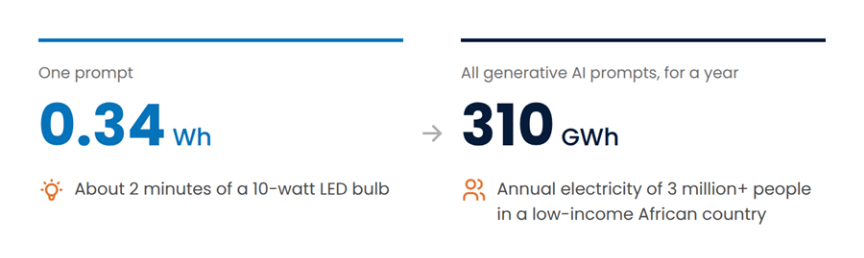
Figure 1: One prompt vs one billion. Source: UNESCO (2025).
Every prompt is processed in a data centre. These buildings contain servers that run around the clock and need constant cooling. In addition to AI, data centres power cloud services, streaming, storage and business software. As a result, AI accounts for only part of their electricity use. However, it is the fastest-growing part.
The International Energy Agency (IEA) estimates that data centres worldwide consumed around 485 terawatt-hours of electricity in 2025. This followed 17% growth in demand in a single year. Meanwhile, consumption at AI-focused data centres grew even faster, by 50%. The IEA projects that total data centre demand will roughly double to around 950 terawatt-hours by 2030. This would represent about 3% of global electricity use. Furthermore, consumption at AI-focused facilities could triple over the same period.
Much of this growth now comes from everyday use rather than building the models. In other words, the energy demand increasingly comes from people using AI. Noman Bashir, a fellow at the MIT Climate and Sustainability Consortium, expects the energy used to answer user requests, known as inference, to eventually make up most of generative AI’s electricity demand. Put simply, the questions people ask every day are becoming the main source of the footprint.
Water is part of the cost too. Bashir estimates that data centres need about two litres of cooling water for every kilowatt-hour of electricity they use. Applied to UNESCO’s per-prompt figure, that works out to roughly two-thirds of a litre of cooling water for every 1,000 average prompts.
That is a little more than a standard bottle of drinking water. In addition to electricity and water, the chips themselves carry a footprint. TechInsights estimates that graphics processing units (GPUs) shipped to data centres rose from about 2.67 million in 2022 to 3.85 million in 2023. This is significant because each one requires energy-intensive manufacturing and mined materials.
Hardware is also the one part of the bill that consumers are already starting to see. As memory makers prioritise chips for AI data centres, supply for everyday devices has tightened. The IEA reports a shortage of high-bandwidth memory, a key component of AI chips. It expects this shortage to last until at least the end of 2027.
As a result, the effects have reached shop shelves. Apple raised prices on MacBooks and iPads in June 2026, citing higher memory costs. Gartner also projects that PC prices will rise 17% and smartphone prices 13% compared with 2025 levels, according to CNBC. We see this as an early sign of how far AI’s demands on the system already reach. The boom is showing up in what people pay for technology, whether they use generative AI themselves.
For a single text question, the honest answer is not much. Google reports that a typical text prompt to its Gemini model uses about 0.24 watt-hours of electricity and 0.26 millilitres of water. That is roughly five drops.
However, estimates vary widely. To put this difference into perspective, the table below shows the lowest and highest published figures alongside an LED-bulb equivalent.
| Source | Energy per request (Wh) | Everyday equivalent (10-watt LED bulb) | Year |
|---|---|---|---|
| Google (Gemini, typical text prompt) | 0.24 | About 1.5 minutes | 2025 |
| International Energy Agency (IEA), ChatGPT request | 2.9 | About 17 minutes | 2024 |
The highest estimate is about twelve times the lowest. First, part of the gap reflects timing. The IEA’s 2026 analysis finds that energy use per AI task has been falling by at least an order of magnitude a year. Therefore, older figures may overstate what a simple query costs today. The rest reflects differences in models, prompt types and which parts of the system each study counts.
There is still no universal figure that reliably describes the cost of an AI prompt across models, providers and types of request. In our view, that spread is itself telling. Public debate often asks for a precision the industry cannot yet provide. This makes transparency about models, workloads and measurement methods as important as any headline number.
The type of request matters far more than the number of requests. A 2024 study by Luccioni and colleagues finds that image generation is among the most energy-intensive things people do with generative AI. On the least efficient model, creating one image can use as much energy as half a smartphone charge. By comparison, text generation can be thousands of times lighter, depending on the models compared.
This difference becomes particularly relevant when viral trends emerge. For example, when a style such as AI-generated retro portraits spreads online, millions of people try it. Many also generate several versions before finding one they like. As an illustration, ten attempts on the least efficient model would use about as much energy as charging a smartphone five times. Scaled up, the same study finds that 1,000 images on the most carbon-intensive model produce emissions equal to driving an average petrol car about 4.1 miles, or roughly 6.6 kilometres.
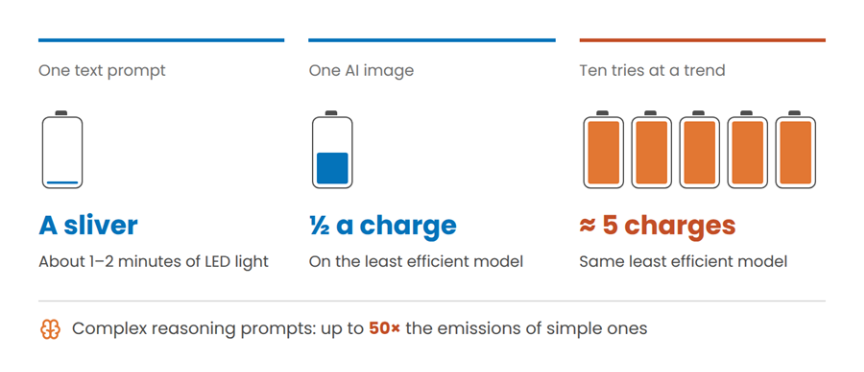
Figure 2: Text vs image vs trend. Sources: Luccioni et al. (2024); Dauner and Socher (2025); text-prompt range from Google (2025) and UNESCO (2025).
No source reviewed here measures the footprint of a specific trend. Therefore, this article does not put a number on any one of them. Nevertheless, the direction is clear. Trends concentrate millions of people on one of the heaviest kinds of AI use, often several times each.
Complex requests add weight as well. Dauner and Socher (2025) find that prompts requiring heavy reasoning can produce up to 50 times the emissions of simple ones. The IEA also reports that video generation, reasoning and agentic tasks can use hundreds or thousands of times more energy per query than simple text. Despite these differences in energy use, a quick question and a demanding one look identical in the chat box.
In our view, the environmental question is not simply whether people use AI, but which kinds of AI use become routine. Occasional text questions are a minor cost. Repeated image generation, video and reasoning-heavy tasks are not. For this reason, we think efficiency alone is unlikely to solve the problem. The IEA finds that energy use per AI task is falling quickly. Yet total data centre demand is still set to double by 2030, because uptake is surging and new uses are far more energy-intensive. Consequently, cheaper requests, multiplied by many more and heavier requests, can still add up to a larger total.
Standard AI tools show no information about the energy used, the water drawn or the model serving a request. Bashir notes that these tools are easy to use and carry no information about their environmental impact. Consequently, everyday users have little reason to cut back.
The information gap extends beyond users. A 2024 analysis by The Guardian of 2020–2022 data found that location-based emissions from the in-house data centres of major technology companies, including Meta, could be 7.62 times higher than the market-based figures highlighted in their corporate reporting. Although the difference lies largely in accounting methods, it shows how much a headline number depends on what is counted. Elsa A. Olivetti of MIT’s Department of Materials Science and Engineering says the technology is moving faster than the ability to measure its trade-offs.
Organisations are in a similar position. In a 2025 Capgemini survey, 24% of businesses had integrated generative AI by 2024. Yet only 12% of executives using it said they measure its environmental impact. We read this as a sign that AI’s environmental problem is partly an information problem. Users, organisations and analysts are all working from incomplete and inconsistent numbers. Moreover, even the IEA calls for more systematic energy disclosures from the technology sector.
Small changes in how people use AI make a measurable difference. Researchers at University College London (UCL), working with UNESCO, tested three changes that reduce energy use without making answers less accurate. However, these results are best-case figures from experiments on open-source models. Actual savings in everyday use will therefore vary.
Keep prompts and answers short. Concise questions and shorter responses can cut energy use by more than half. For example, asking for three bullet points instead of a detailed explanation is a simple way to reduce consumption.
Use a tool sized for the task. Smaller models built for specific jobs, such as translation or summarising, can use up to 90% less energy than a large all-purpose model. Therefore, for many everyday tasks, a smaller tool is enough.
Choose efficient versions where offered. Compressed models can save up to 44% of energy while keeping the same accuracy.
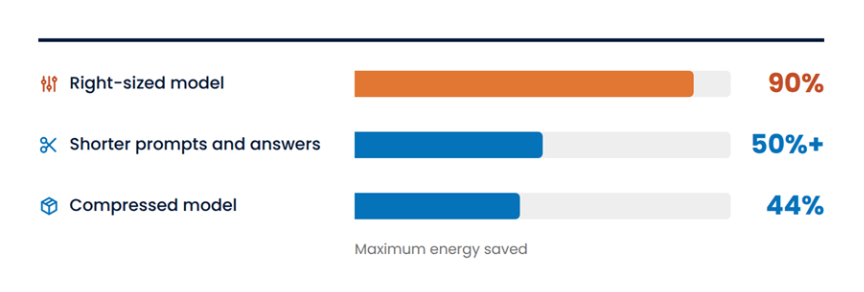
Figure 3: Small habits, big savings. Source: UNESCO and University College London (2025). Figures are best-case savings from experiments on open-source models, so real-world results will vary. The 50%+ bar is drawn at its floor.
Similarly, the same logic applies to trends. This is particularly important because image generation is among the heaviest uses of AI. Therefore, trying a viral style once or twice, rather than regenerating it again and again, avoids multiplying the most energy-intensive kind of request.
Organisations that provide AI tools to staff or students can apply the same logic at scale. For instance, employers, universities and other institutions can ask vendors for per-request energy and water data. They can also choose lighter, task-specific models where these do the job well enough.
These measures carry particular weight in low-resource settings. UNESCO notes that small, efficient models suit places where energy, water and connectivity are limited. As a result, efficiency becomes a cost question as well as an environmental one for users and institutions in lower-income countries, Bangladesh among them.
As generative AI becomes part of everyday life, much of the public debate centres on the ethics of AI-generated content. This includes who owns it, whether it can be trusted and what it means for creative work. Yet the environmental cost of using AI often takes a back seat. This includes the energy, water and hardware behind every prompt.
The people joining the latest AI image trend on social media cannot reasonably be blamed. Few are ever told what a single request costs. Fewer still can picture how small costs add up across more than 1 billion daily users. Although simple habits help, they cannot replace the information that users are never given.
Ultimately, the larger responsibility lies with those who can measure and shape how these systems are used. AI providers hold the data, while regulators and policymakers worldwide can make that cost visible. For instance, policymakers can require providers to report their energy and water use, as other industries already report their emissions. They can also invest in public awareness of what everyday AI use consumes.
The case for acting soon is clear. Data centre electricity demand is set to roughly double again by 2030. Therefore, every year without reporting adds to a bill nobody sees.
The article was authored by Akeef Khan, An Executive in the Marketing team at LightCastle Partners. For further clarifications, please contact: [email protected]
Our experts can help you solve your unique challenges
Stay up-to-date with our Thought Leadership and Insights