



GET IN TOUCH
- Please wait...


For more than a decade, Bangladesh’s development story has been closely tied to the strength of its workforce. Behind the country’s economic growth and transformation are millions of workers, particularly those in blue-collar jobs, who have kept factories running, built industries, supported businesses, and carried the country’s economy forward.
Figure 1: Sankey Diagram of Share of Blue-Collar Workers in Bangladeshi
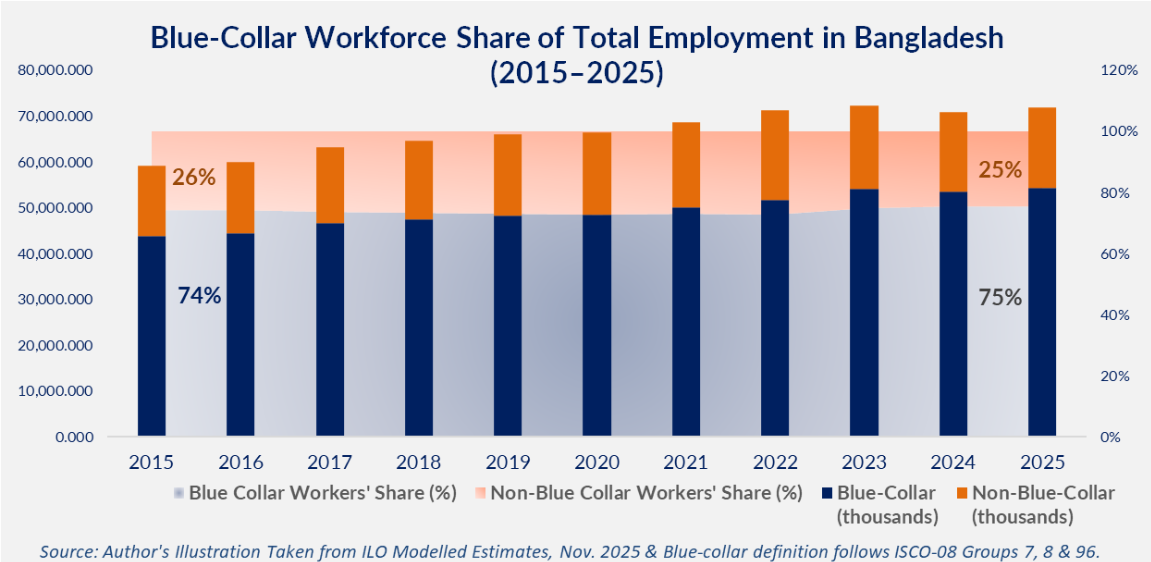
Note: Blue-Collar — ISCO-08 Groups 7, 8 & 96 (craft workers, operators & assemblers, elementary & agricultural occupations). Non-Blue-Collar — managers, professionals, technicians, clerical & service/sales workers.
Yet, the benefits of this growth have not resulted in more jobs for the very workers who have powered it. Bangladesh’s GDP grew at an average annual rate of approximately 6.5% between 2015 and 2023, while the industrial sector’s share of employment fell from 20.4% in LFS 2016–17 to 17.37% in LFS 2024.ii In absolute terms, industrial employment also declined even as output continued to grow, a phenomenon known as jobless growth, which is increasingly leaving Bangladesh’s blue-collar workers behind.
Bangladesh’s employment story becomes even clearer when we look at where workers are concentrated and how much value their work generates. Agriculture remains the country’s largest employer, absorbing 44.67% of total employed persons in 2024, while contributing only around 11.2%–11.7% of GDP.2 This imbalance has deepened as surplus workers have moved back to rural areas and into farming, where labour productivity has declined by an absolute 2.3% annually. Manufacturing tells a different story. Productivity has continued to rise, supported by automation and capital deepening, even as the sector’s share of employment has fallen.
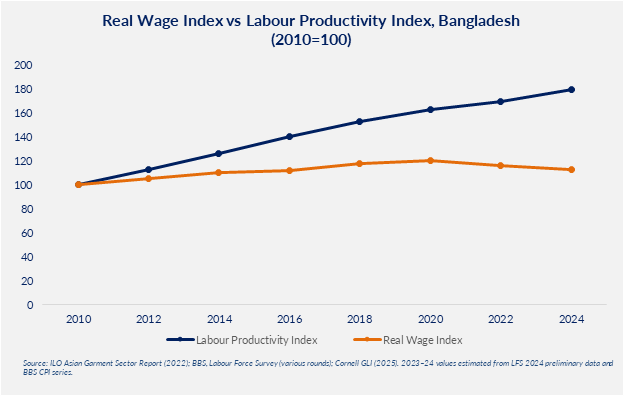
Yet, this productivity growth has not led to improvements in workers’ real wages. Persistent inflation has steadily eroded workers’ purchasing power, peaking at 9.86% in January 2024 and remaining above 10% during much of 2024, hampering the nominal wage gains.
Side by side, the absence of a mandatory annual wage adjustment or inflation-indexation mechanism for minimum wages exacerbates the situation. In the RMG sector, for instance, the entry-level minimum wage was set at BDT 12,500 per month in 2023, while trade unions estimate a living wage of around BDT 23,000, leaving workers with a gap of more than BDT 10,500 between what they earn and what they need for a decent standard of living.
Thus, technological advancement and automation may raise factory productivity and output, but where workers have limited collective bargaining power, a greater share of these gains risks accruing to capital owners as profits rather than reaching the workers whose labour continues to drive production.
Looking at developed economies such as the U.S., Bangladesh risks following a similar path of premature deindustrialisation. The two charts below tracking the United States from 1839 to 2016 show the structural sequence every industrialised economy has followed from agricultural to manufacturing to service sectors. Crucially, that manufacturing phase is what built real wages, organised labour, and the consumption base that made the shift to services sustainable. Deindustrialisation in the US came after manufacturing had done its work.
Figure 2: USA Facing Deindustrialisation During its Peak Economic Developmentiii
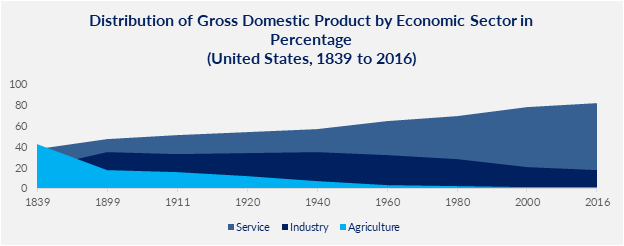
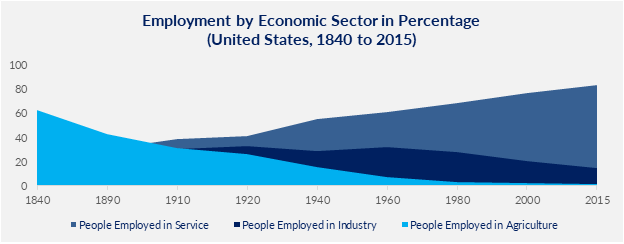
However, unlike the U.S., which built a strong consumer base through decades of manufacturing productivity and rising real wages before shifting to high-value services, Bangladesh risks skipping the high-income manufacturing phase altogether, raising the threat of economic stagnation and the middle-income trap.
As Bangladesh moves from Least Developed Country (LDC) graduation towards its next stage of development, the priority is therefore not simply to protect jobs, but to ensure that its large blue-collar workforce can move into more productive and better-paying activities. This makes productivity-linked wage growth crucial not only to prevent workers from being pushed into low-productivity employment, but also to build the labour-absorbing, high-wage sectors Bangladesh needs for sustained growth.
To avoid the trajectory of falling into the middle-income trap, Bangladesh needs to move beyond the binary of low-wage jobs or limited high-tech employment. Instead, the country needs a broader portfolio of sectors that can absorb workers while steadily increasing productivity and wages. As highlighted in the World Bank’s recent 21st Industrial Policy report, diversifying labour across value-adding manufacturing activities can help create more productive employment and protect blue-collar workers’ earnings from the pressure of rising inflation.

To avoid premature deindustrialisation and growth stagnation, Bangladesh can shift from selling low-cost, low-skilled manual labour to providing high-productivity, technical labour, following the Costa Rican model.
Case Study: Costa Rica’s Semiconductor Technician Trainingiv
The Policy Intervention: In 1996, when Intel expressed concerns about the lack of technically skilled workers to staff its proposed semiconductor assembly and testing plant, the government did not rely on generic educational investments. Instead, it collaborated directly with Intel to co-design a one-year associate degree program in semiconductor manufacturing at the Costa Rican Institute of Technology (ITCR).
The Outcome: This specific vocational program upgraded the capabilities of local blue-collar workers, turning them into specialized electronics technicians. As these workers and managers later moved on to domestic firms, the knowledge and advanced technical skills spread throughout the broader Costa Rican economy.
Bangladesh can draw from this experience by designing demand-driven vocational training around emerging job requirements, enabling blue-collar workers to move with automation rather than be displaced by it. For workers already returning to agriculture, the same logic applies. Agribusiness and agro-processing are not a fallback but an upgrading opportunity, provided the sector is equipped with cold-chain technology, food safety certification, and mechanisation finance rather than treated as an absorber of last resort.
Preventing jobless growth will require Bangladesh to ensure that workers can move with the economy as industries become more technology-driven. The Five-Year Strategic Framework (FYSF) 2026–2031 provides a pathway centred on four priorities.
Figure 3: Priority Heatmap: Transitioning Blue-Collar Workers to High-Wage, Tech-Enabled Roles
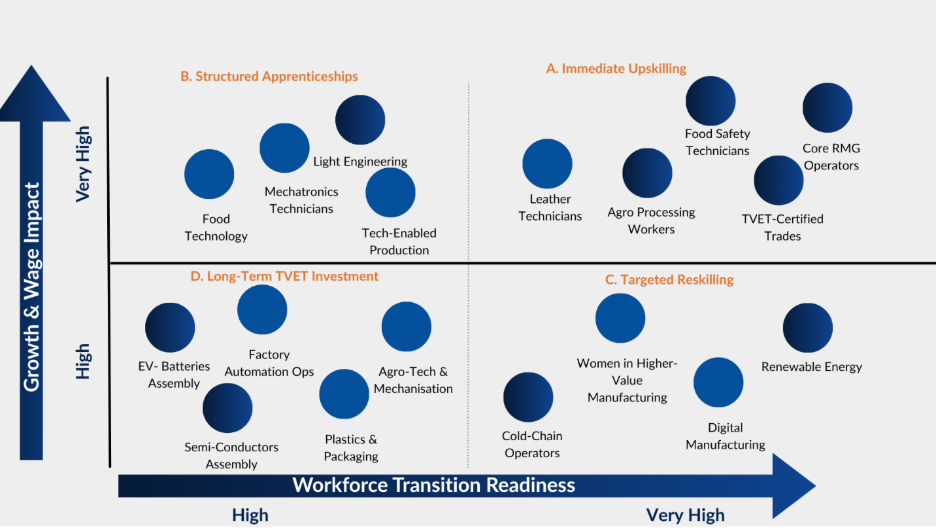
Together, these measures can help workers move from routine, vulnerable jobs into higher-value, technology-enabled manufacturing and modern agribusiness, ensuring that Bangladesh not only create more productive industries, but also better opportunities and higher wages for the people who power them.
This article was authored by Sadia Karim, a Business Consultant at LightCastle Partners. For further clarifications, contact here: [email protected]
Our experts can help you solve your unique challenges
Stay up-to-date with our Thought Leadership and Insights