


GET IN TOUCH
- Please wait...

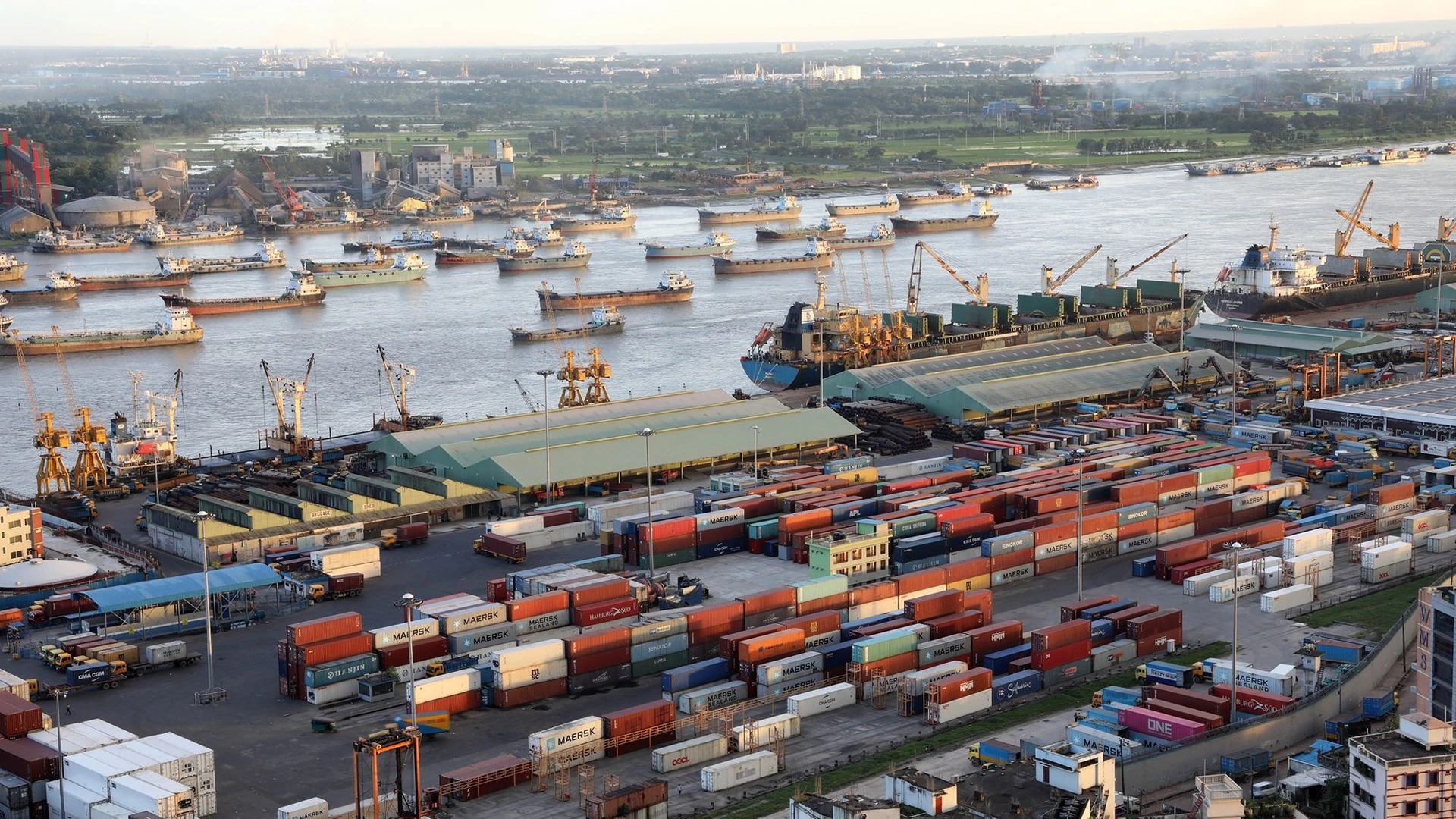
Bangladesh’s exports stood at USD 48.28 billion in Fiscal Year 2024–25. They recovered by 8.58 percent from the previous year but remained below the record USD 55.6 billion achieved in Fiscal Year 2022–23. Beneath this recovery, however, lies a persistent structural vulnerability. Ready-made garments (RMG) continued to account for 81.5 percent of total exports, generating USD 39.35 billion in FY2024–25. Emerging sectors have shown signs of growth, but the export basket remains heavily concentrated. As a result, Bangladesh has made limited progress in converting its broader productive capacity into a more diversified and resilient export base.
An export sector of this scale took three decades to build and remains a genuine national asset. However, the question now is how Bangladesh can extend the productive capabilities developed for RMG. These capabilities can support the growth of other export sectors. At the same time, the narrow export portfolio leaves the economy exposed to cost inflation, buyer consolidation, and trade disruptions. These risks accompany dependence on a single industry and add to Bangladesh’s persistent competitiveness challenges. Moreover, Bangladesh’s expected 2029 graduation from Least Developed Country status will end the preferential market access that has cushioned this dependence for decades. Global competition is also intensifying. Meanwhile, the country’s traditional diversification candidates have yet to gain significant traction. Leather and leather goods, Bangladesh’s second-largest export category, have remained at around USD 1.2 billion. Similarly, jute exports have continued their multi-year decline.
The focus now should be on where Bangladesh can build its next export engine. Manufacturing contributes roughly a quarter of GDP and employs 8.1 million workers, while RMG accounts for just 5.4% of the national labor force. Furthermore, more than 2.2 million young people enter the labor market each year. Greater export diversification is therefore critical. It can expand value addition and strengthen the currency. It can also increase competitiveness, build external-sector resilience, and create the growth and livelihoods needed to absorb this workforce.
Several new sectors are starting to show growth potential. For example, non-leather footwear exports are nearing USD 500 million. Meanwhile, plastics have posted double-digit growth. In addition, pharmaceutical exports rose roughly 14 percent year-on-year on the strength of expanding domestic manufacturing capability. Collectively, these sectors show that the compliance discipline, factory infrastructure, and low-cost manufacturing base built over three decades of garment exporting can support other potential industries.
What stands between that potential and its realization is sectoral readiness. With an Economic Complexity Index of –1.03, Bangladesh trails every regional peer. In particular, thin compliance and certification infrastructure, logistics costs close to 20 percent of export value, and a tariff regime that rewards domestic sales over exports constrain competitiveness. The opportunity lies in converting existing industries into the country’s next export engines. This requires identifying sectors where Bangladesh can compete internationally. It also requires determining what they need to move up the value chain. The strategy should draw on successful international experience. Therefore, the focus should extend beyond existing export size. We need to assess which sectors offer the strongest commercial potential, what constraints prevent them from scaling, and what policy, investment and private-sector actions can turn that potential into competitive export industries.
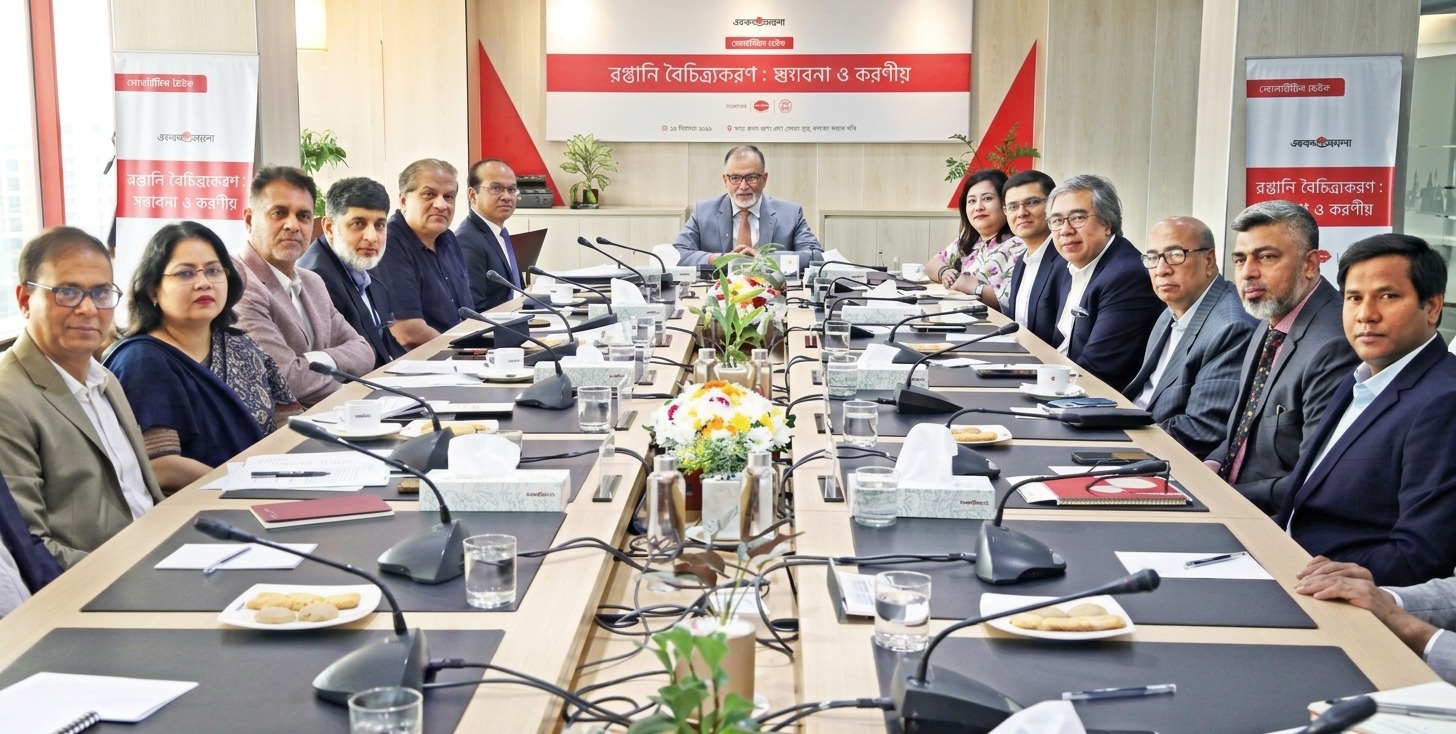
Figure: Roundtable Discussion Hosted by HSBC and the Ministry of Commerce of the Government of Bangladesh
To address this challenge, HSBC Bangladesh engaged LightCastle Partners to identify, prioritize, and chart a path for the industries best positioned to drive this transition. The objective was to develop a prioritized strategy for candidate sectors. The strategy assessed economic potential, sectoral competitiveness, and alignment with national priorities. The team also triangulated the findings against BIDA’s Foreign Direct Investment Heatmap. It also used LightCastle’s Foreign Direct Investment Blueprint and Business Confidence Index, along with the Government of Bangladesh’s Export Policy 2024–2027.
The research combined comprehensive secondary research, trade and market analysis, economic complexity assessment, global benchmarking, and industry stakeholder engagement across five candidate sectors. These included agro-processing, leather and footwear, consumer electronics, pharmaceuticals, and jute and jute products. The team validated the findings through 19+ key informant interviews. Participants included industry associations, business leaders, sector experts, investors, development partners, government bodies, research institutions, and academia. The team also conducted expert consultations. Sector assessments examined export performance, global demand, competitive positioning, value-chain conditions, market destinations, trade preferences, and investment potential. In addition, international benchmarks and peer-country experiences helped identify relevant pathways for export diversification.
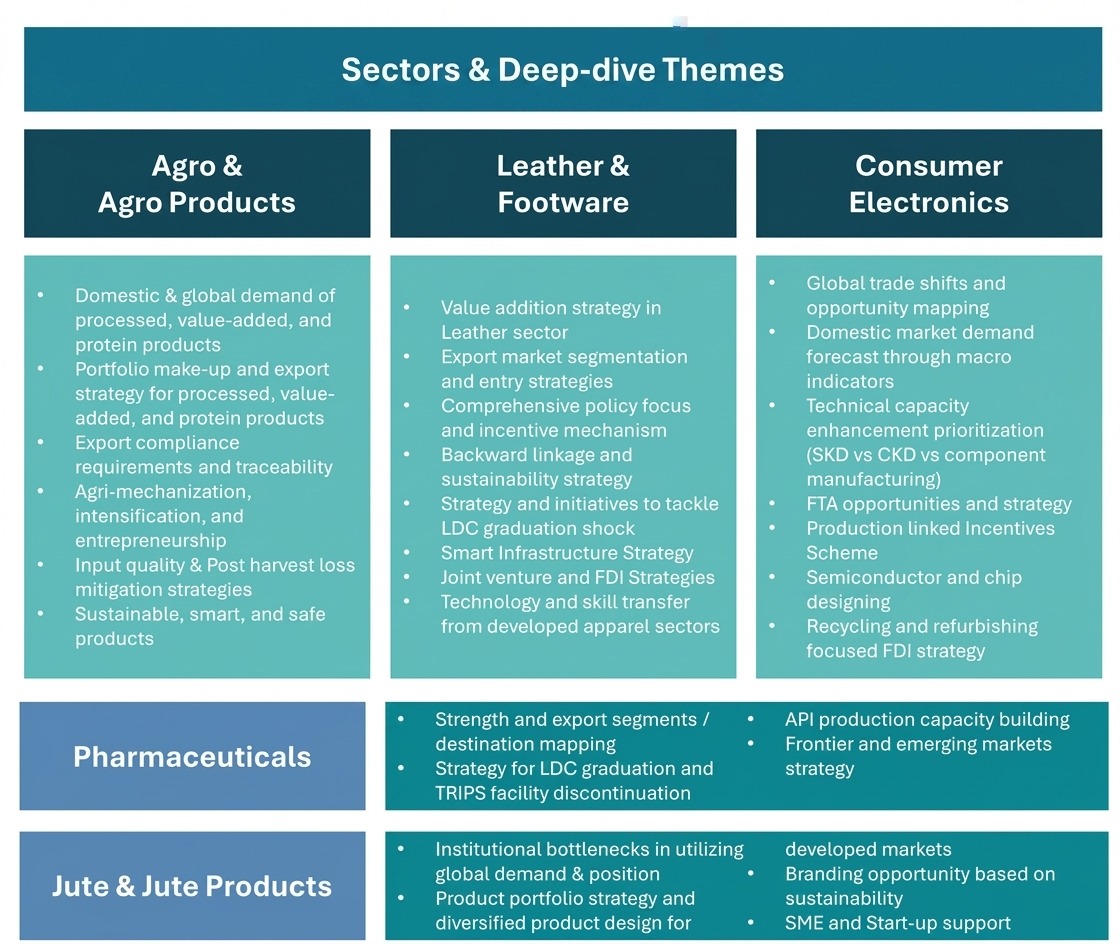
Figure: Potential Export Sectors Selected for Deep Dive.
The analysis connected macro-level constraints with their sector-level implications. It examined how trade policy, logistics, tariffs, investment conditions, and geopolitical shifts affect competitiveness within individual sectors. The Opportunity Mapping Framework assessed sectoral strengths and global export competitiveness. It also helped prioritize sectors for deeper analysis. For the high-impact sectors, the team assessed market opportunities and capturable market share against demand trends, trade preferences, and global economic conditions. Furthermore, target tables and sector-level KPIs provided a deeper analytical layer. They focused on the action areas identified in the Export Policy 2024–2027. They translated broad policy priorities into measurable sector opportunities, initiatives, and implementation requirements. Global case studies, including experiences from India, Vietnam and South Korea, helped identify approaches relevant to Bangladesh. Finally, the analysis assessed investor and private-sector alignment alongside the policy and institutional requirements for implementation.
Building on the diagnosis, the report presents five sector-specific roadmaps, each anchored to a 2030 target and a defined execution agenda. Each sector requires a different intervention. However, the roadmaps apply a common strategic logic. This is to convert existing productive capability into compliant, market-ready, and globally competitive supply. The interventions focus on constraints most likely to unlock export growth.
Agro-processing should transition from production-led expansion toward market-led export development. It should prioritize high-potential product-market corridors, cold-chain and logistics infrastructure, and commercially viable compliance systems. This approach positions the sector to capture a share of the USD 770 billion global halal meat market. It also targets a processed food market projected to approach USD 300 billion by 2033. Together, these opportunities support a pathway from USD 1.5 billion toward USD 5 billion in exports by 2030.
Leather and footwear must prioritize footwear as its primary growth engine. The sector should gradually upgrade from Original Equipment Manufacturing (OEM) to Original Design Manufacturing (ODM) production to capture greater unit value. Alongside Central Effluent Treatment Plant (CETP) governance reform and performance-linked finance, this creates a pathway for growth. Exports could rise from USD 1.7 billion toward USD 8 billion by 2030. As a result, footwear remains the principal growth engine.
For Consumer electronics, the roadmap suggests moving beyond basic assembly. The sector should shift from semi-knocked-down to completely knocked-down manufacturing. At the same time, it should build local supply chains, tooling finance, and SME guarantees for backward integration. The sector can capture demand redirected by the “China Plus One” shift. Its near-term trajectory could take exports from USD 165 million toward USD 300 million. Through value extension, this could unlock up to USD 12 billion for Bangladesh by 2030. However, this depends on systematically removing quality barriers.
Pharmaceuticals can build on its existing United States Food and Drug Administration (USFDA) and EU GMP capabilities. It can combine Active Pharmaceutical Ingredient (API) localization, higher-value product specialization, and strategic trade facilitation. The roadmap provides a structured pathway from USD 200 million toward USD 1.5 billion in exports by 2030. Meanwhile, interventions will address short- and medium-term capability requirements.
Jute, meanwhile, must focus on shifting the sector from traditional commodities toward higher-value diversified products. This means combining technical textiles, jute-based packaging and jute-stick charcoal with mill modernization and targeted trade diplomacy. The approach creates a pathway from USD 820 million toward USD 1.5–2 billion in exports by 2030. In this model, value addition rather than volume expansion will serve as the primary growth lever.
None of these five trajectories is achievable in isolation. Instead, all depend on a shared institutional agenda: recalibrating trade and tariff policy to remove structural disincentives to exporting, building internationally credible testing and certification infrastructure, and replacing blanket subsidies with performance-based incentives. The evidence indicates a decisive point. Continued reliance on a single export engine is no longer compatible with Bangladesh’s post-Least Developed Country ambitions or the employment demands of a rapidly expanding workforce. Therefore, this five-sector agenda offers a credible path toward a more diversified and resilient manufacturing economy. However, Bangladesh must execute it with urgency and coordination. It can help absorb the workforce, withstand external shocks, and sustain long-term growth.
Our experts can help you solve your unique challenges