



GET IN TOUCH
- Please wait...


When we read headlines about artificial intelligence (AI), we usually see two extremes. On one side, optimistic forecasts claim AI could increase global GDP by 15%, creating an estimated USD 132.54 trillion in value by 2035.¹ On the other side, companies around the world are cutting jobs to fund AI investments. Oracle, for example, cut 18% of its global workforce in 2026 to expand its AI and cloud infrastructure.²
The second trend appears to contradict the first. Large-scale job losses rarely support higher national GDP growth. So, what does the evidence actually suggest?
A recently updated paper by MIT economist Daron Acemoglu presents a much more modest outlook. He estimates that AI will increase GDP by only 0.95% to 1.1% over the next decade, far below PwC’s 15% projection.³
To reach this estimate, Acemoglu first identified the tasks AI can automate. He then grouped them into four categories.
Automation refers to cases where AI completely takes over a task and reduces costs. Examples include mid-level clerical work such as text summarization and data classification.
Task Complementarity describes situations where AI automates smaller subtasks but leaves the core task to humans. For example, a doctor can use AI to analyze medical images while making the final diagnosis.
Deepening of Automation occurs when AI improves tasks that organizations already automate. One example is AI-enhanced scanning systems in factories.
New Task Creation refers to entirely new forms of work created by AI, such as AI engineering.
Acemoglu also divided tasks into two groups: those that are economically viable to automate and those that are not. Some tasks, such as translation and copywriting, offer clear financial benefits when automated. Others may be technically automatable but remain too expensive. Organizations often need to invest heavily in software, hardware, and specialized talent. In many cases, those costs exceed the expected savings.
His analysis found that only 23% of AI-exposed tasks are economically worthwhile to automate. After combining this figure with estimated labor cost savings, he concluded that AI would increase total factor productivity by about 0.66%. This translates into GDP growth of roughly 0.9% to 1.16% over ten years.
Economist Alexander Arnon reached a similar conclusion. He estimates that AI will fully automate only 1% of jobs in the United States.⁴
Arnon classified tasks based on their exposure to AI. Exposed tasks include work that generative AI can perform easily, such as information processing, data synthesis, and routine cognitive tasks. Non-exposed tasks rely on physical skills, manual labor, or human judgment that AI cannot easily replicate. Examples include grounds maintenance, construction, and manual manufacturing.
Using this framework, Arnon found that about 42% of jobs in the United States contain AI-exposed tasks. However, only 1% of all jobs face a high risk of full automation. His findings challenge the common claim that AI will replace nearly all human jobs.
US Job’s Exposure To AI (%)
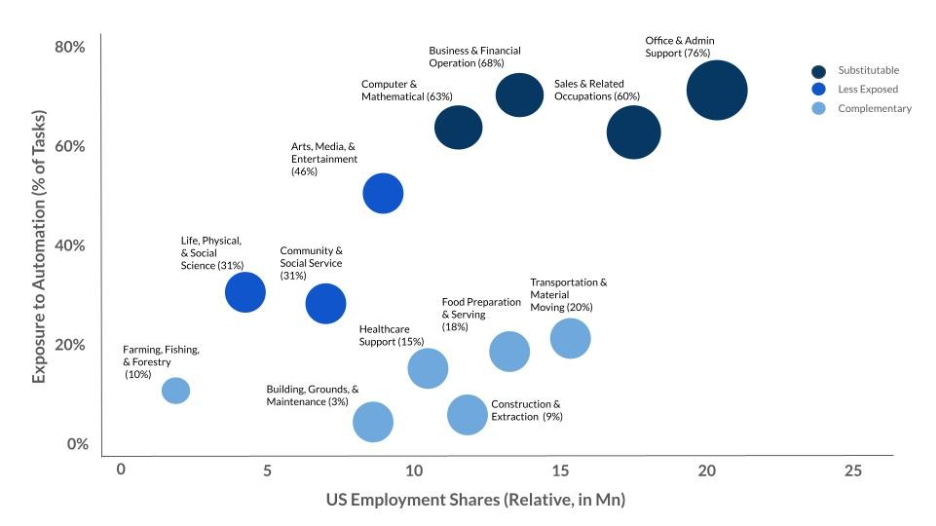
Source: Penn Wharton Budget Model, 2025. The chart above maps US occupations by their level of AI exposure and the degree to which AI complements rather than replaces human work in those roles. Bubble size reflects the relative size of the workforce in each occupation group
Evidence suggests that AI will reshape jobs rather than replace them. Research by BCG estimates that AI will reshape 50–55% of jobs in the United States.⁵ Instead of eliminating workers, AI will change their responsibilities and the skills employers expect.
Even Sam Altman has revised his earlier view. He once warned that AI would displace human workers in the near term, fueling widespread concern. More recently, however, Altman acknowledged that his intuition was wrong. Instead, he now believes AI systems are more likely to work alongside humans than replace them.⁶
These studies point to a common conclusion. Both the highly optimistic predictions of AI-driven GDP growth and the widespread fears of mass job displacement are likely overstated.
However, these findings do not tell the whole story. Most current research and economic projections focus on advanced economies, particularly the United States. AI’s impact on GDP is likely to differ across countries because they vary in capital availability, infrastructure, and economic structure.
Advanced economies rely heavily on knowledge-intensive services. Many of these activities are easier to automate with AI, making them more vulnerable to disruption. In contrast, developing economies depend more on labor-intensive sectors such as agriculture, manual manufacturing, and informal commerce. AI cannot easily replace many of these activities.
At the same time, developing countries face a different challenge. Many knowledge-based industries lack access to advanced technologies because of infrastructure limitations and digital literacy gaps. These constraints slow innovation and could widen the inequality gap between advanced and developing economies.
Data from the World Bank illustrates this difference. The Penn Wharton Budget Model (2025) estimates that generative AI exposes 42% of jobs in the United States. In South Asia, however, only 22% of jobs are AI-exposed. Among those jobs, only 7% face a risk of displacement.⁷
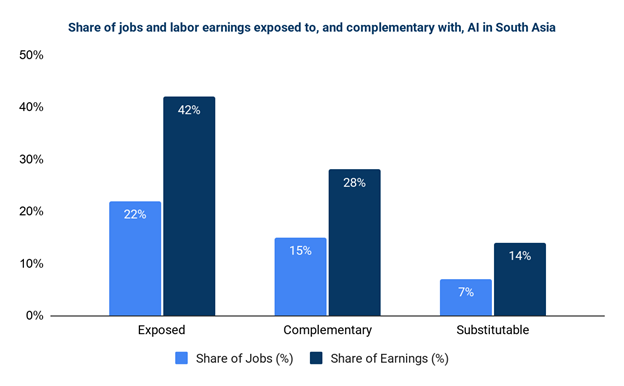
Source: World Bank, 2025. Exposure to AI = composite AI exposure score above the median across occupations. Complementary = complementarity score above the median and above-median exposure. Substitutable = complementarity score below the median and above-median exposure. Bars show the share of jobs and total wage earnings in each category.
At the same time, South Asia lacks the infrastructure needed to fully benefit from AI. The Oxford Insights Government AI Readiness Index 2025 highlights this gap. The index measures governments’ ability to use AI for public benefit across six dimensions: policy, infrastructure, governance, public sector adoption, development and diffusion, and resilience. It covers 195 countries.
Advanced economies in North America and Western Europe score 60 or higher. These scores reflect decades of investment in digital infrastructure, research capacity, and institutional frameworks. In contrast, South Asia and Sub-Saharan Africa score below 50.
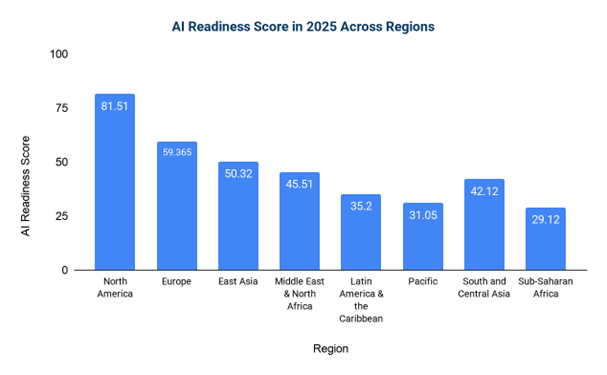
Source: Oxford Insights, 2025. The chart above shows the discrepancies in AI readiness across different regions in the world.
This gap does not exist because these regions use less AI. Instead, they lack the infrastructure needed to use AI productively. Countries without reliable broadband, a skilled technical workforce, or strong data governance cannot generate the same value from AI as countries such as the United States or Singapore, even when adoption rates appear similar.
South and Southeast Asia illustrate this challenge well. Many countries in these regions report strong AI growth indicators but struggle to turn that momentum into measurable economic gains. The share of AI-related job postings in South Asia more than doubled between 2023 and 2025. At the same time, AI could contribute an additional USD 1 trillion to Southeast Asia’s GDP by 2030.⁸˒⁹ Despite this potential, the region continues to score below the global average on AI readiness. This gap suggests that many countries cannot fully capitalize on AI because they lack the supporting infrastructure.
India leads South Asia in AI readiness, scoring 66.6 on the Oxford AI Readiness Index, compared with a regional average of 40.6.¹⁰ The NITI Aayog estimates that AI could add USD 500–600 billion to India’s economy by 2030.¹¹ However, a large implementation gap remains. While 88% of Indian firms have adopted AI in at least one business function, only 7% have integrated it across all operations.¹²
Indonesia presents a similar picture. The country leads the world in workplace AI adoption, with 92% of organizations using AI, ahead of both the United States and China.¹³ AI could also contribute up to USD 366 billion to Indonesia’s GDP by 2030, accounting for more than one-third of Southeast Asia’s projected AI economic impact.¹⁴ However, Indonesia scores only 59.9 on the Oxford AI Readiness Index. This places it behind regional peers such as Malaysia (62.3) and Thailand (63.2). The country also recorded the lowest R&D investment as a share of GDP among G20 nations in 2020.¹⁵ These figures suggest that Indonesia still lacks the research capacity and supporting infrastructure needed to maximize AI’s economic potential.
India and Indonesia point to the same conclusion. Both countries show strong AI adoption and significant growth potential. However, infrastructure constraints continue to limit their ability to realize those gains.
Bangladesh faces a similar reality. Sectors such as technology, ready-made garments (RMG), and business services already show growing exposure to AI and automation. Although AI-driven growth projections remain positive, gaps in digital skills, workforce readiness, research capacity, and investment continue to limit the country’s ability to translate AI adoption into broad-based economic growth.
Government AI Readiness Scorecard
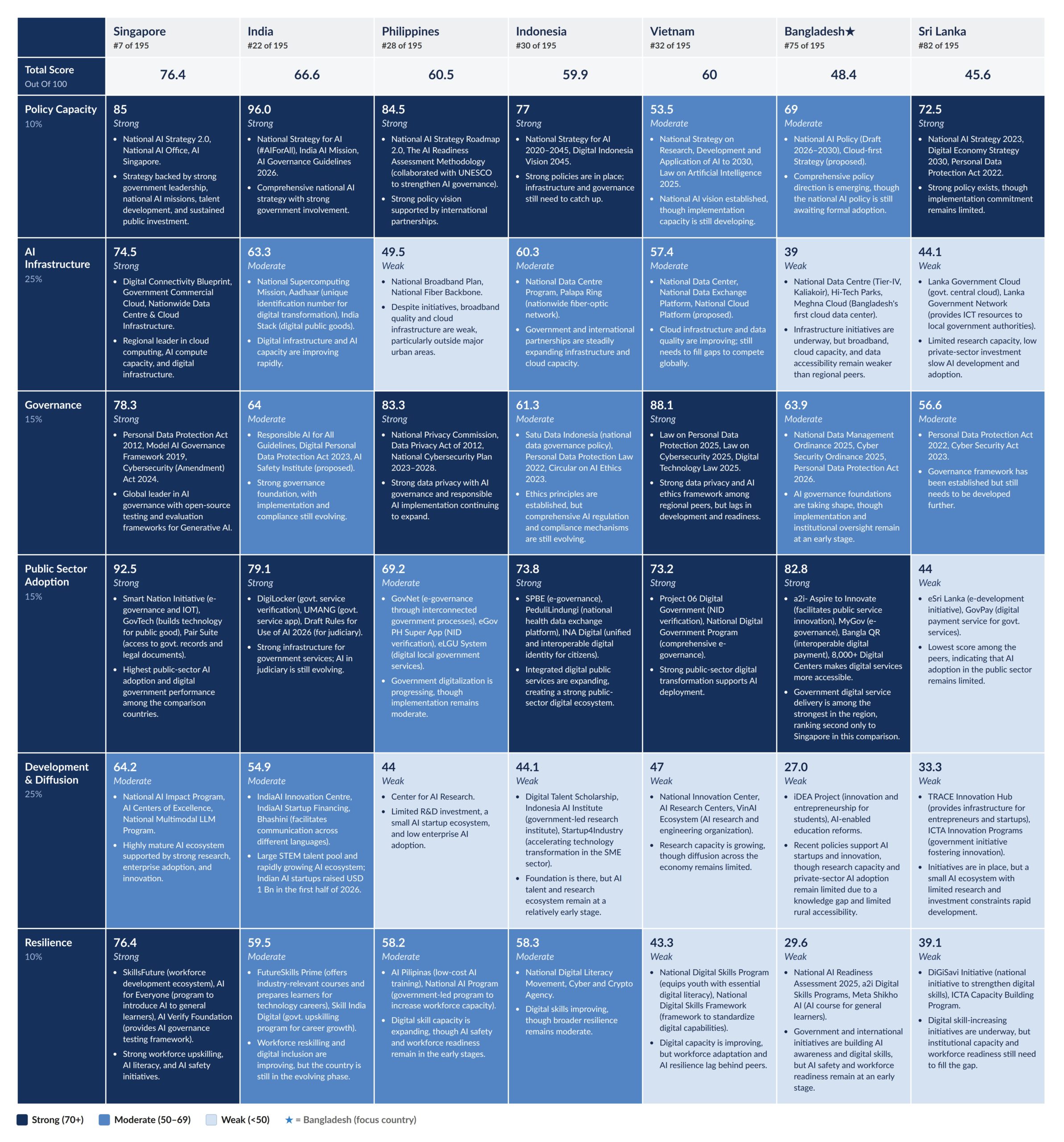
Source: Oxford Insights, 2025. The table compares AI readiness across six pillars and scores them out of 100. 7 countries from South Asia and South East Asia are presented. Data for each country is collected from UNESCO (AI Readiness Assessment Methodology & Country Reports) and official government websites of Singapore, India, Philippines, Indonesia, Vietnam, Bangladesh, and Sri Lanka.
The table above draws on data from the Oxford Insights Government AI Readiness Index 2025, which evaluates 195 countries across six pillars. Each pillar measures a government’s ability to use AI effectively for public benefit.
For Bangladesh, the findings are clear. The country scores Moderate or Weak across five of the six pillars. Public Sector Adoption stands out as the only Strong category, with a score of 82.8, the second-highest among the selected peer countries after Singapore. This performance reflects sustained government investment in digital public services through initiatives such as a2i, MyGov, Bangla QR, and nationwide digital service delivery.
Bangladesh has also established an encouraging policy foundation. The National AI Policy, the Personal Data Protection Act, the Cyber Security Ordinance, and the National Data Management Ordinance demonstrate a clear commitment to AI governance. However, the country still struggles to translate these ambitions into broad-based AI adoption.
The largest constraints appear in the three capacity-driven pillars. Bangladesh scores only 39 in AI Infrastructure, 27 in Development and Diffusion, and 29.6 in Resilience. Although investments in digital infrastructure, startup support, and AI capacity building continue, major gaps remain. These include broadband and computing infrastructure, research and innovation capacity, digital literacy, AI talent development, workforce readiness, and enterprise adoption.
The country’s moderate scores in Policy Capacity (52.8) and Governance (49.9) reinforce the same message. Bangladesh’s main challenge is no longer developing policies. Instead, it must strengthen the institutional, technological, and human capacity needed to implement those policies at scale.
Despite these readiness gaps, Bangladesh can still benefit from AI and automation. Early evidence already shows that AI delivers measurable results when the right conditions exist.
In the services sector, mobile financial services and technology companies already use AI to improve efficiency and generate new growth. bKash, the country’s largest mobile financial services provider, reported a 76% increase in productivity and 15% monthly onboarding growth after introducing AI-powered retail tools.¹⁶ Technology startups are also using AI to improve productivity and secure international contracts.
Manufacturing has produced similar results. AI-based quality assurance tools developed by Skylark Soft have helped ready-made garment (RMG) factories reduce defects by 15% while increasing productivity by 12%.¹⁷ As global buyers continue to push for greater automation and higher production standards, investing in AI-enabled quality control is becoming a competitive necessity rather than an optional upgrade.
Agriculture also presents promising opportunities. Pilot projects that use AI for crop monitoring and precision irrigation have increased productivity by as much as 25%.¹⁸ Scaling these solutions, however, remains a challenge. Many rural communities still lack reliable internet access and digital skills. At the same time, local agricultural advisors play an essential role in connecting farmers to markets. AI systems should therefore support these intermediaries instead of replacing them.
Across all three sectors, the main constraint is not the technology itself. Bangladesh must strengthen the infrastructure, skills, and policy environment needed to adopt AI at scale and translate technological progress into economic gains.
Bangladesh does not face an immediate threat of widespread AI-driven job displacement. However, it also cannot ignore AI’s growing influence on the labor market. AI offers clear opportunities to improve productivity, strengthen competitiveness, and support long-term economic growth. The country has already built an important policy foundation, and several sectors have begun adopting AI solutions.
The experience of peer economies offers an important lesson. Developing AI policies and encouraging early adoption are only the first steps. Long-term success will depend on effective implementation, continued investment in infrastructure and skills, and stronger collaboration between the public and private sectors. Ultimately, whether AI becomes a driver of inclusive growth or widens existing inequalities will depend on how quickly Bangladesh builds the institutional, technological, and human capacity needed to put those policies into practice.
The article was authored by Sabiba Hossain, Business Analyst at LightCastle Partners. For further clarifications, please contact: [email protected]
Our experts can help you solve your unique challenges
Stay up-to-date with our Thought Leadership and Insights